Rhythm is the regular flow of movement or sound created by alternating strong, accented elements with weaker ones. While many animals move at steady paces, humans are the only primates that naturally synchronize their bodies to an external beat. This biological wiring allows people to coordinate movements, dance together, and perceive time through organized patterns.
By the edgi team We find the most surprising true thing about an idea and build a 60-second lesson around it.
Most animals can react to sound, but they cannot naturally tap along to a consistent pulse. Research shows humans are the only primates capable of entrainment, the biological ability to synchronize body movements to an external beat.
If you tap your foot to a song, you are doing something no chimpanzee can naturally do.
Prediction machines
Your brain doesn't just receive rhythm; it actively creates it. It treats sound as a series of predictions, constantly guessing when the next strong beat will land to prepare your muscles for movement.
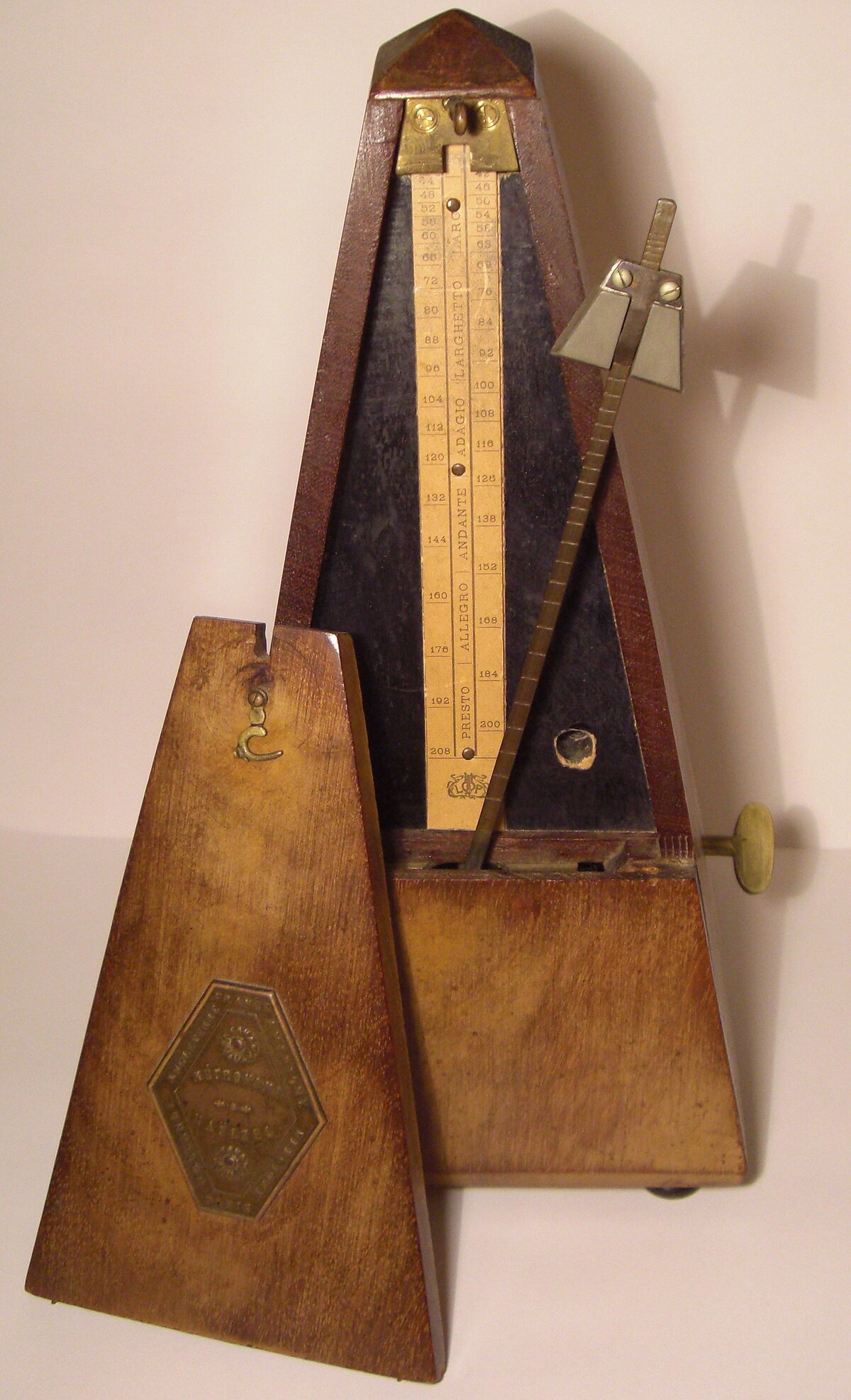
This is why a simple metronome can help Parkinson's disease patients regain their stride; it provides an external anchor for a motor system that has lost its internal clock.
A Maelzel's Metronome, a pyramid-shaped wooden device, is shown with its front cover removed, revealing a pendulum and a scale marked with tempo indications. Myself, CC BY-SA 3.0, via Wikimedia Commons
Evolutionary glue
Why did we evolve this? Rhythm is social glue. Synchronized movement allowed early humans to hunt together, perform rituals, and act as a single, cohesive unit.
A group of Siddi tribal dancers are performing on a stage in Delhi, illuminated by stage lights. Ramesh Lalwani, CC BY 2.0, via Wikimedia Commons
We don't just listen to rhythm; we use it to tether ourselves to each other and the physical world.
How rhythm works
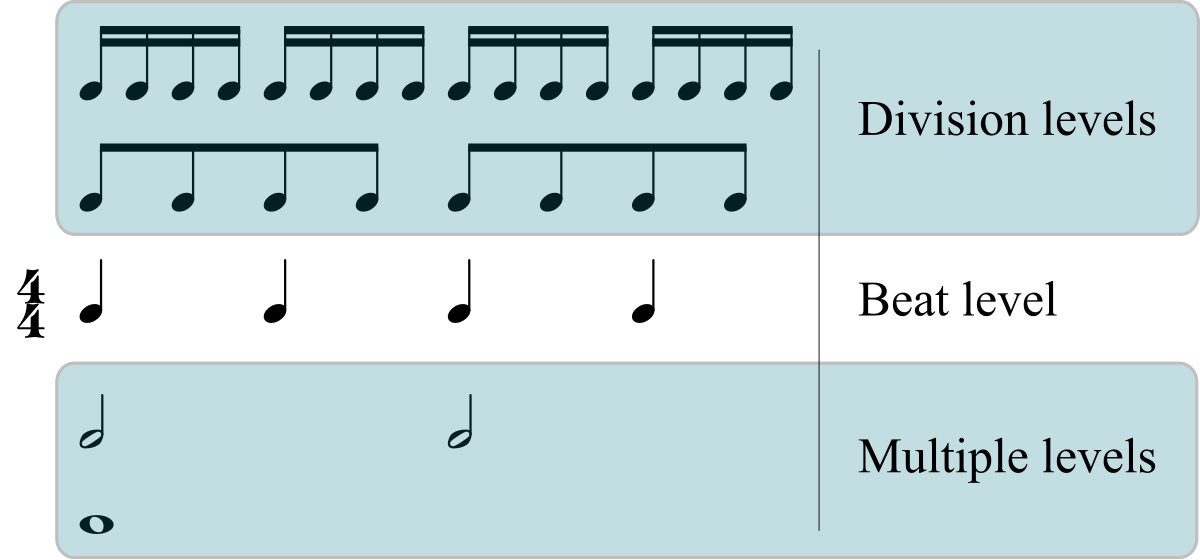
A rhythmic pattern requires at least one accented strong beat paired with one or two unaccented weak beats. Listeners do not hear music as isolated ticks on a clock. Instead, the brain groups distinct pulses into a metric hierarchy.
The metric hierarchy organizes a central beat level between faster division levels and slower grouped multiples. Dbolton, CC BY-SA 3.0, via Wikimedia Commons
This hierarchy operates across multiple speeds at once. A fundamental beat level provides the steady tempo to which people tap their feet or dance, while faster division levels and slower groupings organize the sound above and below it. Fast-decaying sounds from percussion instruments make these pulses especially clear, as each hit drops toward silence before the next strike arrives.
Complex traditions build on this foundation. Some musical cultures layer multiple rhythms at once, known as polyrhythm, or run simultaneous time signatures, known as polymeter. Examples include the interlocking kotekan rhythms of Indonesian gamelan and the cross-rhythms of Sub-Saharan Africa.
Why humans evolved entrainment
Chimpanzees and other primates do not synchronize their movements to an auditory beat, though some parrots share the ability. Neurologist Oliver Sacks noted that human affinity for rhythm is so deeply rooted that individuals generally do not lose it after a stroke.
Anthropologist Joseph Jordania suggested that natural selection favored rhythmic capabilities in early hominids to build collective identity. Shared rhythmic actions, from war cries and shamanic drumming to military drills and modern combat training, induce focused states that encourage individuals to prioritize group survival over personal safety.
Where rhythm appears outside music
Rhythm extends across linguistics, movement, and physical design. In poetry and speech, it governs the flow of stressed and unstressed syllables. In performance arts like hip-hop, the exact rhythmic placement of spoken syllables defines the style.
Visual artists and architects treat rhythm as timed movement through space. A building façade develops rhythm through the geometrical spacing and repetition of structural elements, such as columns and windows.
Test yourself
What role does rhythm play in human brain function during sensory processing?
It acts as a predictive mechanism for action. The brain uses rhythm predictively, guessing when the next beat will land to prime the motor system for movement rather than just passively listening.
Rhythm perception is the passive receipt of sound signals by the brain.
False. Rhythm is not a passive reception; the brain acts as a prediction machine that actively prepares muscles for the next anticipated beat.
Play the lesson in edgi and the card is yours. It lands on your Map next to the ideas it connects to, and turns from matte to foil to gold as you learn more around it.
Animals like circus performers or the Lipizzaner horses of Vienna appear to dance, but research indicates they respond to subtle visual or tactile signals from handlers rather than entraining to the music itself. Sacks noted no verified record exists of non-human mammals being trained to tap in synchrony with an auditory beat.
What is the difference between a beat and rhythm?
A beat is the basic, repeating unit of time that sets the tempo of a piece. Rhythm is the broader pattern created by grouping unaccented beats around accented ones across time.