The anthropic principle is the idea that the universe must have conditions capable of supporting life, because otherwise no observers would exist to study it. Rather than proving the cosmos was tailored for humans, it acts as an observation selection effect. We find ourselves in a universe with workable physical constants simply because we could not appear anywhere else.
By the edgi team We find the most surprising true thing about an idea and build a 60-second lesson around it.
Imagine winning the lottery every single day for a year. You might think the game is rigged in your favor. But if the game were rigged against you, you would have lost on day one and never been around to play again.
An 1814 English State Lottery Ticket is shown, with the number "5753" handwritten across it. I took a photograph of this lottery document I own, CC BY-SA 3.0, via Wikimedia Commons
This is the anthropic principle: we observe a universe fit for life because we could not exist in one that wasn't.
The cosmic constant
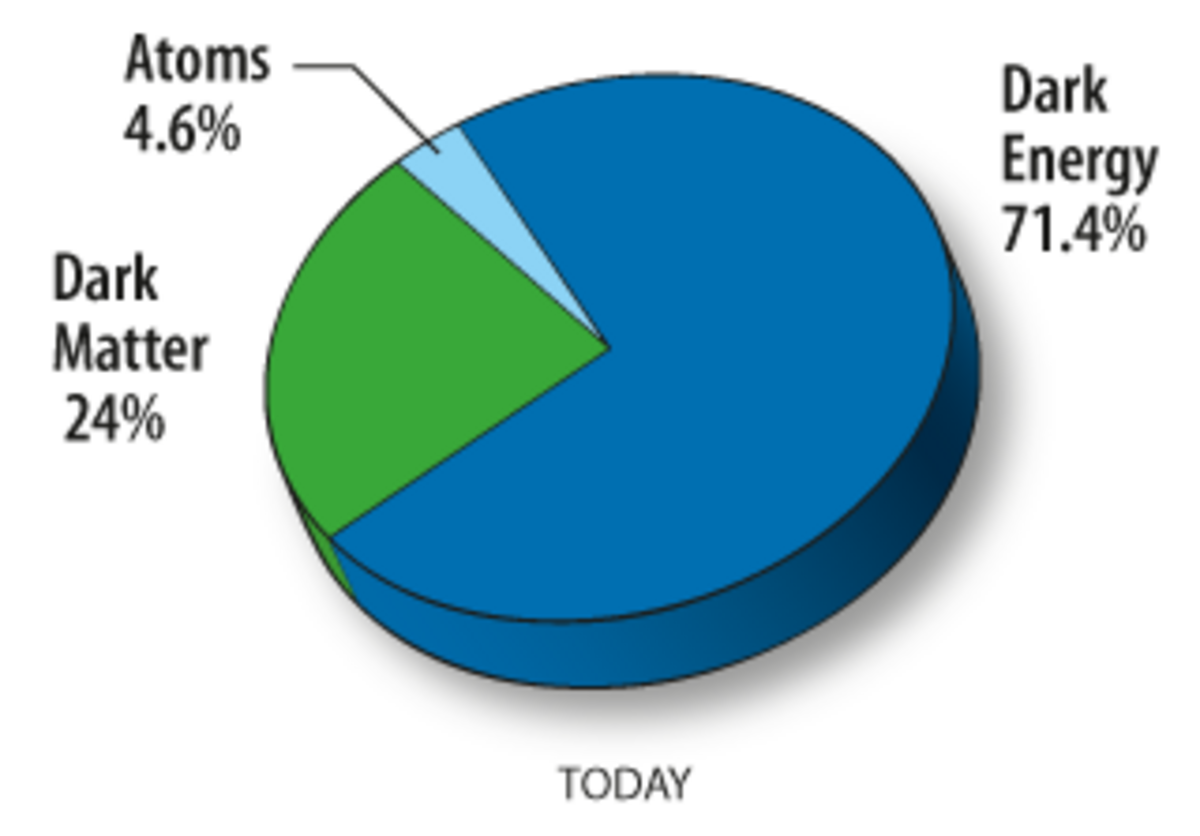
Physicist Brandon Carter introduced this idea in 1973 to address the unsettling fine-tuning of our universe. Take the cosmological constant, the energy of empty space. It is incredibly precise.
Pie chart showing the estimated ratios of dark matter, dark energy, and atoms in the universe, based on 9-year WMAP data. NASA/WMAP Science Team, Public domain, via Wikimedia Commons
If it were even a fraction larger, the universe would have expanded so fast that stars and galaxies never would have formed.
The data point
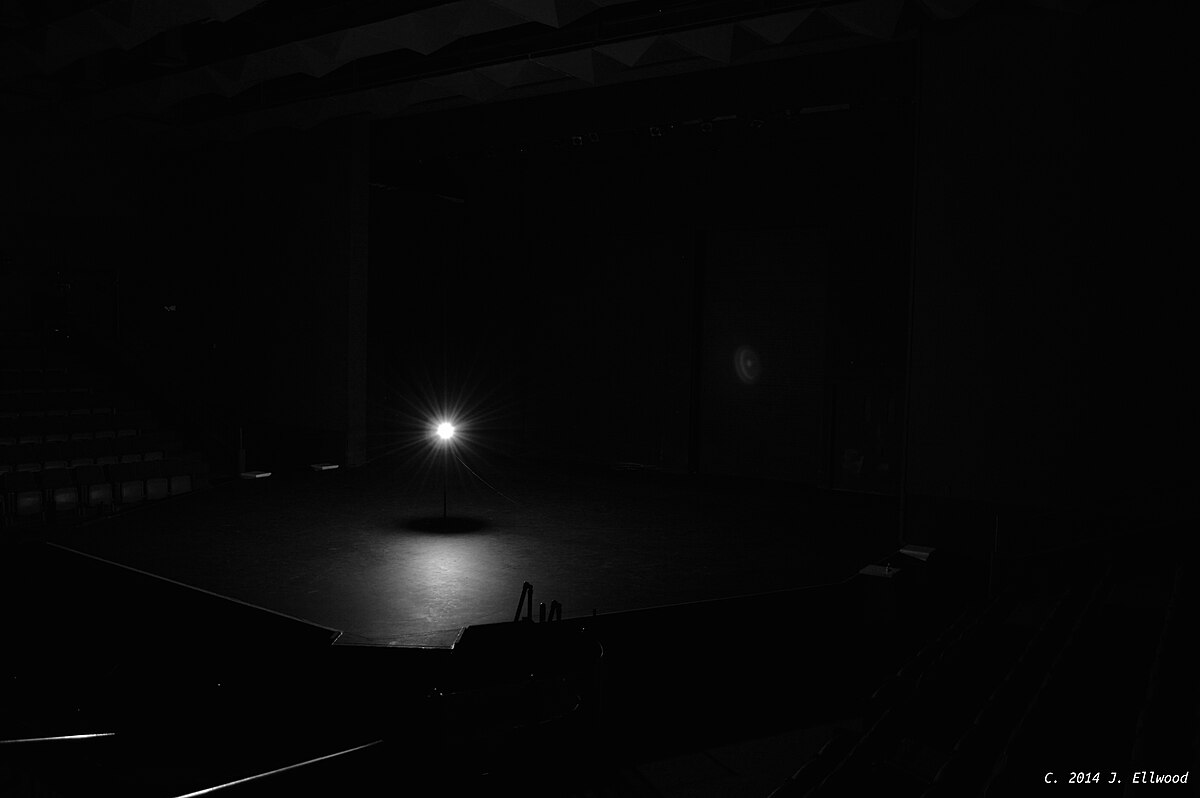
We aren't the center of the stage; we are just the only ones left in the theater. Our existence is a data point that forces the universe to look this way.
A ghost light illuminates an empty stage in a darkened theater, casting a bright circle of light on the center of the stage. Ellwood jon, CC BY-SA 3.0, via Wikimedia Commons
It is not that the universe was built for us; it is that we are the only ones left to ask why it exists at all.
How observation selection works
The universe appears finely balanced to allow life, but our presence as observers acts as a strict filter on what we can see. Physicist Brandon Carter introduced the term in 1973 in response to the Copernican principle, arguing that while our location in space and time is not central, it is inevitably privileged to some extent.
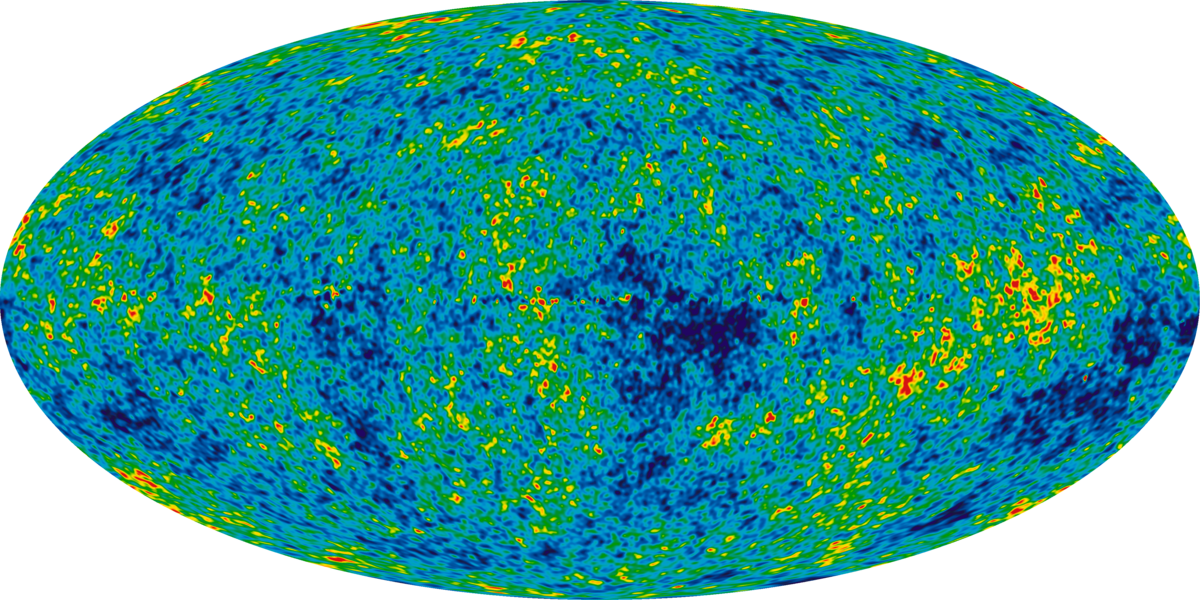
Fluctuations in the cosmic microwave background provided direct evidence that the universe evolves over time rather than remaining in a steady state. NASA / WMAP Science Team, Public domain, via Wikimedia Commons
The term itself is a bit of a misnomer. The principle does not require human biology or carbon-based chemistry specifically. Any observers, heavy atoms, stones, stars, or galaxies would produce the exact same constraint: an impossible universe has nobody around to measure its laws.
Physical constants and the golden age
In 1961, Robert Dicke showed that the age of the universe seen by observers cannot be random. If the universe were only one-tenth its current age, stellar nucleosynthesis would not have had time to produce elements like carbon, leaving no rocky planets. If it were ten times older, most stars would have burnt out into white dwarfs, destroying stable planetary systems.
Fundamental forces face similar limits. A slight increase in the strong or weak interaction would convert all primordial hydrogen into helium, preventing the formation of water and long-lived stars. Steven Weinberg also noted that particle physics predicts a cosmological constant 120 orders of magnitude larger than observed, a value that would cause inflation so rapid that stars could never condense.
Test yourself
How does the anthropic principle explain universe fine-tuning?
As a selection effect of our existence. The anthropic principle explains fine-tuning not as intentional design, but as a selection effect where observers only find themselves in universes capable of supporting life.
Does the anthropic principle suggest the universe was specifically built for us?
No, it is a selection effect.. The anthropic principle explains that we observe life-friendly conditions simply because we cannot exist in environments that lack them, not because the universe was intentionally crafted for our arrival.
The Weak Anthropic Principle (WAP) states that the universe must have properties that allow life to develop at some stage.
False. That is the Strong Anthropic Principle; the Weak version simply states that our location in space and time is restricted by the requirements of our existence.
Play the lesson in edgi and the card is yours. It lands on your Map next to the ideas it connects to, and turns from matte to foil to gold as you learn more around it.
What is the difference between weak and strong anthropic principles?
The weak form states that our location in space and time must be compatible with the existence of observers. Stronger variants make broader cosmological claims about the necessity of universe parameters producing life, which face criticism for being difficult to falsify.
Why do some scientists criticize anthropic reasoning?
Critics argue that anthropic explanations lack falsifiability and risk discouraging researchers from searching for deeper physical explanations. Relying on an observation selection effect can treat numerical coincidences as self-explanatory instead of finding underlying physical mechanisms.