The Drake equation is a mathematical formula that estimates how many active, communicative alien civilizations exist in our galaxy. Astronomer Frank Drake created it in 1961 as a discussion agenda rather than a strict calculator. It shows which astronomical, biological, and technological steps must occur before we can detect radio signals from another world.
By the edgi team We find the most surprising true thing about an idea and build a 60-second lesson around it.
In 1961, ten scientists gathered at the Green Bank Observatory to discuss the Search for extraterrestrial intelligence. They called themselves the Order of the Dolphin. During the meeting, chemist Melvin Calvin received a phone call in the shared kitchen, he had just won the Nobel Prize.
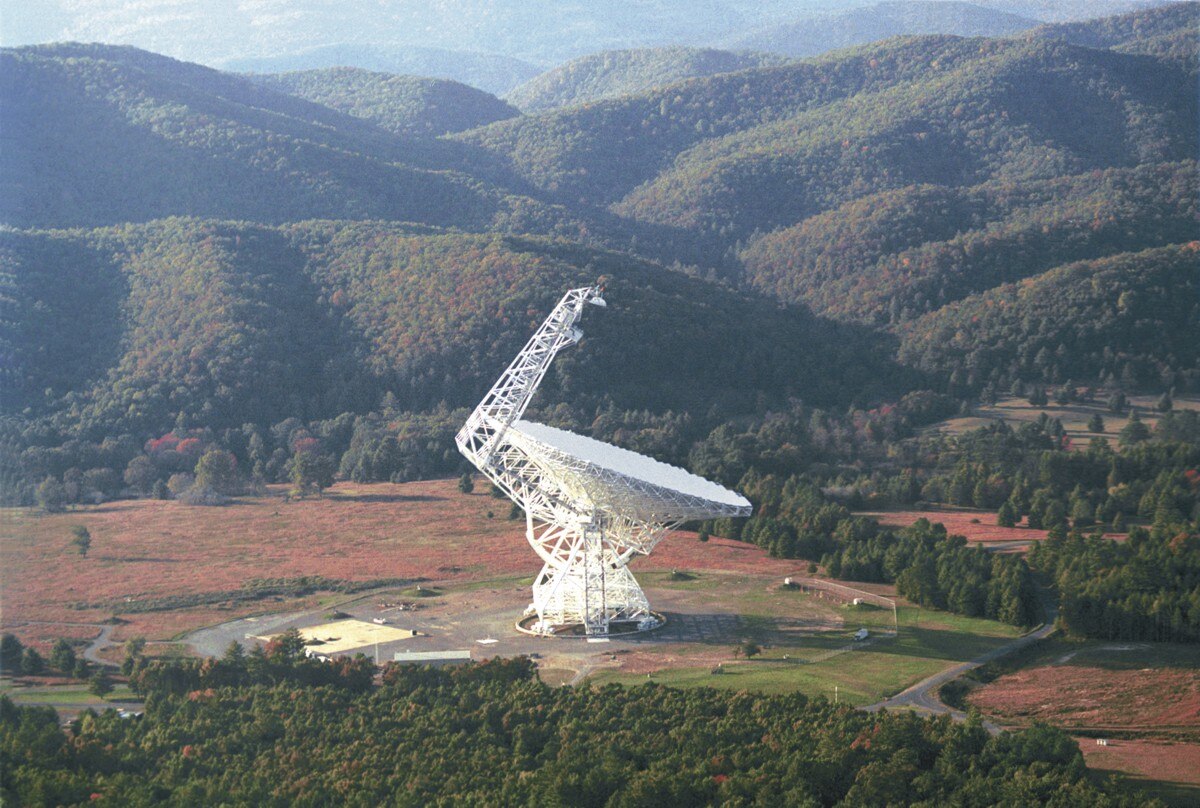
Aerial view of the Green Bank Telescope, a large single-dish radio telescope, situated in a valley surrounded by forested mountains. NRAO/AUI, CC BY 3.0, via Wikimedia Commons
The agenda
Frank Drake needed to keep the conversation focused, so he scribbled a string of probabilities on a chalkboard. It wasn't a calculator; it was an agenda. He broke the mystery of Astrobiology into manageable chunks: star formation, planets, and the likelihood of life.
Portrait of Frank Drake in the 1960s, wearing glasses and a suit with a striped tie. NRAO/AUI/NSF, CC BY 4.0, via Wikimedia Commons
The silent universe
The equation forces us to confront the Fermi Paradox: if the math suggests thousands of civilizations should exist, why is the galaxy so silent? It turns out the hardest variable isn't finding an Exoplanet; it's guessing how long a civilization survives before destroying itself.
The seven factors of the equation
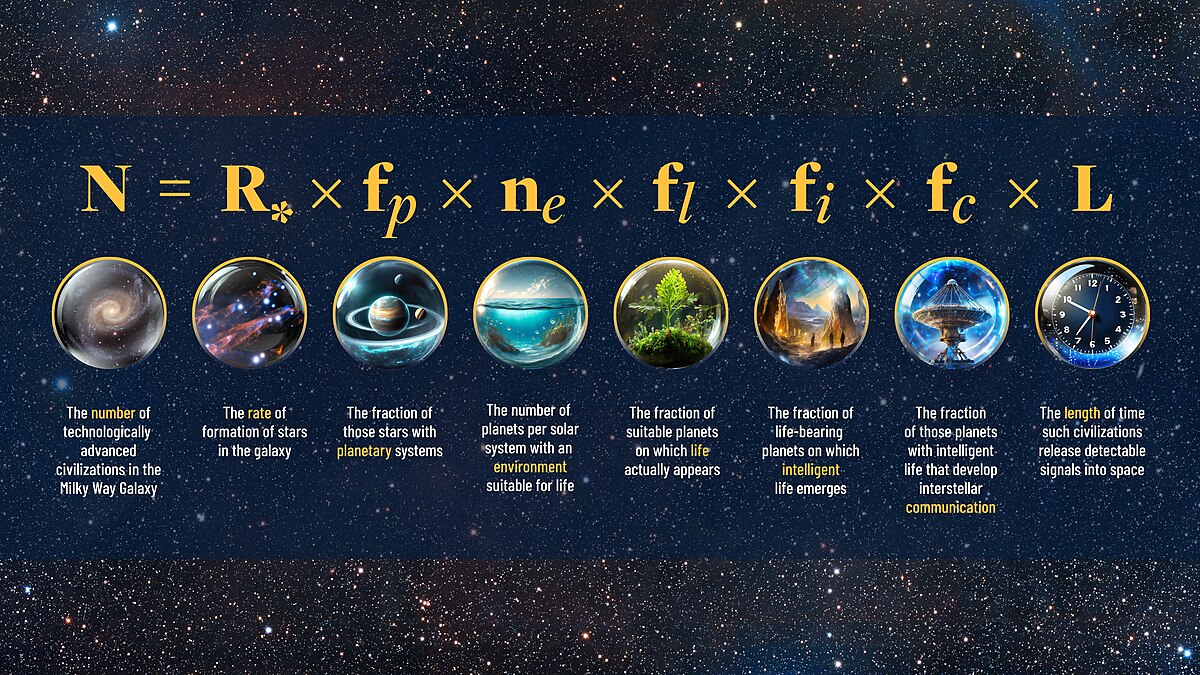
The formula multiplies seven specific terms to reach N, the number of detectable civilizations in the Milky Way. It begins with the astronomical factors: the rate of star formation (R*), the fraction of stars with planets (fp), and the average number of habitable planets per planetary system (ne).
The seven multiplicative factors that make up the Drake equation. NOIRLab/AURA/NSF/P. Marenfeld, CC BY 4.0, via Wikimedia Commons
It then moves through biology and society. These terms include the fraction of habitable planets where life develops (fl), the fraction where intelligent life evolves (fi), and the fraction that build technology releasing detectable signals into space (fc). The entire calculation is scaled by L, the length of time those civilizations continue transmitting signals.
Why the equation cannot give a firm number
The Drake equation cannot yield a precise answer because several of its variables are highly conjectural. While astronomers can estimate star formation rates, terms like the fraction of intelligent species that build radio transmitters or the lifespan of a technical civilization vary across many orders of magnitude.
Because these numbers are multiplied together, their uncertainties compound rapidly. Rather than proving how many civilizations exist, the equation serves as a framework to organize scientific investigation into abiogenesis, planetary habitability, and interstellar communication.
The early search for radio signals
In 1959, physicists Giuseppe Cocconi and Philip Morrison suggested searching for alien signals at 21 centimeters (1,420.4 MHz), the natural radio emission wavelength of neutral hydrogen. They reasoned this common frequency was an obvious galactic meeting point.
Frank Drake stands beside a radio telescope at Green Bank, where early SETI observations took place. NRAO/AUI/NSF, CC BY 4.0, via Wikimedia Commons
In 1960, Frank Drake ran Project Ozma at the Green Bank Observatory. He scanned two nearby Sun-like stars, Epsilon Eridani and Tau Ceti, for six hours a day across four months. The project found no signals, which prompted Drake to convene the 1961 Green Bank meeting where he introduced his equation.
Test yourself
What was the original purpose of the Drake Equation when Frank Drake first wrote it on a chalkboard?
To structure an agenda for a conference. The equation was initially created as a conversational framework to keep a scientific meeting focused on solvable research pieces rather than as a precise prediction tool.
The Drake Equation was created primarily to provide a precise calculation of the exact number of civilizations in the galaxy.
False. Drake designed the equation as a discussion agenda to organize complex scientific questions, not as a mathematical tool for calculating a definitive, factual count.
The variable 'ne' estimates the average number of planets per star that can potentially support ___.
life. This parameter focuses on the 'habitable zone' where conditions are just right for biology as we know it to exist.
Play the lesson in edgi and the card is yours. It lands on your Map next to the ideas it connects to, and turns from matte to foil to gold as you learn more around it.
Project Ozma was the first systematic search for extraterrestrial radio signals, run by Frank Drake in 1960. It used an 85-foot dish at Green Bank to monitor the stars Epsilon Eridani and Tau Ceti near the 21-centimeter hydrogen line.
Why was the 1961 meeting group called the Order of the Dolphin?
The ten scientists at the Green Bank meeting named themselves after attendee John C. Lilly's research into dolphin communication. They later commemorated the gathering with a plaque at the observatory hall.