Fermi ParadoxWhy the math demands aliens we cannot see
The Fermi paradox is the conflict between the high mathematical probability of extraterrestrial life and the complete lack of evidence that any exists. Billions of stars are older than our Sun, giving potential alien civilizations plenty of time to explore or colonize space. Despite this vast timeline, humanity has found no alien radio signals, artifacts, or spacecraft.
By the edgi team We find the most surprising true thing about an idea and build a 60-second lesson around it.
In 1950, physicist Enrico Fermi was walking to lunch at Los Alamos. His colleagues were debating a New Yorker cartoon about missing trash cans.
Fermi interrupted the chat, asking, 'But where is everybody?' He had mentally calculated the age of the galaxy against the speed of space travel and realized the math simply didn't add up.
The great filter
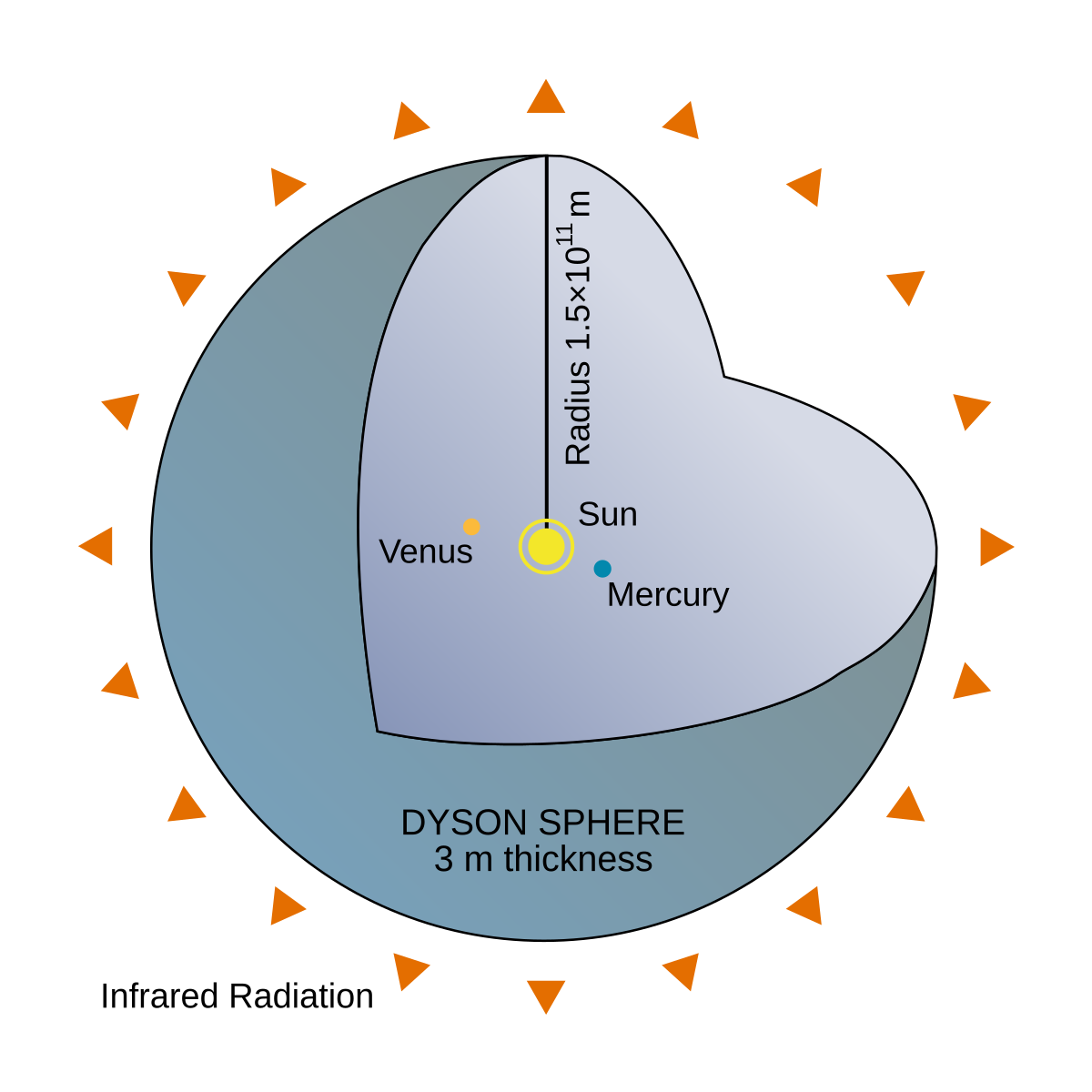
The galaxy is billions of years old. A civilization could colonize the entire Milky Way in a few million years, a blink in cosmic time. If life is common, space should be loud with radio signals or massive engineering projects like a Dyson sphere.
Diagram of a Dyson Sphere, a hypothetical megastructure enclosing a star. User:Bibi Saint-Pol, Public domain, via Wikimedia Commons
The silence suggests a Great Filter, a systematic barrier that stops life from becoming a space-faring civilization.
The dark forest
One chilling explanation is the Dark Forest theory. It suggests the universe is a predatory landscape where being noticed means being destroyed.
Civilizations stay quiet not because they are alone, but because they are hiding.
Why does the paradox exist?
The Milky Way contains billions of stars similar to the Sun, and many host Earth-like planets in their habitable zones. Many of these stellar systems are billions of years older than our own solar system. If life developed normally on even a tiny fraction of them, some civilizations would have had a head start of millions or billions of years.
Even at the slow speeds of non-relativistic space travel, a civilization could cross and colonize the entire galaxy in a few million years. Because the Milky Way is over ten billion years old, extraterrestrial species should have spread everywhere by now. The paradox lies in the silence: humans have observed no signs of massive astro-engineering, like Dyson spheres, and no spacecraft have ever visited Earth.
Theoretical answers to this absence vary widely. Some researchers propose that intelligent life is exceptionally rare or destroys itself quickly. Others suggest that civilizations deliberately stay quiet or that humanity lives in an isolated corner of the galaxy.
Who came up with the idea?
Physicist Enrico Fermi formulated the argument during a 1950 walk to lunch at Los Alamos National Laboratory with colleagues Emil Konopinski, Edward Teller, and Herbert York. After discussing flying saucers and faster-than-light travel, Fermi abruptly blurted out, "But where is everybody?" He quickly estimated the probability of Earth-like planets, the emergence of life, and the lifespan of technology, concluding that extraterrestrials should have visited Earth long ago.
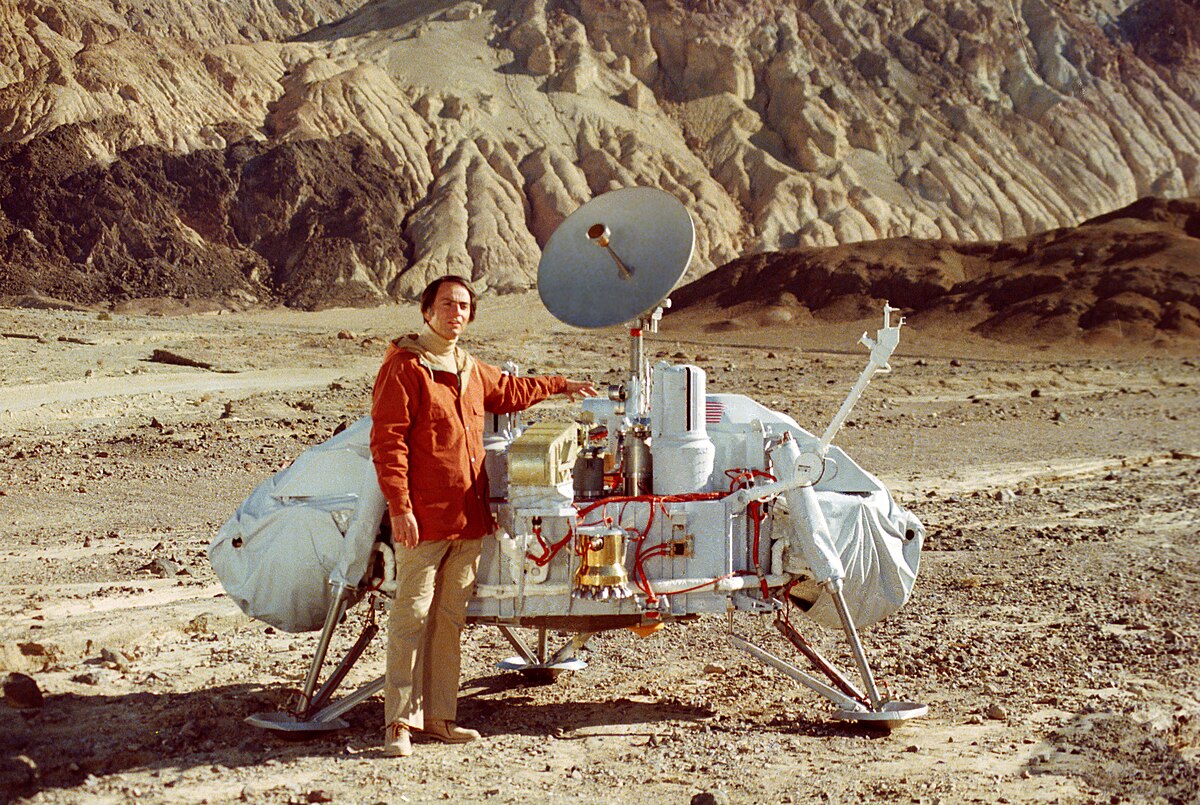
Carl Sagan, standing beside a Viking lander, published the first printed mention of the Fermi paradox in 1963. NASA/JPL, Public domain, via Wikimedia Commons
Earlier versions of the concept appeared long before Fermi. Bernard Le Bovier de Fontenelle raised the core dilemma in 1686, Jules Verne explored it in 1865, and Soviet rocket pioneer Konstantin Tsiolkovsky debated it in the 1930s. Tsiolkovsky suggested that alien civilizations might actively quarantine humanity to allow our society to develop on its own.
Carl Sagan brought Fermi's question into print in a 1963 paper. In 1975, Michael Hart published a formal breakdown categorizing solutions into physical limits, deliberate alien choices, time constraints, and past unrecorded visits.
Test yourself
What does the Fermi Paradox highlight about the galaxy?
The mismatch between odds and evidence. The paradox points out a contradiction: high probability of alien life versus total lack of observed contact.
What is the core conflict addressed by the Fermi Paradox?
The age of the galaxy versus the lack of evidence of life.. The paradox highlights that the galaxy is old enough for civilizations to have colonized it, making their absence statistically improbable rather than just distant.
The Fermi Paradox highlights a conflict between high ___ estimates and a lack of evidence.
probability. Statistically, there should be thousands of civilizations, but we see zero evidence of them.
Play the lesson in edgi and the card is yours. It lands on your Map next to the ideas it connects to, and turns from matte to foil to gold as you learn more around it.
The Great Filter is a theoretical barrier that prevents life from developing into an interstellar civilization. It suggests that either the jump from basic chemistry to advanced intelligence is almost impossible, or advanced societies routinely destroy themselves before leaving their home planets.
What is the Dark Forest theory?
The Dark Forest theory proposes that civilizations intentionally stay silent and hide their presence. In a hostile cosmos, revealing a planet's location could invite immediate destruction from other species.
What was the zoo hypothesis?
The zoo hypothesis, echoing ideas by Konstantin Tsiolkovsky and later proposed by John Ball, suggests advanced extraterrestrial life exists but intentionally isolates Earth. Under this view, aliens avoid contact to observe humanity or protect our cultural development.