Great FilterWhy finding alien life would be bad news
The Great Filter is the hypothesis that an extremely difficult barrier prevents life from evolving from simple chemistry into an interstellar civilization. It explains why the universe appears empty despite containing billions of stars. If early evolutionary steps turn out to be common, the barrier must lie ahead of us as a future extinction event.
By the edgi team We find the most surprising true thing about an idea and build a 60-second lesson around it.
The universe is vast and old, yet it is eerily silent. We see no signs of alien mega-structures or galactic empires. The Great Filter is the idea that a critical, near-impossible barrier prevents life from evolving into a space-faring civilization.
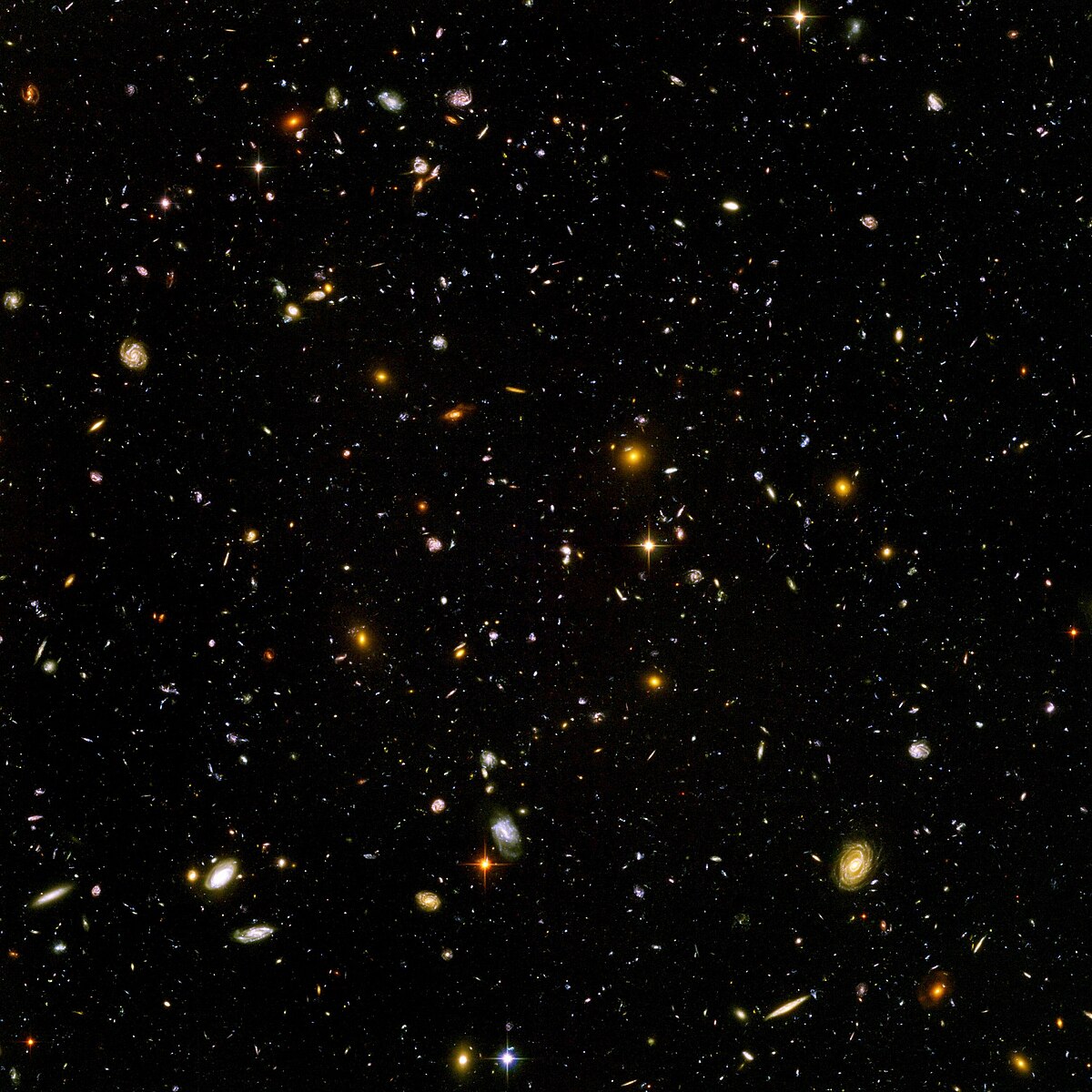
The Hubble Ultra Deep Field image, a deep-space photograph revealing thousands of galaxies of various shapes and colors against a dark background. NASA and the European Space Agency., Public domain, via Wikimedia Commons
Either the barrier is behind us, meaning we are incredibly lucky to have survived, or it is still ahead, waiting to extinguish us.
The mars nightmare
If we discover fossilized life on Mars, it suggests that abiogenesis, the origin of life, is common and easy. That would be a catastrophe. It implies the Filter isn't the birth of life, but something later.
If life evolves easily but civilizations consistently go extinct, then the 'Filter' must be a future event that destroys us too.
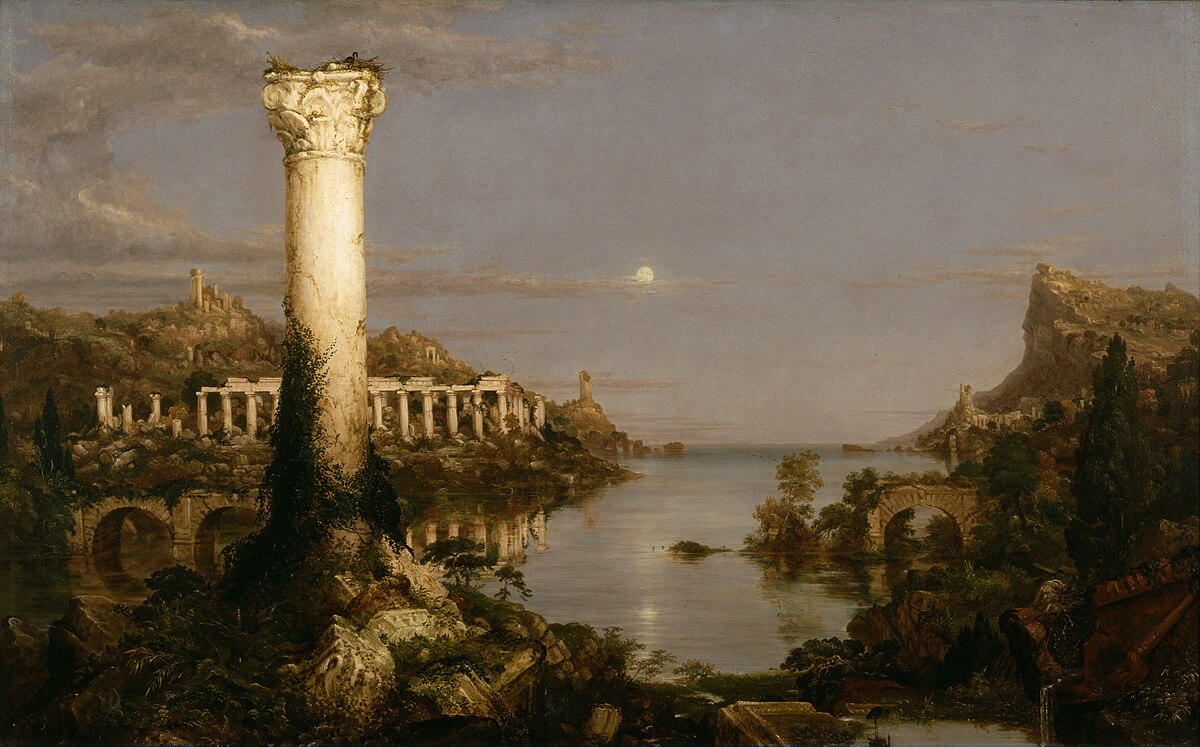
A painting by Thomas Cole titled "The Course of Empire: Desolation" (1836) depicts a desolate landscape with the ruins of a once-grand city. Thomas Cole, Public domain, via Wikimedia Commons
A likely culprit
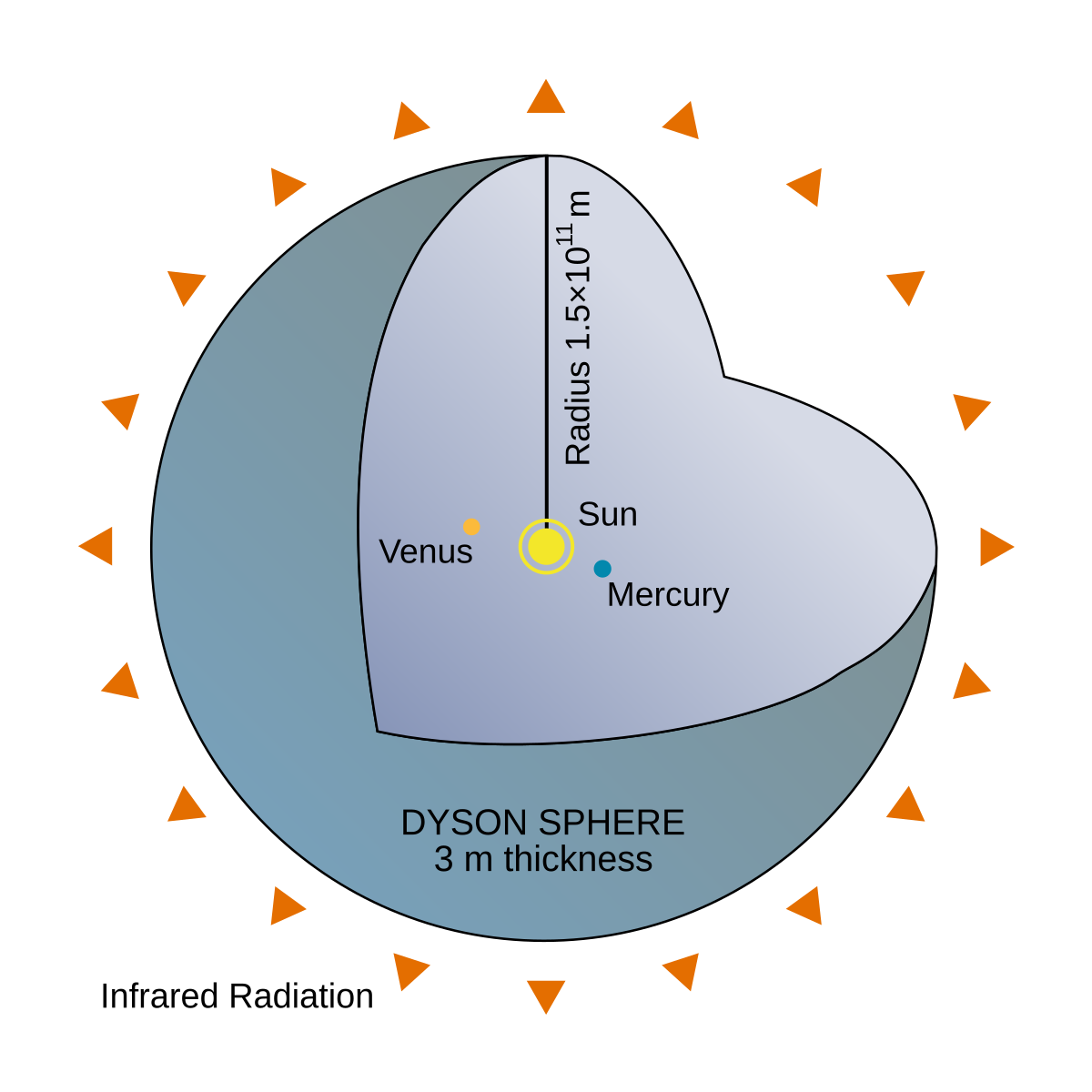
Economist Robin Hanson proposed this to solve the Fermi Paradox: the contradiction between the high probability of aliens and the lack of evidence. He noted we don't see Type III civilizations on the Kardashev scale, which would harness the energy of entire galaxies.
Diagram of a Dyson Sphere, a hypothetical megastructure enclosing a star. User:Bibi Saint-Pol, Public domain, via Wikimedia Commons
Something is systematically pruning the universe. We are either the only ones who made it, or the next ones to fail.
How the Great Filter explains the Fermi paradox
The universe is ancient, but we see no evidence of alien transmissions, visits, or self-replicating space probes. Physical processes in nearby solar systems and distant galaxies look completely dead rather than shaped by advanced civilizations. Life typically expands to fill all available territory, meaning an interstellar species would have colonized the Milky Way on timescales far shorter than the age of the universe.
Economist Robin Hanson introduced the Great Filter in an online essay written in August 1996 to address this contradiction. He argued that moving from a basic star system to a colonizing species requires at least one nearly impossible hurdle. Because we observe only one advanced civilization, something in nature systematically prevents the rest from spreading.
The nine evolutionary steps
Hanson outlined an evolutionary path made of nine major milestones. The sequence begins with a habitable planetary system, the formation of reproductive molecules like RNA, simple single-cell life, and complex single-cell life. It continues through sexual reproduction, multicellular life, tool-using intelligent animals, an advancing civilization, and finally an interstellar colonization explosion.
At least one transition on this list must have a vanishingly low probability. If early transitions like eukaryogenesis are the true barrier, humanity has already passed the filter and holds a strong chance of survival. If those early steps happen easily throughout the galaxy, then the barrier must occur late in the sequence, threatening our civilization with catastrophic collapse or resource exhaustion before we reach space.
How astronomers search for the Filter
Modern astronomy searches for data to determine where the barrier sits. Telescopes scanning ultraviolet to near-infrared wavelengths look for biosignatures indicating basic life on other worlds, while mid-infrared observations search for technosignatures from advanced technology.
If future surveys discover that simple life is widespread across the galaxy while technosignatures remain absent, the odds increase that the Great Filter lies ahead of humanity. Finding independent, multicellular fossils on Mars would eliminate several early candidates from the list, narrowing down the barrier to a future obstacle.
Test yourself
Does the Great Filter theory imply that finding fossilized life on Mars is good news or bad news for humanity?
Bad news because the barrier lies ahead. Finding life on Mars means abiogenesis is easy, which implies the insurmountable Great Filter must be a future catastrophe waiting for us.
If complex life were discovered on Mars, how would it affect the Great Filter?
It suggests the Filter is still ahead.. If life emerges easily, the Great Filter cannot be the origin of life itself. This implies the barrier preventing interstellar civilization lies in our future rather than our past.
If we discover complex life on Mars, it would suggest that the Great Filter is likely behind us.
False. Finding complex life nearby suggests that the development of life is easy, which implies the 'filter' might still be ahead of humanity.
Play the lesson in edgi and the card is yours. It lands on your Map next to the ideas it connects to, and turns from matte to foil to gold as you learn more around it.
Economist Robin Hanson proposed the concept in an online essay titled "The Great Filter, Are We Almost Past It?" in August 1996. He updated the paper in September 1998 to explain why the observable universe lacks signs of advanced extraterrestrial life.
What specific past biological step might be the Filter?
Astrophysicist Matt O'Dowd suggested that eukaryogenesis, the transition from simple prokaryotes to complex single-celled life, is a strong past candidate. This step required overcoming structural limits in discovering new functional proteins.
What future obstacles could act as the Great Filter?
Future hurdles include catastrophic self-destruction, extreme resource exhaustion, or the long-term impact of procrastination as technology relieves daily survival pressures. Any of these events could prevent a civilization from achieving interstellar colonization.