Artificial general intelligence is a hypothetical type of computer system that can match or exceed human abilities across virtually every cognitive task. Unlike narrow AI programs that only play chess or generate text, an AGI can transfer skills between unrelated fields and solve brand new problems without extra programming. Building one could lead to machines that continuously upgrade their own code.
By the edgi team We find the most surprising true thing about an idea and build a 60-second lesson around it.
Current AI is narrow, it excels at specific tasks like chess or coding but lacks common sense. We are stuck in Moravec's paradox: computers can calculate complex orbits in seconds but still struggle to fold a laundry basket.
AGI would break this, possessing the human-like ability to generalize knowledge across any domain.
The explosion
The real power of AGI isn't just raw speed; it's recursive self-improvement. If an AGI can rewrite its own code to become 10 percent smarter, it can use that new intellect to make the next version 20 percent smarter.
This feedback loop could trigger an intelligence explosion, leaving human cognitive capacity behind in a flash.
The alignment problem
This is why researchers are obsessed with AI alignment. We must ensure a god-like machine shares human values before it starts optimizing the world in ways we cannot control or reverse.
If you get the goal wrong, you get the future wrong.
What makes an AI general?
Narrow AI handles isolated chores, but true general intelligence demands a flexible combination of skills. Researchers expect an AGI system to reason, build strategies, make judgments under uncertainty, plan ahead, learn from experience, and hold common sense knowledge. It must also communicate in natural language and combine all of these capabilities to reach arbitrary goals.
Physical abilities also count toward full autonomy. A complete system benefits from sensing its surroundings through sight or hearing, moving through physical space, manipulating physical tools, and detecting hazards. Without these traits, a program remains a disembodied digital tool rather than a fully independent agent.
How do researchers test for AGI?
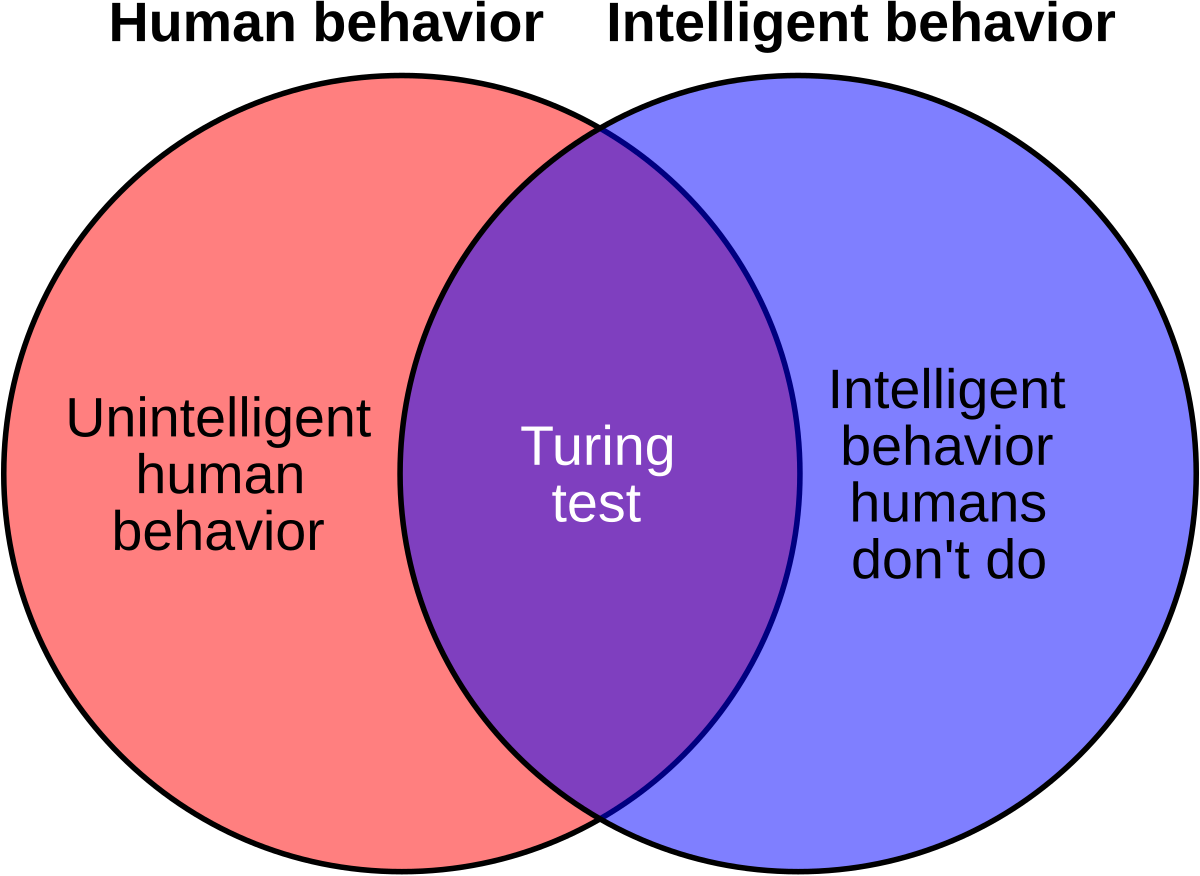
In 1950, Alan Turing proposed a test where a machine tries to pass as human in a text conversation. In a 2025 study, the language model GPT-4.5 was judged to be the human participant in 73 percent of five-minute conversations, beating the 67 percent score achieved by actual human test subjects.
The Turing test checks whether software can produce human-like conversational answers, though critics argue it tests deception rather than broad machine intellect. en:User:CharlesGillingham, User:Stannered, Public domain, via Wikimedia Commons
Physical capability requires different benchmarks, such as the Flat Pack Furniture Test. In 2013, MIT researchers built IkeaBot, an autonomous multi-robot system that assembled an IKEA Lack table in ten minutes without pre-programmed assembly instructions. Passing separate conversational and manual tests brings software closer to the broader definition of human-level intelligence.
How is AGI classified?
Google DeepMind organizes AGI by five performance tiers: emerging, competent, expert, virtuoso, and superhuman. A competent AGI outperforms 50 percent of skilled adults on non-physical tasks, while a superhuman system beats 100 percent of humanity.
DeepMind also measures systems by their degree of autonomy, ranging from simple tools to fully autonomous agents. Marcus Hutter defined this universal target mathematically in 2000 through AIXI, framing intelligence as an agent's ability to achieve goals across a wide range of environments.
Test yourself
What defines Artificial General Intelligence (AGI) compared to current narrow AI?
Generalizing across diverse domains. AGI is defined by its broad cognitive flexibility and common sense across any domain, whereas narrow AI excels only at isolated tasks.
In the context of Artificial General Intelligence, what drives an intelligence explosion?
Recursive self-improvement. Recursive self-improvement allows an advanced system to redesign its own code, creating a feedback loop of rapidly compounding intellect.
What core capability distinguishes Artificial General Intelligence from narrow AI?
Generalizing knowledge across any domain. While narrow AI excels at specific calculations, Artificial General Intelligence is defined by its ability to apply human-like reasoning across entirely new domains.
Claim the Artificial General Intelligence (AGI) card
Play the lesson in edgi and the card is yours. It lands on your Map next to the ideas it connects to, and turns from matte to foil to gold as you learn more around it.
What is the difference between AGI and artificial superintelligence?
Artificial general intelligence matches or surpasses human cognitive abilities across all tasks. An artificial superintelligence, or ASI, is a hypothetical AGI that becomes drastically smarter than any human intellect.
Who came up with the term artificial general intelligence?
Mark Gubrud first used the term in 1997 during a discussion of automated military systems. Shane Legg and Ben Goertzel reintroduced and popularized the term around 2002.
What is weak AI compared to strong AI?
Weak or narrow AI solves specific, well-defined problems without general cognitive skills or consciousness. Some academic sources use strong AI specifically for systems that possess general intelligence alongside actual sentience or conscious experience.