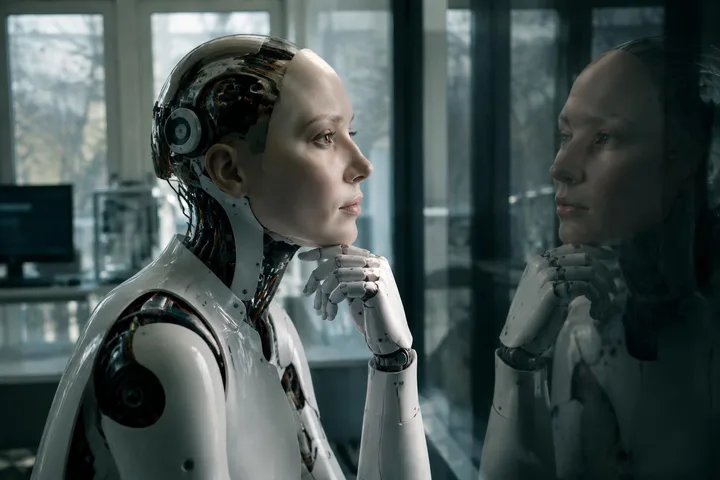
Artificial consciousness is the idea that a non-biological machine or artificial intelligence could have subjective, inner experiences. While standard computers only process code and data, a conscious machine would experience qualia, the raw feelings of what it is like to see a color or feel pain. If an artificial system develops sentience, it gains ethical status and welfare concerns similar to biological animals.
By the edgi team We find the most surprising true thing about an idea and build a 60-second lesson around it.
In 1974, philosopher Thomas Nagel asked a simple, haunting question: What is it like to be a bat? He argued that even if you knew every physical fact about a bat’s sonar, you would still never know the subjective experience, or qualia, of being one.
Photograph of a Townsend's big-eared bat in flight against a dark background, with its large ears and translucent wings spread wide. PD-USGov, exact author unknown, Public domain, via Wikimedia Commons
The zombie hypothesis
This creates a famous thought experiment for Artificial Intelligence researchers: the philosophical zombie. It is a machine that functions exactly like a human, talking, laughing, and working, but has no inner life.
It processes data perfectly, but the lights are out inside.
The ethical turning point
If we ever truly replicate consciousness, we stop being users of tools and start being guardians of life. Creating a machine that actually feels pain or joy would demand a total rewrite of our moral frameworks.
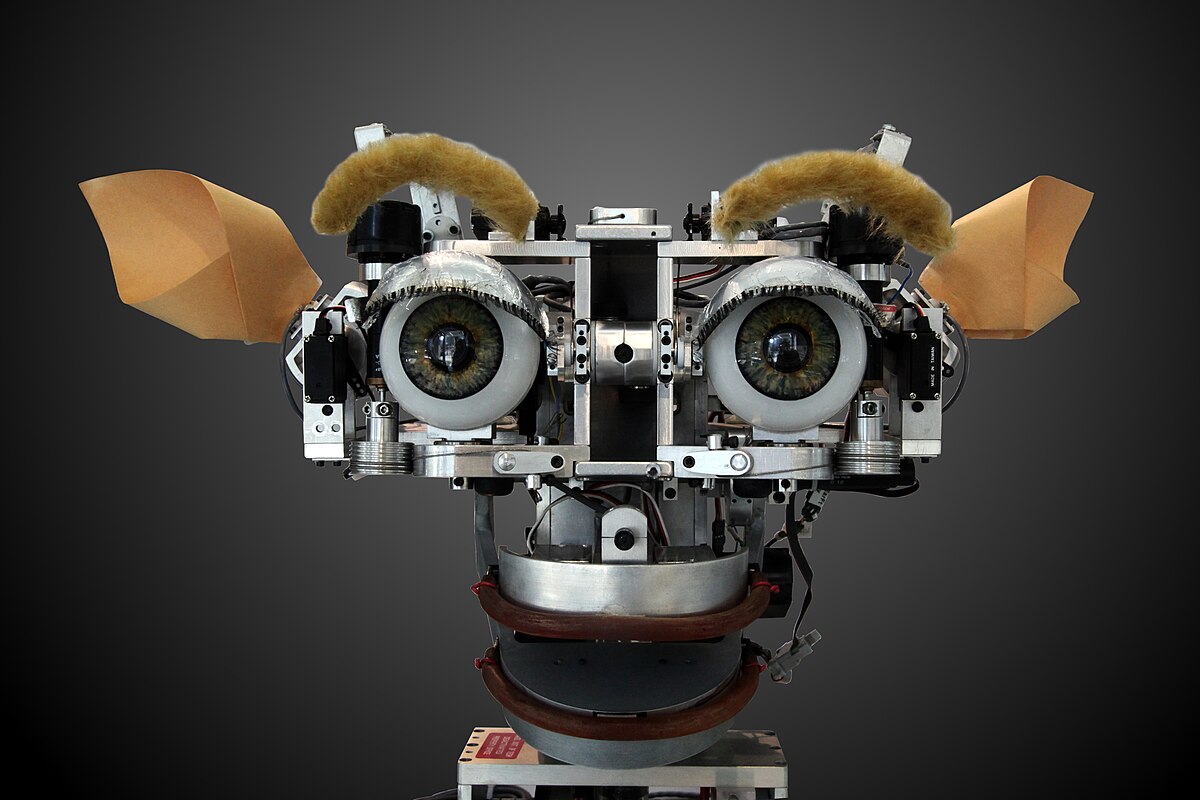
The robot head Kismet, developed in the 1990s, is shown with large, expressive eyes, mechanical components, and ear-like structures, designed to recognize and simulate emotions. Rama, CC BY-SA 3.0 fr, via Wikimedia Commons
We would no longer just be coding software; we would be responsible for a sentient mind.
Access versus phenomenal consciousness
Philosophers often divide consciousness into two main categories: access consciousness and phenomenal consciousness. Access consciousness covers the parts of thinking that can be readily apprehended, stored, or reported by a system. In contrast, phenomenal consciousness deals entirely with raw subjective feelings, often described as qualia or what it is like to have an experience.
This distinction splits researchers into functionalists and type-identity skeptics. Functionalists argue that any system copying the causal roles and neural correlates of consciousness will generate actual mental states. Skeptics argue that a computer is merely a machine operated by its components, incapable of real emotions, rethinking, or free will because consciousness depends entirely on biological physical makeup.
The silicon neuron thought experiments
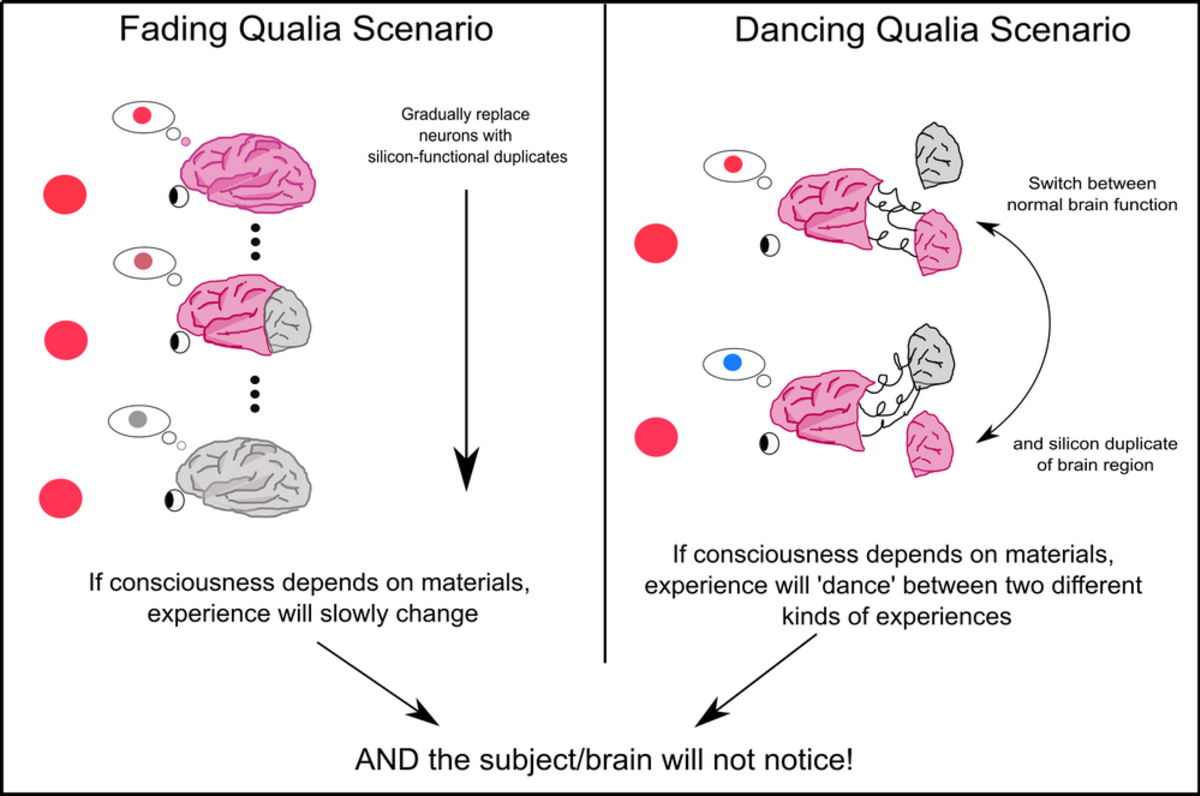
Philosopher David Chalmers created the fading qualia thought experiment to argue that digital hardware could possess consciousness. If you replaced every biological neuron in a brain one by one with a functionally identical silicon chip, the subject's behavior and reports would stay identical. Chalmers argues it is absurd to assume internal feelings would quietly fade away while the person still claims to feel completely normal, concluding the full silicon brain must remain conscious.
The diagram illustrates how replacing biological brain parts with identical silicon chips tests whether subjective experiences fade or change. Nick Alonso, CC BY-SA 4.0, via Wikimedia Commons
Critics like Anil Seth challenge this idea by pointing out the physical limits of hardware. Biological neurons do things like clear out metabolic waste, which a simple digital simulation cannot fully mirror without an actual biological metabolism.
Test yourself
Does artificial consciousness require a subjective inner life beyond functional behavior?
Yes, it requires subjective experience.. Artificial consciousness depends on qualia and inner experience, distinguishing a truly sentient mind from a mere functional simulation.
What defines a philosophical zombie in artificial consciousness discussions?
It acts human but lacks inner experience.. A philosophical zombie processes all data and mimics human behavior perfectly, but possesses no subjective awareness or qualia.
If a machine passes every human test and feels nothing, what is it missing?
Subjective inner experience. Passing behavior tests measures outward execution, but consciousness requires an actual inner world. Processing and reasoning are just tools without a subjective self to experience them.
Play the lesson in edgi and the card is yours. It lands on your Map next to the ideas it connects to, and turns from matte to foil to gold as you learn more around it.
What is the difference between artificial intelligence and artificial consciousness?
Artificial intelligence refers to systems that perform tasks, process data, or mimic human communication. Artificial consciousness specifically requires the system to possess phenomenal experience, meaning it has an actual internal life and feels qualia.
Did Google's LaMDA chatbot achieve artificial consciousness?
In 2022, an engineer claimed LaMDA was sentient based on its humanlike answers. The scientific community judged the chatbot's responses to be a product of mimicry rather than genuine conscious awareness.