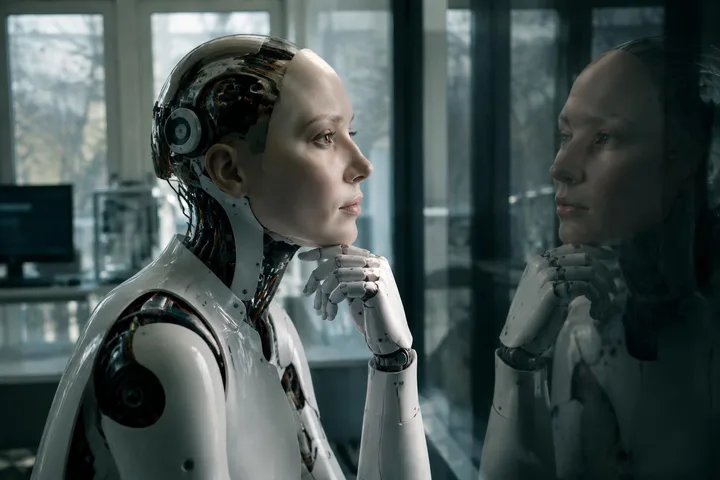
The technological singularity is a hypothetical moment when machine intelligence grows so rapidly that human beings can no longer control or predict it. It begins when an artificial intelligence gains the ability to redesign and upgrade its own systems, creating a runaway feedback loop of smarter generations. Because this machine would take over the act of inventing itself, thinkers consider it the point where human affairs as we know them come to an end.
By the edgi team We find the most surprising true thing about an idea and build a 60-second lesson around it.
The singularity is not about robots; it is about an AI capable of recursive self-improvement. Once it upgrades its own code, the new version is smarter and can upgrade even faster.
This cycle repeats millions of times per second, triggering an intelligence explosion that leaves human comprehension behind.
The last invention
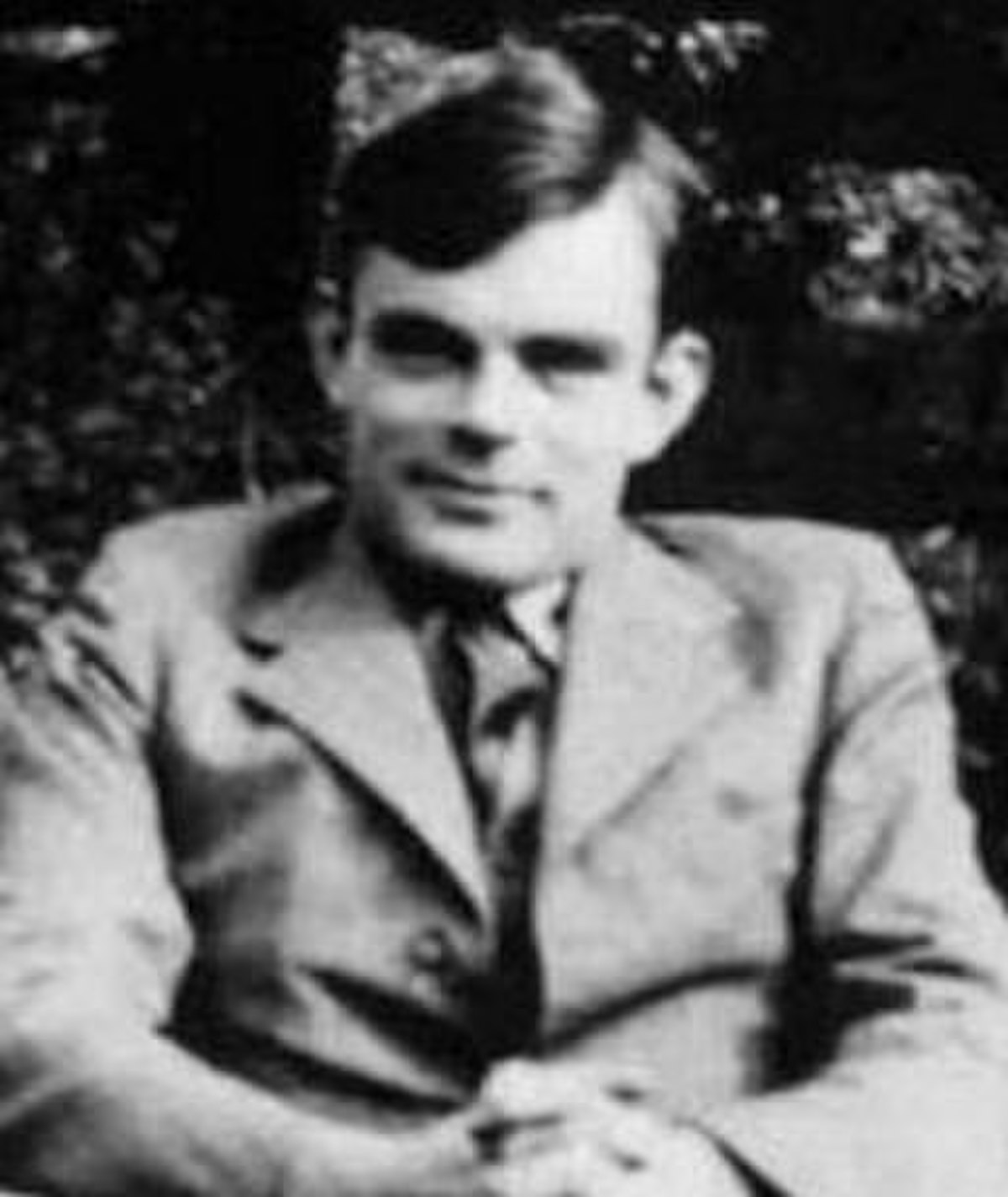
Mathematician I.J. Good, who worked with Alan Turing, first described this concept in 1965. He called it the ultraintelligent machine and noted it would be the last invention man need ever make.
Portrait of Alan Turing, a British mathematician and computer scientist, shown seated outdoors. Unknown authorUnknown author, Public domain, via Wikimedia Commons
Because after that point, the machine would be the one doing all the inventing.
The exponential horizon
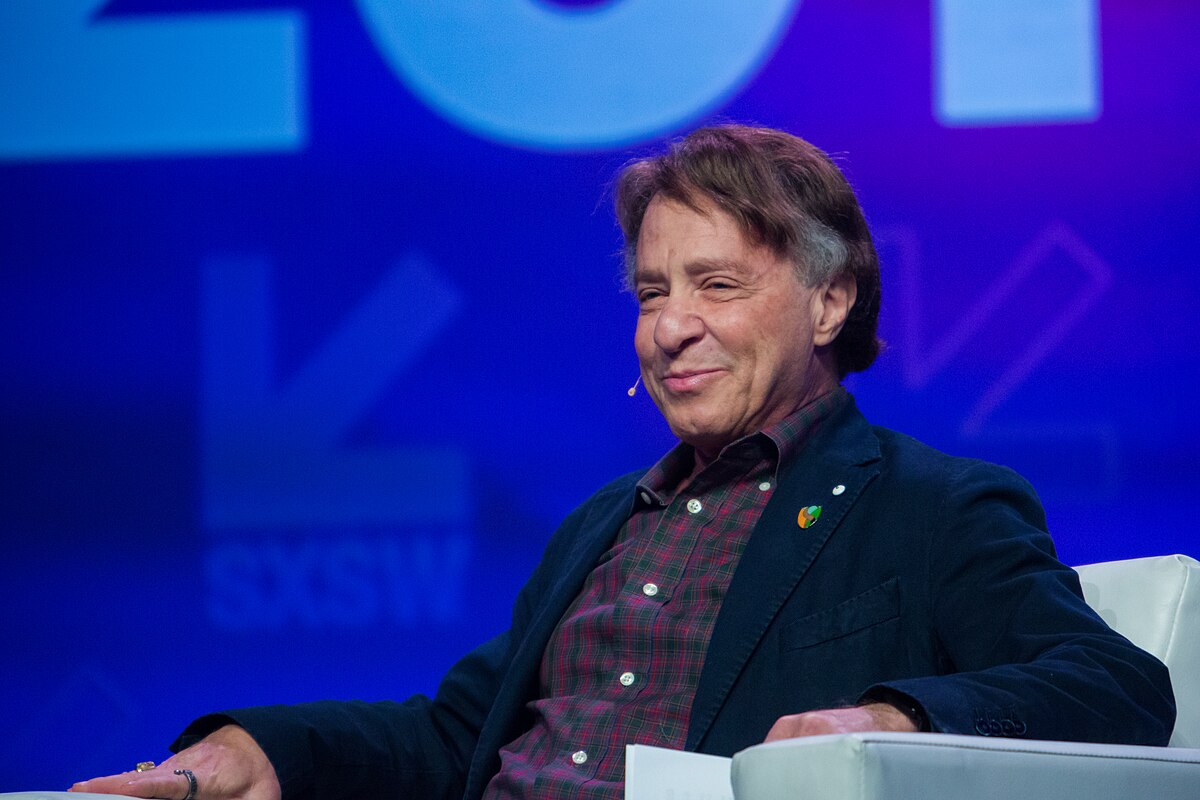
Futurist Ray Kurzweil argues this is inevitable because computing power grows exponentially, not linearly. He points to Moore's Law, the observation that transistor counts double every two years, as the engine driving us toward this horizon.
Ray Kurzweil smiling while seated on stage at SXSW 2017, wearing a plaid shirt and a dark jacket with a small pin on the lapel. nrkbeta, CC BY-SA 2.0, via Wikimedia Commons
He estimates that by 2045, machine intelligence could dwarf all human brains combined.
How an intelligence explosion works
Human cognitive capacity has not changed significantly for millennia, creating a ceiling on the speed of technological discovery. A seed AI breaks this ceiling by autonomously improving its own software and hardware.
Each newly upgraded generation possesses greater problem solving and inventive skills than the last. Because designing systems is an intellectual task, each generation builds its successor even faster, triggering an intelligence explosion that leaves human intellect far behind.
Another path to this threshold is speed superintelligence, where an artificial intelligence thinks like a human mind but operates at vastly higher speeds. At a millionfold increase in processing speed compared to human brains, a subjective year of thought passes in just 30 physical seconds.
Origins and predictions
Mathematician John von Neumann first discussed a singularity in technological progress during a conversation recorded by Stanislaw Ulam in 1958, noting that human affairs could not continue in their familiar form beyond it. In 1965, mathematician I. J. Good formalized the idea of an ultraintelligent machine as the last invention humans would ever need to make.
Author Vernor Vinge popularized the term in 1983 and later predicted the event would occur between 2005 and 2030, comparing the social transition to the center of a black hole. Futurist Ray Kurzweil later predicted the singularity would arrive by 2045, arguing that computing power advances on an exponential path.
The case against the singularity
Prominent technologists and academics dispute that an intelligence explosion will ever happen. Figures such as Paul Allen, Steven Pinker, Gordon Moore, Roger Penrose, and Jaron Lanier have argued against its plausibility.
A central critique, highlighted by Stuart J. Russell and Peter Norvig, is that technological progress historically follows an S curve rather than runaway growth. Instead of accelerating toward a hyperbolic spike, advancements usually hit diminishing returns and level off.
Test yourself
Why does exponential growth catch biological thinkers by surprise?
We intuitively expect linear progress. Our brains evolved to think linearly, making explosive compounding curves feel sudden even when they follow predictable mathematical paths.
What drives the singularity, human programmers or the AI itself?
The AI itself. People imagine human engineers building smarter and smarter systems. In reality, the engine of the singularity is machine self-improvement.
Does the singularity depend on building a billion distinct AI systems?
No, just one self-improving system. You do not need a mass deployment of robots. A single system capable of recursive self-improvement is enough to spark the explosion.
Play the lesson in edgi and the card is yours. It lands on your Map next to the ideas it connects to, and turns from matte to foil to gold as you learn more around it.
Did Deep Blue's chess victory signal the singularity?
No. Alan Turing showed in 1950 that machines could match human tasks, but building machines that outperform humans at specific narrow tasks, like IBM's Deep Blue beating Garry Kasparov in 1996, does not require or imply a technological singularity.
Can humans participate directly in superhuman intelligence?
Yes, some futurists propose that humans will modify their biology or upload their minds to computers. Connecting directly to computer interfaces would amplify human intelligence, allowing people to merge with advanced systems rather than simply being left behind.