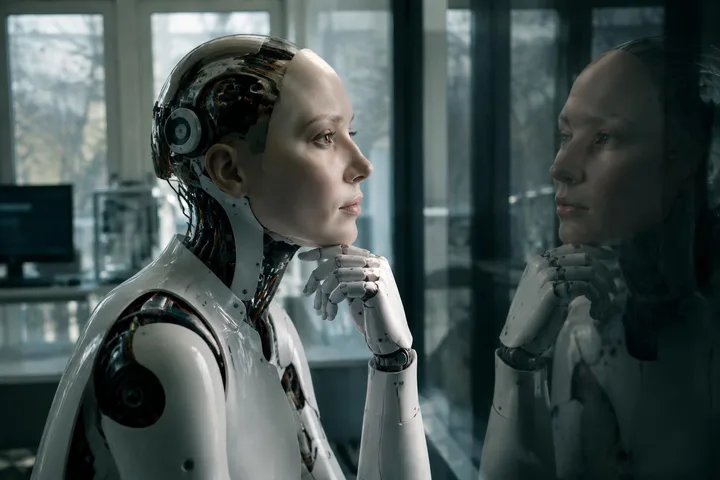
Moravec's paradox is the discovery that tasks humans find difficult, such as playing grandmaster chess or doing calculus, are easy for computers, while tasks humans find effortless, such as walking or recognizing a face, are exceptionally hard for machines. It reveals that human intuition about what counts as complex intelligence is inverted. What feels natural to a toddler is backed by millions of years of evolutionary optimization.
By the edgi team We find the most surprising true thing about an idea and build a 60-second lesson around it.
In the 1980s, AI researcher Hans Moravec noticed a strange pattern in computing. It was surprisingly simple to build a machine that could beat a human grandmaster at chess.
A worker at the Centers for Disease Control in the 1980s is shown typing on a computer keyboard, with a CRT monitor displaying text. U.S. Centers for Disease Control, Public domain, via Wikimedia Commons
Yet, it was nearly impossible to build a robot that could walk across a cluttered room without crashing.
Evolutionary depth
We assume logic is 'hard' because it requires intense focus in school. But for our brains, math is a brand-new, thin layer of software.
Physical movement and sensory perception are the result of billions of years of evolutionary trial and error, hard-coded into our oldest biological structures.
The final hurdle
This is Moravec's paradox: the 'hard' things are easy for AI, and the 'easy' things are hard. We can train an AI to write a symphony or solve calculus in seconds.
But mastering the physical world, through fields like computer vision, remains the true test for achieving Artificial General Intelligence.
Why is walking harder for machines than chess?
Abstract reasoning is an evolutionary newcomer, while sensory perception has been refined by natural selection for hundreds of millions of years. Skills like catching a ball, recognizing voices, and moving through space are backed by massive biological machinery that functions without conscious effort. Because humans do not have to think deliberately about walking across a room, early researchers assumed it was simple to program.
Logic, geometry, and mathematics appeared only recently in evolutionary history, perhaps less than one hundred thousand years ago. Human brains have not mastered these abstract tasks, which is why schoolwork feels exhausting. For a computer, following formal logic rules requires very little computation, but reverse-engineering the unconscious sensory systems of the brain requires solving enormous complexity.
How the paradox misled early AI research
In the early decades of AI research, scientists predicted that human-level artificial intelligence was only a few decades away. They succeeded quickly in writing software that solved algebra problems, proved logic theorems, and played checkers. Because educated adults found these tasks difficult, researchers assumed that mastering vision, movement, and common sense would follow easily once the logical framework was built.
Robotics researcher Rodney Brooks pointed out that early researchers defined intelligence as the specific skills that educated scientists found challenging, such as symbolic integration and chess. They ignored everyday survival skills, such as telling a coffee cup apart from a chair or walking from a bedroom to a living room. This realization led Brooks in the 1980s to build Nouvelle AI, a framework focused entirely on physical sensing and direct action rather than abstract symbolic thought.
Test yourself
Does Moravec's Paradox imply that logical reasoning requires more advanced AI than physical dexterity?
No. Moravec's paradox shows that logical reasoning is actually easier for AI to master than physical dexterity, because abstract logic is a recent evolutionary development.
In Moravec's Paradox, why are low-level motor skills harder for AI than complex logic tasks?
Refined by millions of years of evolution. Sensory and motor skills are built on billions of years of biological trial and error, making them far more complex to engineer than recent cognitive inventions like math.
Which requires more complex computation for a robot: abstract logic or walking?
Walking is harder. Logic is a recent, thin layer of software for brains, making it easy for machines to simulate. Physical movement relies on billions of years of deep evolutionary wiring.
Play the lesson in edgi and the card is yours. It lands on your Map next to the ideas it connects to, and turns from matte to foil to gold as you learn more around it.
Hans Moravec articulated the observation in 1988 alongside AI researchers Marvin Minsky and Rodney Brooks. Moravec pointed out that giving machines the physical mobility and perception of a one-year-old was far harder than making them perform at adult levels on logic tests.
What did Marvin Minsky say about human awareness?
Marvin Minsky noted that humans are least aware of what their minds do best. We consciously notice the simple logical processes that require effort and struggle, while remaining unaware of complex sensory systems that run flawlessly in the background.
Do all researchers agree with Moravec's interpretation?
No, some researchers offered different views on the paradox. AI pioneer Allen Newell called the concept a myth in 1983, while researcher Arvind Narayanan described it as a reflection of what tasks the AI community chooses to prioritize rather than a rule about what computers can solve.