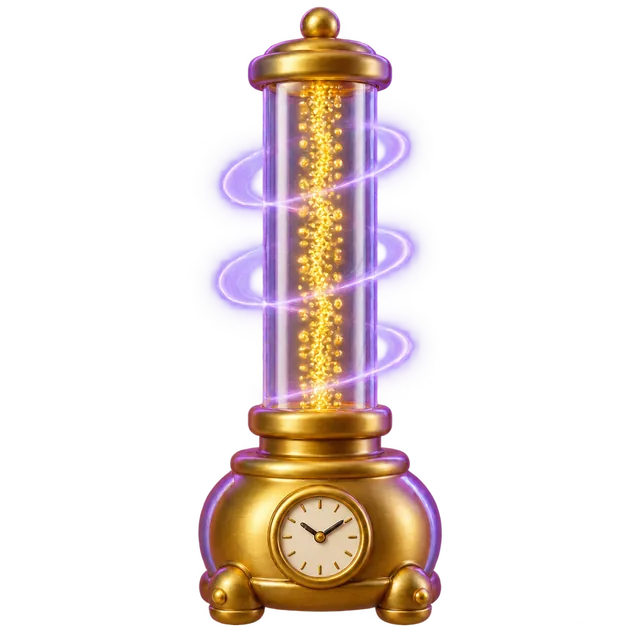
An atomic clock is a device that tracks time by measuring the exact resonant frequency of electromagnetic radiation needed to make electrons jump between energy levels in atoms. This natural atomic frequency is so stable that international science defines the standard second using the caesium-133 atom. These precise devices form the backbone of modern global timekeeping and satellite navigation systems.
By the edgi team We find the most surprising true thing about an idea and build a 60-second lesson around it.
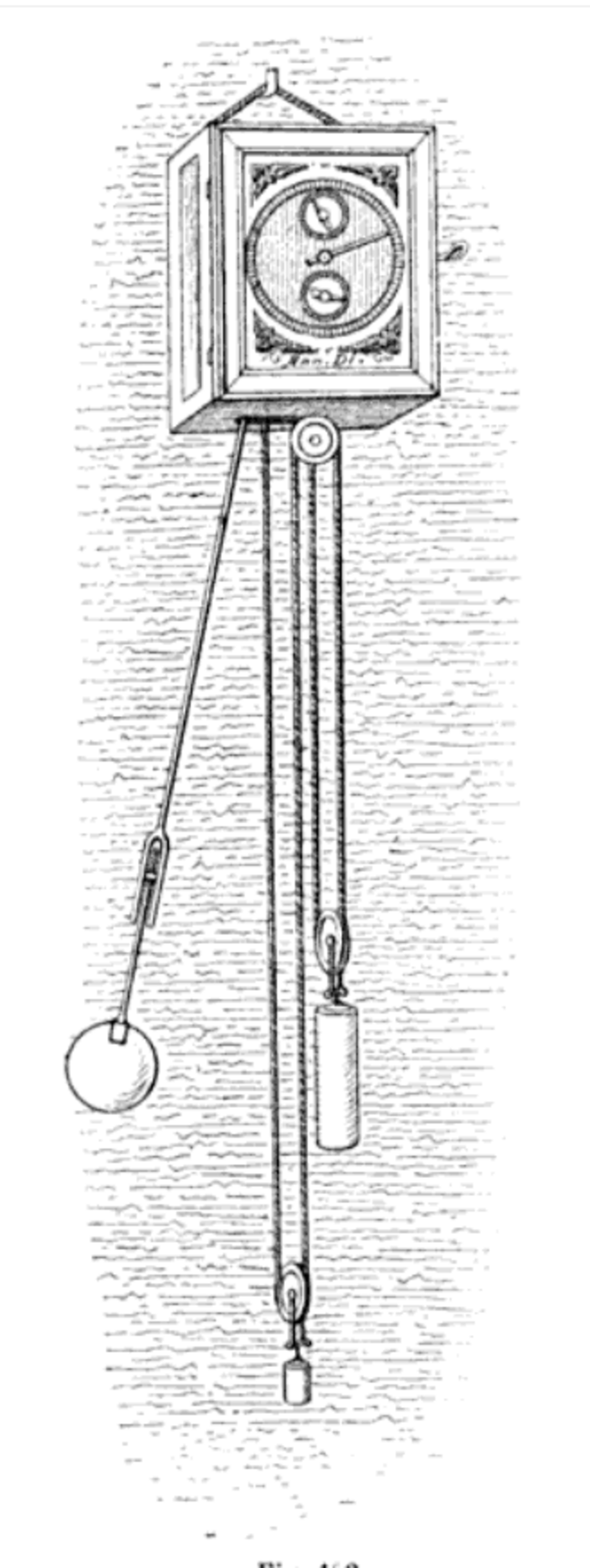
Pendulums swing and quartz crystals vibrate, but atoms possess a far more stable heartbeat. Under quantum mechanics, electrons occupy specific energy levels. To jump between them, they require an exact frequency of electromagnetic radiation.
A front view illustration of Huygens' first pendulum clock, showing the clock face at the top, a long pendulum, and two weights suspended by ropes and pulleys. Unknown authorUnknown author, Public domain, via Wikimedia Commons
For caesium-133, that transition happens at a locked frequency of precisely 9,192,631,770 cycles per second.
How it works
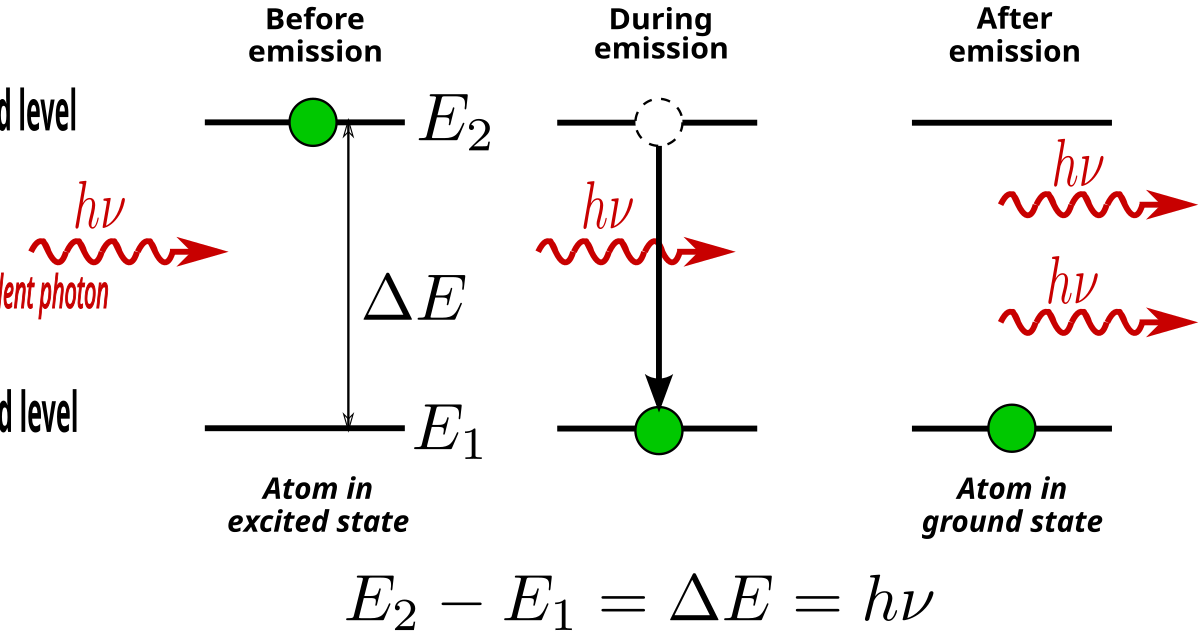
An atomic clock sprays caesium atoms through a chamber and bombards them with microwaves. If the microwave frequency matches the atom's natural resonance, the atoms change state.
Diagram illustrating stimulated emission, showing an atom transitioning from an excited state to a ground state due to an incident photon. V1adis1av (talk · contribs), CC BY-SA 4.0, via Wikimedia Commons
A detector counts these successful shifts and feeds the data back to adjust the microwave generator, keeping it locked to the atomic heartbeat.
Gps and beyond
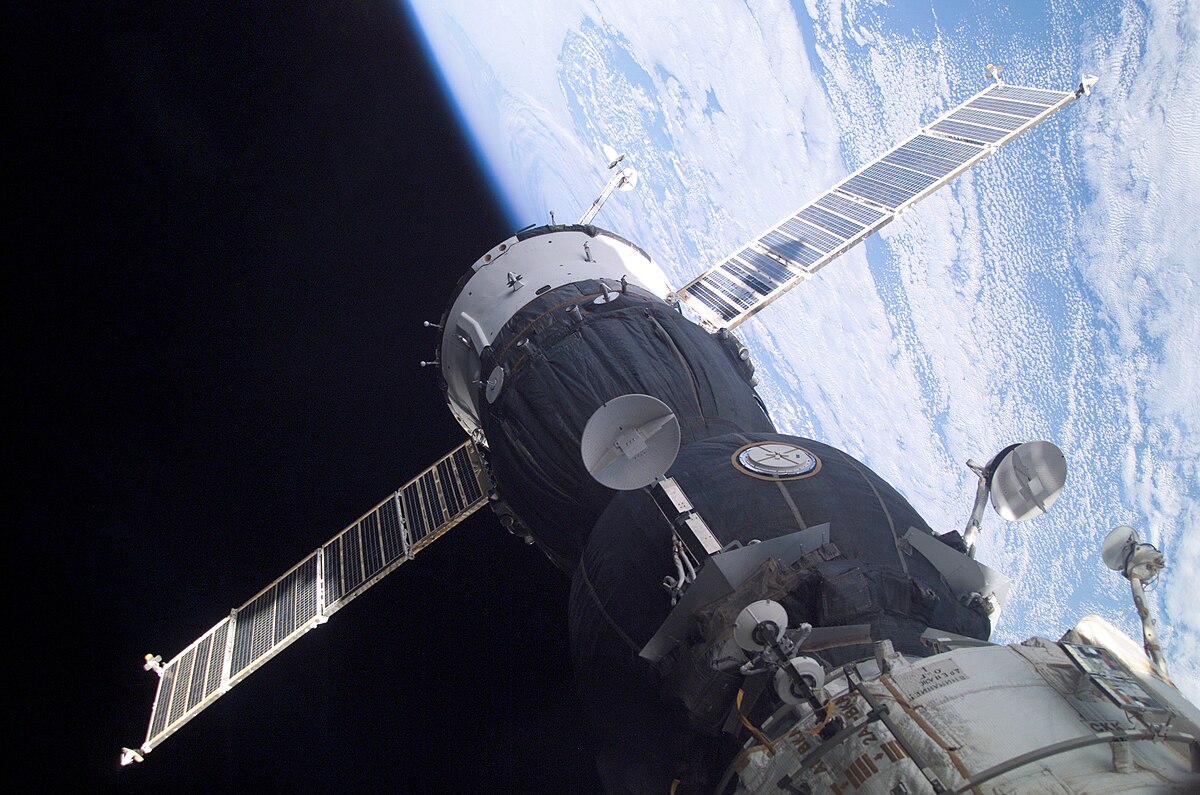
This extreme precision is not just for physics laboratories. It quietly runs the modern world. Every Global Navigation Satellite System relies on orbiting atomic clocks to calculate your position on Earth down to the meter.
Illustration of a GPS Block IIIA satellite orbiting Earth, featuring large solar panels extended from its central body. U.S. Air Force, Public domain, via Wikimedia Commons
Because light travels one foot in a billionth of a second, an error of a single microsecond would throw your GPS location off by hundreds of feet.
How does an atomic clock keep time?
In 1968, international standards officially defined one second as exactly 9,192,631,770 cycles of the microwave radiation that triggers an energy state shift in a caesium-133 atom at rest near absolute zero. Mechanical pendulums and quartz crystals shift their ticking speed when temperatures fluctuate, but the energy gaps inside an atom remain constant under controlled conditions.
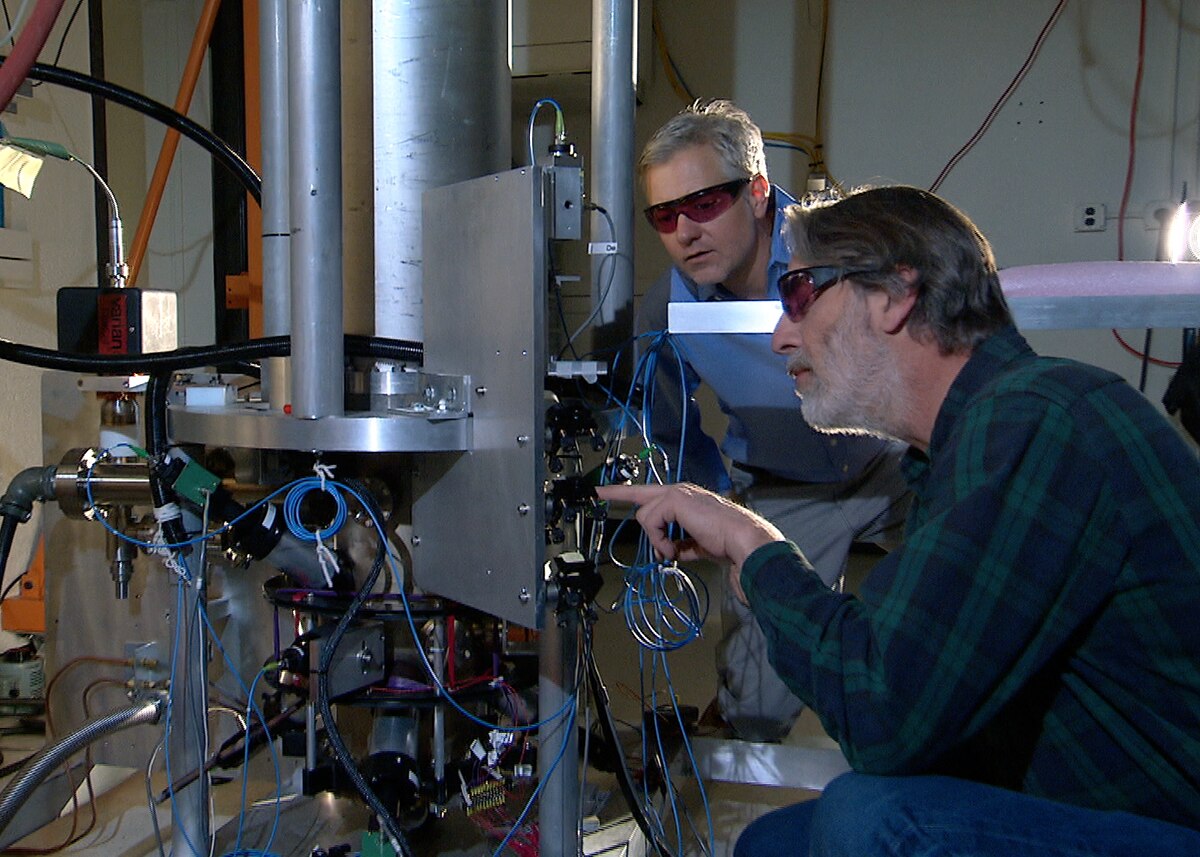
Physicists Steve Jefferts and Tom Heavner stand with NIST-F2, a caesium fountain clock serving as a United States civilian time standard. National Institute of Standards and Technology - Physics Laboratory: Time and Frequency Division, Public domain, via Wikimedia Commons
To run an atomic clock, an oscillator exposes caesium atoms to microwaves. When the microwave beam matches the atom's natural resonant frequency, the atoms absorb the radiation and change state. A detector counts the shifted atoms and continuously adjusts the microwave generator, locking its frequency to the atom's constant internal transition rate.
Primary time standards, such as the NIST-F2 caesium fountain clock in the United States, use cooled atoms to achieve an uncertainty of roughly 1 part in 10 to the 16th power. This standard underpins International Atomic Time (TAI) and Coordinated Universal Time (UTC).
Why satellite navigation requires atomic time
A timing error of just one nanosecond throws off satellite positioning by roughly 30 centimetres when calculated at the speed of light. Because of this, satellite navigation networks such as the United States' GPS and Europe's Galileo depend directly on atomic clocks operating aboard orbiting spacecraft.
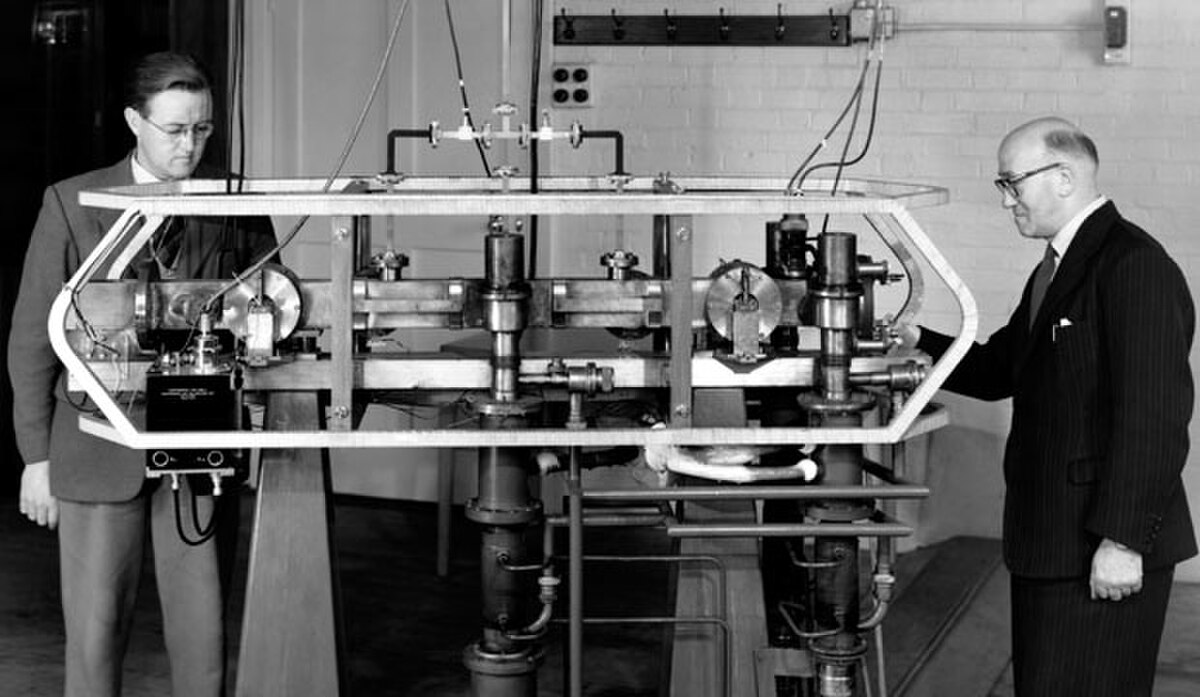
Louis Essen and Jack Parry constructed the world's first caesium-133 atomic clock in 1955 at the National Physical Laboratory. National Physical Laboratory, Public domain, via Wikimedia Commons
Every base unit in the International System of Units, except the mole, relies on the precision of the second. The stability of atomic clocks ensures that ground receivers can measure the exact travel time of radio signals from space to pinpoint locations on Earth within meters.
The shift toward optical atomic clocks
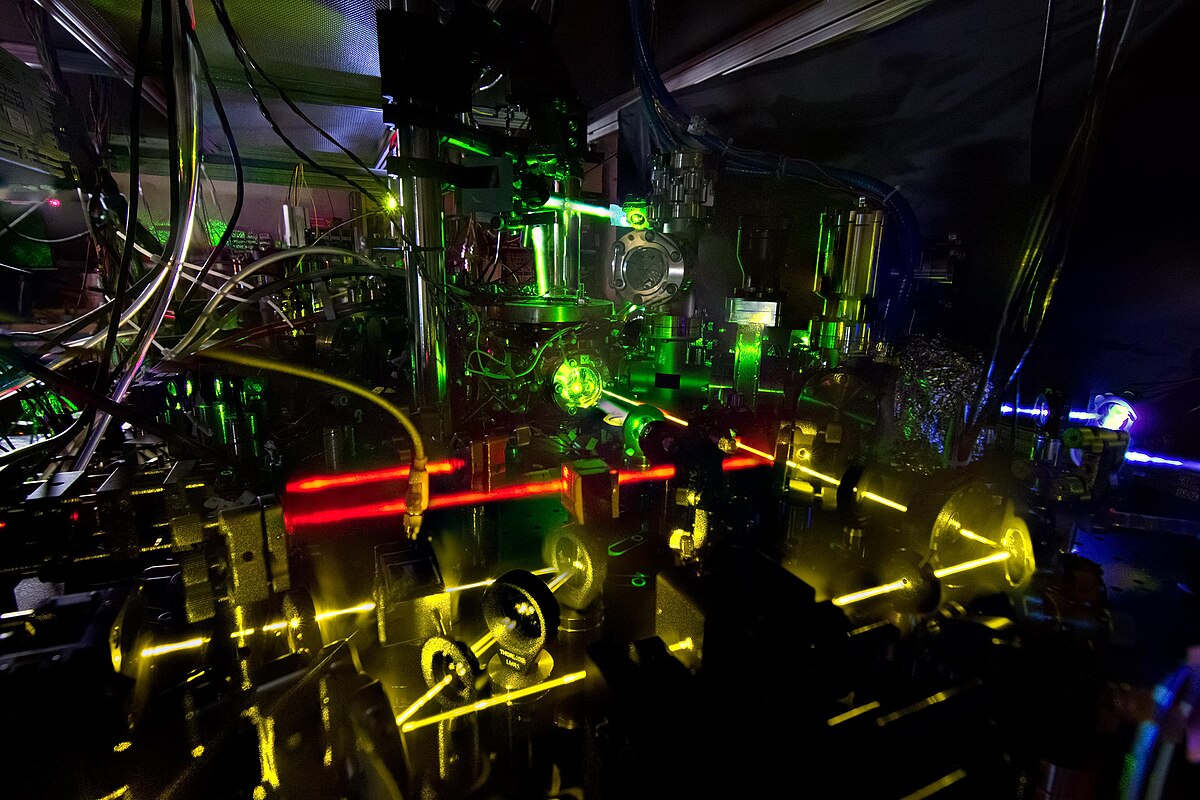
Standard atomic clocks use microwave frequencies, but modern optical clocks use visible light lasers, which oscillate at much higher frequencies and yield far sharper measurements. In July 2025, researchers at NIST demonstrated an optical clock using a trapped aluminium ion that achieved precision across roughly 19 decimal places.
An ytterbium optical lattice clock uses laser light to measure atomic transitions at higher frequencies than microwave clocks. Credit: N. Phillips/NIST, Public domain, via Wikimedia Commons
These optical clocks support new applications, including relativistic geodesy (detecting changes in gravity based on time dilation) and testing the fundamental constants of physics. Due to these rapid advances, international metrology groups are preparing for a potential redefinition of the SI second around 2030.
Test yourself
Why can an atomic clock outperform a quartz clock?
Atomic resonance provides a more stable frequency reference. The advantage is the stability of the atoms’ resonant frequency, not simply a faster tick or the speed of the microwaves.
How does an atomic clock keep its microwave frequency accurate?
It adjusts the microwaves to match atomic resonance. The clock detects when caesium atoms change state and uses that signal to tune the microwaves to the atoms’ stable resonance.
Why can an atomic clock outperform a quartz clock?
Atomic resonance provides a more stable frequency reference. The advantage is the stability of the atoms’ resonant frequency, not simply a faster tick or the speed of the microwaves.
Play the lesson in edgi and the card is yours. It lands on your Map next to the ideas it connects to, and turns from matte to foil to gold as you learn more around it.
Louis Essen and Jack Parry built the first practical caesium atomic clock in 1955 at the National Physical Laboratory in the United Kingdom. Earlier prototypes in 1949 had attempted timekeeping using phase transitions in ammonia molecules.
Why do civil clocks use leap seconds if atomic clocks are so accurate?
Atomic clocks track International Atomic Time (TAI), which runs at a perfectly steady rate. Earth's physical rotation is slightly irregular, so civil time (UTC) occasionally inserts leap seconds to keep our calendar aligned within one second of the planet's rotation.
What is an optical frequency comb?
Developed alongside lasers in the 1990s, optical frequency combs are tools that measure the extremely fast vibrations of optical clocks. They allow researchers to link optical-range laser transitions back to measurable electronic time standards.