Time dilation is the difference in elapsed time measured by two clocks, caused either by their relative speed or by differences in gravity. Because the speed of light is constant for everyone, a clock moving relative to an observer must tick more slowly than a resting clock. As an object's speed approaches the speed of light, its passage of time slows toward a complete stop relative to someone watching from rest.
By the edgi team We find the most surprising true thing about an idea and build a 60-second lesson around it.
In 1971, two physicists put atomic clocks on commercial airliners and flew them around the world. They were testing Einstein's theory of special relativity.
When the planes landed, the clocks were slightly off. The ones on the planes had experienced less time than the ones on the ground.
The gps reality
GPS satellites orbit at high speeds and weaker gravity, a result of General Relativity, meaning their clocks tick faster than ours. They gain about 38 microseconds every day.
If engineers didn't program the satellites to compensate for this time dilation, your phone's location data would drift by kilometers every single day.
A smartphone displaying a web map application showing Lake Lappajärvi in Finland. Santeri Viinamäki, CC BY-SA 4.0, via Wikimedia Commons
The flexible dimension
Time is not absolute. It is a dimension that bends and stretches depending on your velocity through space. The faster you move, the slower time passes for you relative to a stationary observer.
We are all time travelers, just at speeds too slow to notice without atomic clocks.
Why does speed slow down time?
The speed of light in a vacuum never changes, regardless of how fast you move toward or away from its source. Because light speed is constant for all observers, distance and time must bend instead.
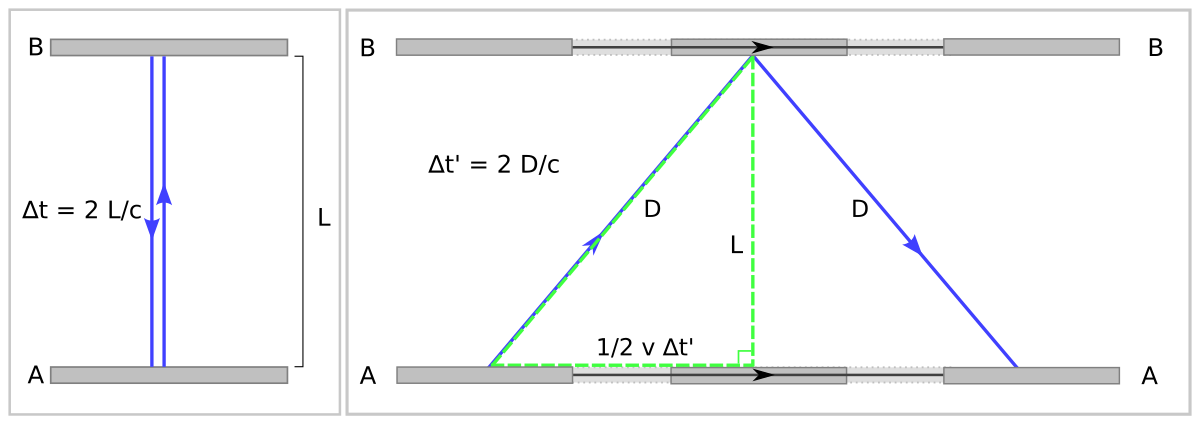
In a resting clock (left), light travels straight between two mirrors, but in a moving clock (right), light must follow a longer diagonal path at the same constant speed. Sacamol, CC BY-SA 4.0, via Wikimedia Commons
Consider a simple clock made of a light pulse bouncing between two parallel mirrors. To an observer sitting next to the clock, the light travels straight up and down over a distance of 2L. To a moving observer, the mirrors shift while the light is in flight, forcing the beam along a longer, diagonal path. Because the light must travel a greater distance at the exact same speed, the tick takes longer to complete, meaning the moving clock runs slower.
How time dilation affects real space travel
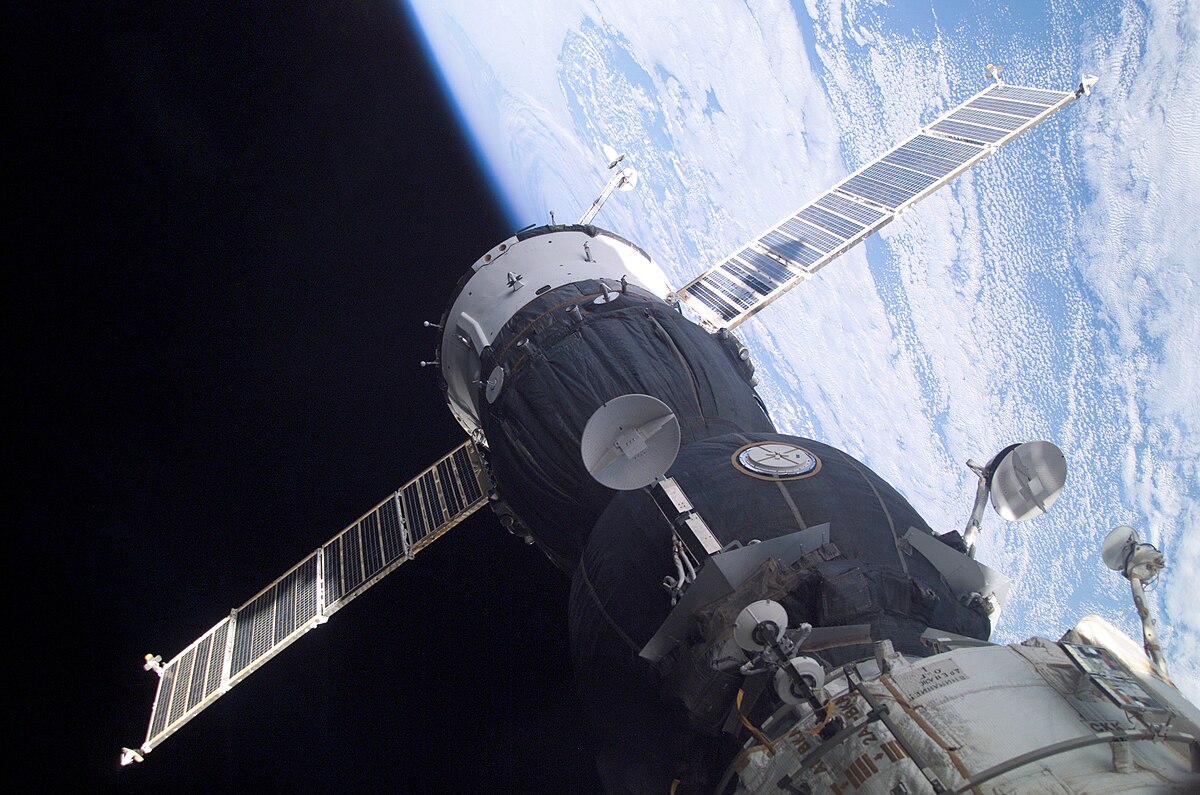
At everyday speeds, relativistic time differences are minuscule. After six months on the International Space Station traveling at about 7,700 meters per second, an astronaut ages roughly 5 milliseconds less than someone remaining on Earth. Cosmonauts Sergei Krikalev and Sergey Avdeev both accumulated about 20 milliseconds of time dilation over their careers.
Clocks aboard the International Space Station tick slightly slower than ground clocks due to their high orbital velocity. NASA, Public domain, via Wikimedia Commons
At near-light speeds, the effect would allow human interstellar travel. With a constant 1 g acceleration, passengers could cross the entire known Universe within a single human lifetime. While one year of travel for a fast crew might correspond to ten years passing on Earth, time only stops entirely if an object reaches 299,792,458 meters per second.
Play the lesson in edgi and the card is yours. It lands on your Map next to the ideas it connects to, and turns from matte to foil to gold as you learn more around it.
Can you visually watch a moving clock tick slower?
No, you cannot directly see time dilation with your eyes. Because light takes time to travel from a moving clock to your eyes, optical effects like the Doppler shift alter how the clock appears, making calculations of proper time necessary to measure the true difference.
Who first discovered time dilation?
Joseph Larmor and Emil Cohn derived the mathematical formulas for time dilation around the turn of the 20th century. Albert Einstein demonstrated in 1905 that time dilation reflects the nature of time itself in special relativity, and Hermann Minkowski clarified it with the concept of proper time in 1907.