General relativity is the theory that gravity is not an invisible pulling force, but the physical bending of four-dimensional space and time caused by mass and energy. Objects moving near a massive body simply follow the straightest possible paths along that curved surface. It replaced Isaac Newton's law of gravity by proving that time runs at different speeds and light bends depending on the presence of matter.
By the edgi team We find the most surprising true thing about an idea and build a 60-second lesson around it.
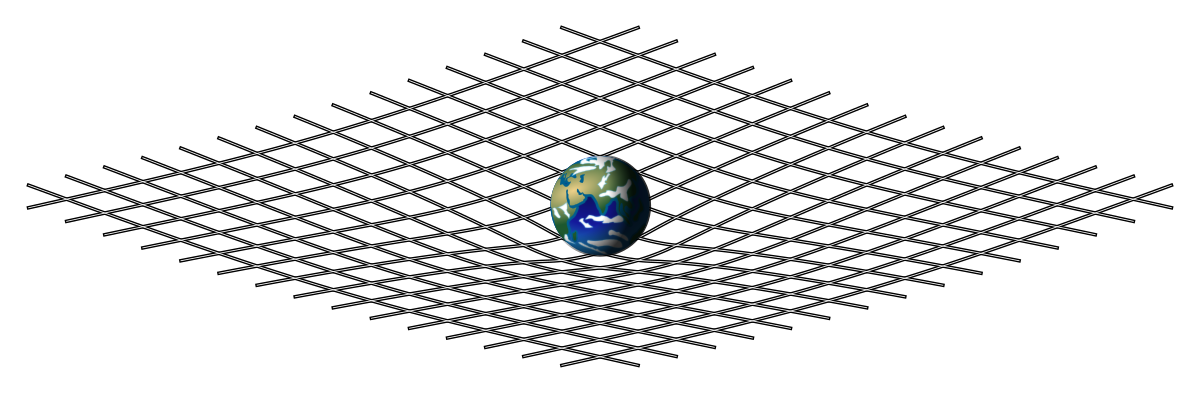
Imagine the universe as a flat sheet. If you place a bowling ball in the center, the fabric dips. Anything rolling near it follows that curve, not a straight line. That is gravity.
Analogy illustrating spacetime curvature, showing a grid-like lattice distorted by the presence of Earth at its center. Original: Mysid Derivative work: Waddie96, CC BY-SA 3.0, via Wikimedia Commons
It isn't an invisible force pulling objects; it is simply objects following the geometry of warped spacetime.
The 1919 proof
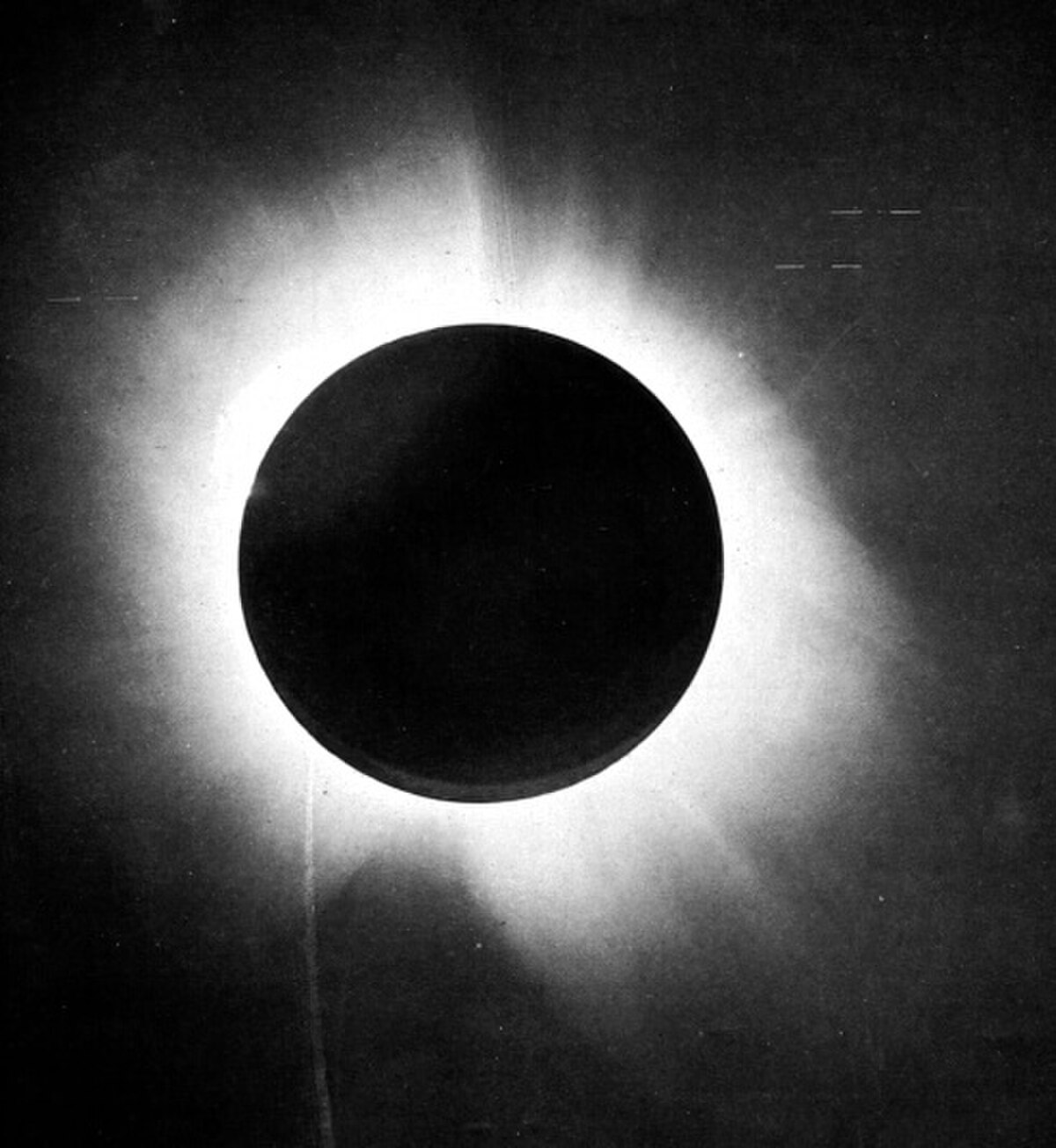
For centuries, we thought gravity was a force. Einstein argued it was a shape. In 1919, astronomers waited for a total solar eclipse to test him.
Black and white photograph of the 1919 total solar eclipse, showing the dark silhouette of the Moon obscuring the Sun, with the Sun's bright corona visible around its edges. Frank Watson Dyson / Arthur Eddington / Charles Rundle Davidson, Public domain, via Wikimedia Commons
They measured stars near the sun and found they appeared in the wrong spot; the sun's mass had bent the space around it, proving Einstein right.
The daily correction
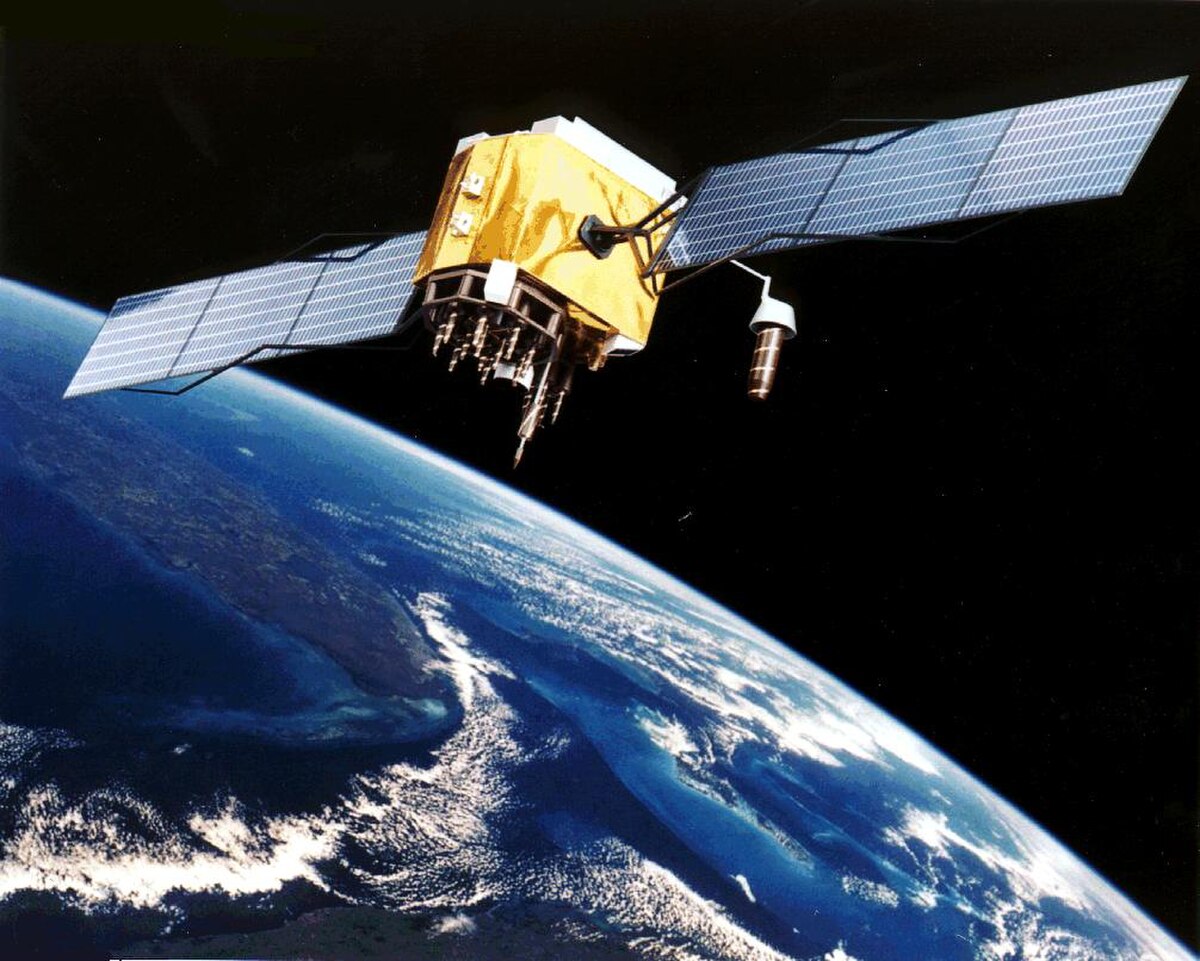
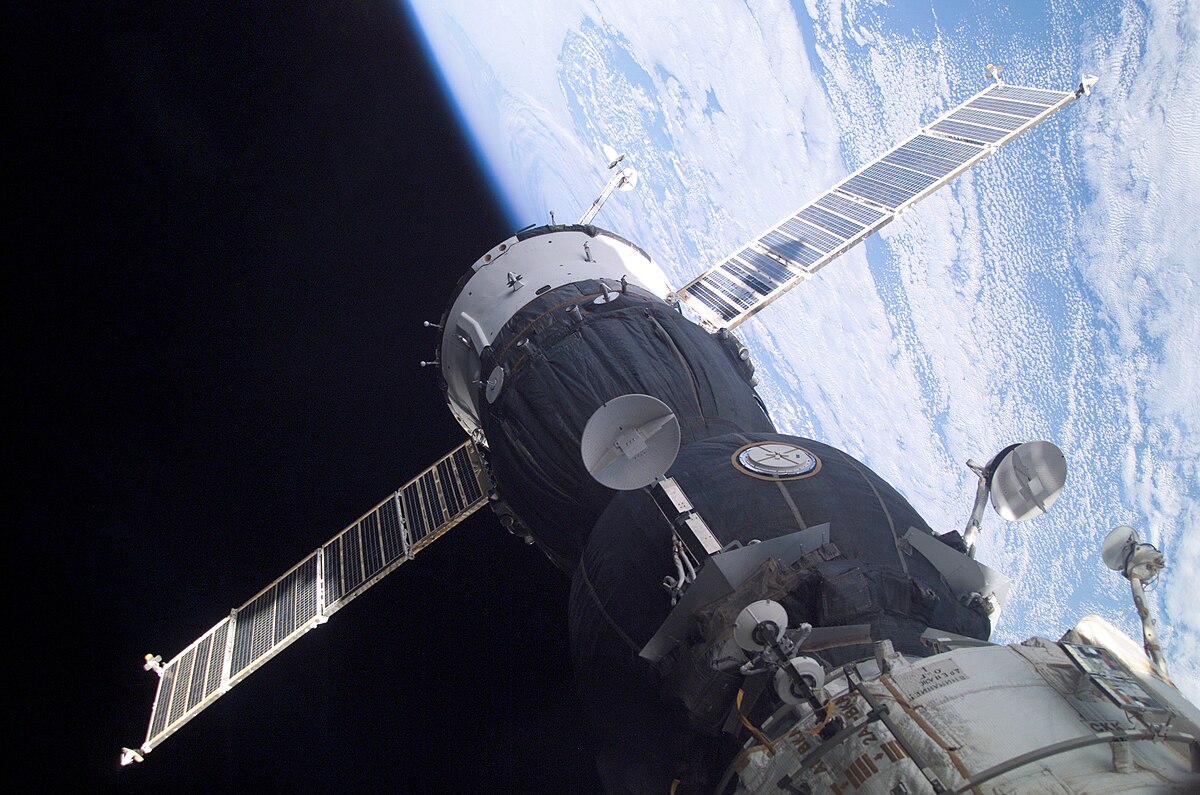
Einstein’s theory isn't just for black holes; it is in your pocket. Because gravity warps time, GPS satellites orbit where time flows faster than on the ground.
An artistic rendering of a GPS satellite in orbit above Earth, with its solar panels extended. NASA, Public domain, via Wikimedia Commons
Without Einstein’s equations to adjust for that difference, your navigation would drift by kilometers every day.
How does spacetime curvature replace gravitational force?
In 1915, Albert Einstein published the Einstein field equations, a system of second-order differential equations that define how matter, radiation, energy, and momentum warp four-dimensional spacetime. Physicist John Archibald Wheeler summarized the mechanism: space-time tells matter how to move, and matter tells space-time how to curve.
Einstein used Riemannian geometry, a form of non-Euclidean geometry introduced to him by mathematician Marcel Grossmann, to build this framework. In this model, planets, light, and falling objects do not feel an attractive force pulling them off course. They travel along the natural geometry of a universe curved by mass.
What astronomical phenomena does general relativity predict?
Karl Schwarzschild calculated the first exact solution to the Einstein field equations in 1916, describing the geometry around a mass and predicting black holes. These are regions where spacetime is distorted so heavily that nothing, including light, can escape.
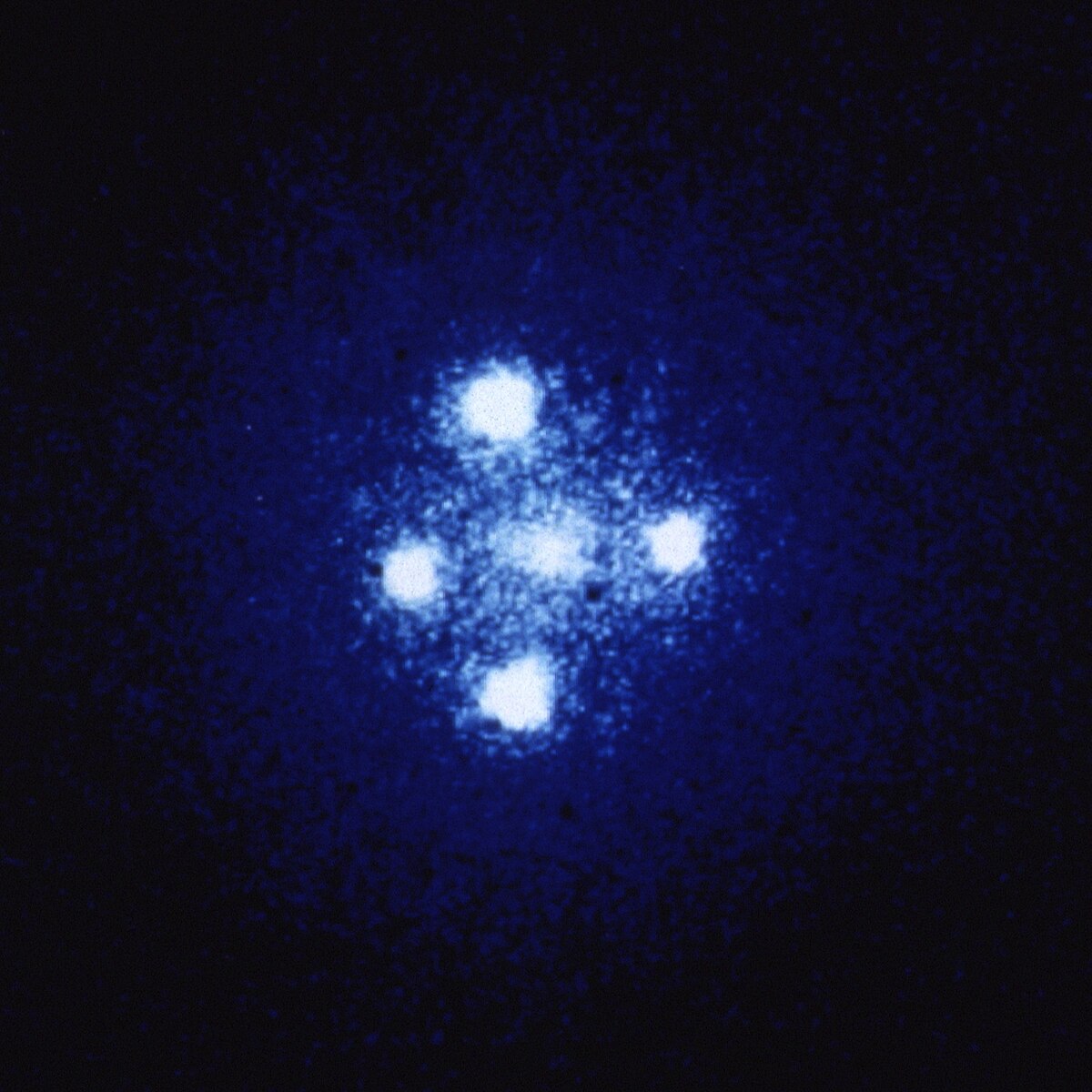
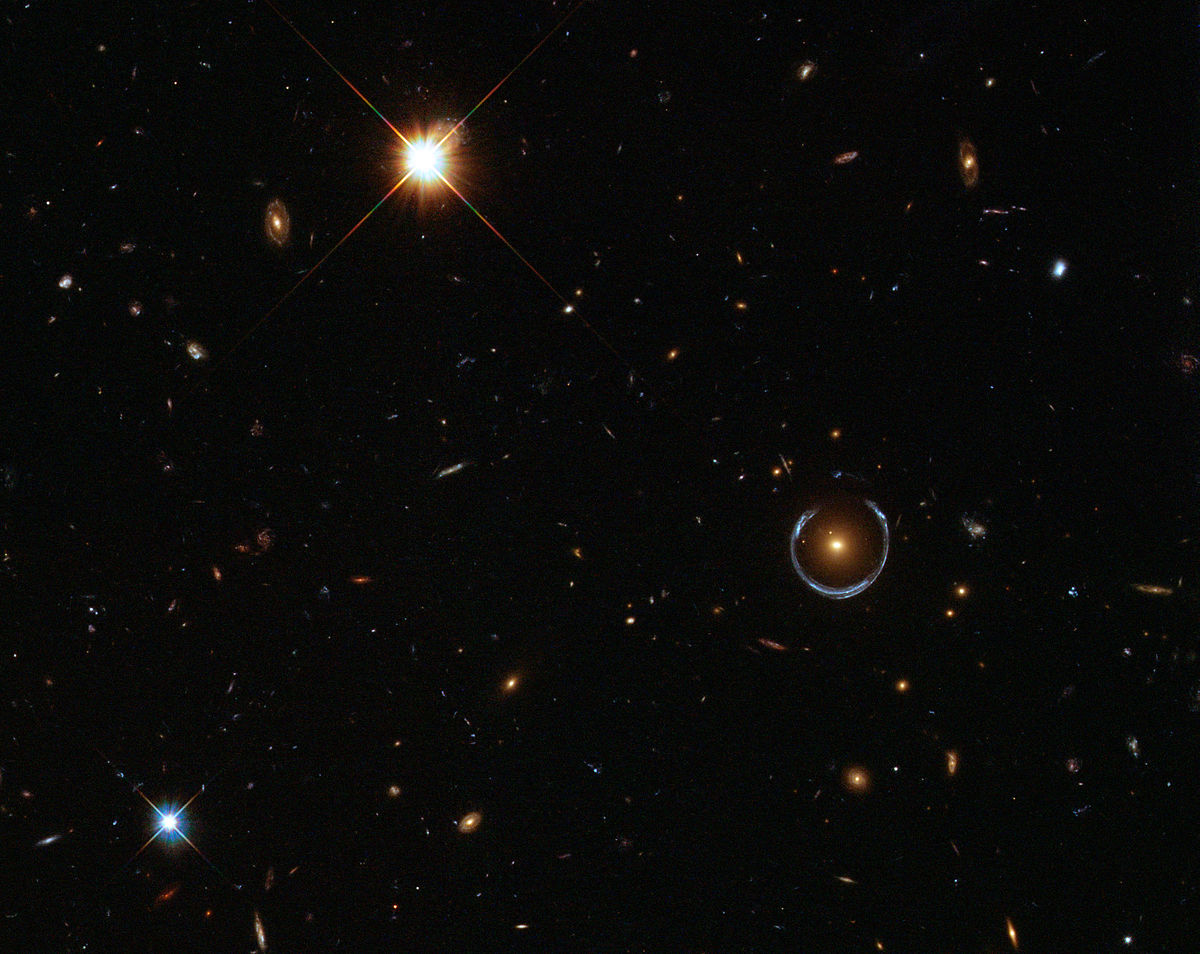
An Einstein cross appears when gravitational lensing splits the light of a single distant astronomical object into four distinct images. NASA, ESA, and STScI, Public domain, via Wikimedia Commons
The theory also predicts gravitational lensing, where the curved space around massive objects bends passing light into distorted or multiple images. Observations have confirmed this effect alongside gravitational redshift, the Shapiro time delay, and gravitational waves detected by observatories like LIGO.
How did general relativity shape modern cosmology?
When Einstein applied his equations to the universe in 1917, he added a cosmological constant to keep the model static. In 1922, Alexander Friedmann found expanding solutions that required no constant, which Georges Lemaître used to formulate the earliest Big Bang models.
Edwin Hubble's 1929 observations confirmed the universe is expanding, prompting Einstein to call the cosmological constant his biggest blunder. Today, time-dependent solutions of general relativity provide the framework for understanding cosmic microwave background radiation and the history of the cosmos.
Test yourself
Einstein's theory was famously confirmed during a solar ___ in 1919 by Arthur Eddington.
Eclipse. Eddington used the darkness of the eclipse to see stars behind the sun and prove their light was being bent.
General Relativity describes gravity as a force that pulls objects together, rather than a geometric property of spacetime.
False. Gravity isn't a pulling force here; it's the curvature of spacetime itself, caused by mass and energy.
The publication of General Relativity by Albert Einstein occurred in 1916.
True. Einstein finalized the theory and presented the field equations to the Prussian Academy of Sciences in late 1915, with publication in 1916.
Play the lesson in edgi and the card is yours. It lands on your Map next to the ideas it connects to, and turns from matte to foil to gold as you learn more around it.
How does general relativity relate to Isaac Newton's gravity?
Newtonian gravity works as an approximation of general relativity in regions where spacetime is almost flat and masses are stationary. General relativity refines Newton's model by accounting for the bending of light, gravitational time dilation, and the orbital shifts of planets like Mercury.
Does general relativity work with quantum physics?
No self-consistent theory of quantum gravity exists yet. Physicists have not found a way to reconcile general relativity with the laws of quantum mechanics or unite gravity with the strong, weak, and electromagnetic interactions.
What are gravitational waves?
Gravitational waves are ripples in spacetime predicted by general relativity that propagate at the speed of light. They are produced by events like collapsing stars and have been directly observed by observatories such as LIGO.