Speed of LightThe universal limit that sets the meter
The speed of light is the universal speed at which electromagnetic waves and massless particles travel through a vacuum, which is empty space. It is fixed at exactly 299,792,458 meters per second, acting as an absolute speed limit for all matter and information in the universe. Because of this finite speed, looking at distant objects across space means observing them as they were in the past.
By the edgi team We find the most surprising true thing about an idea and build a 60-second lesson around it.
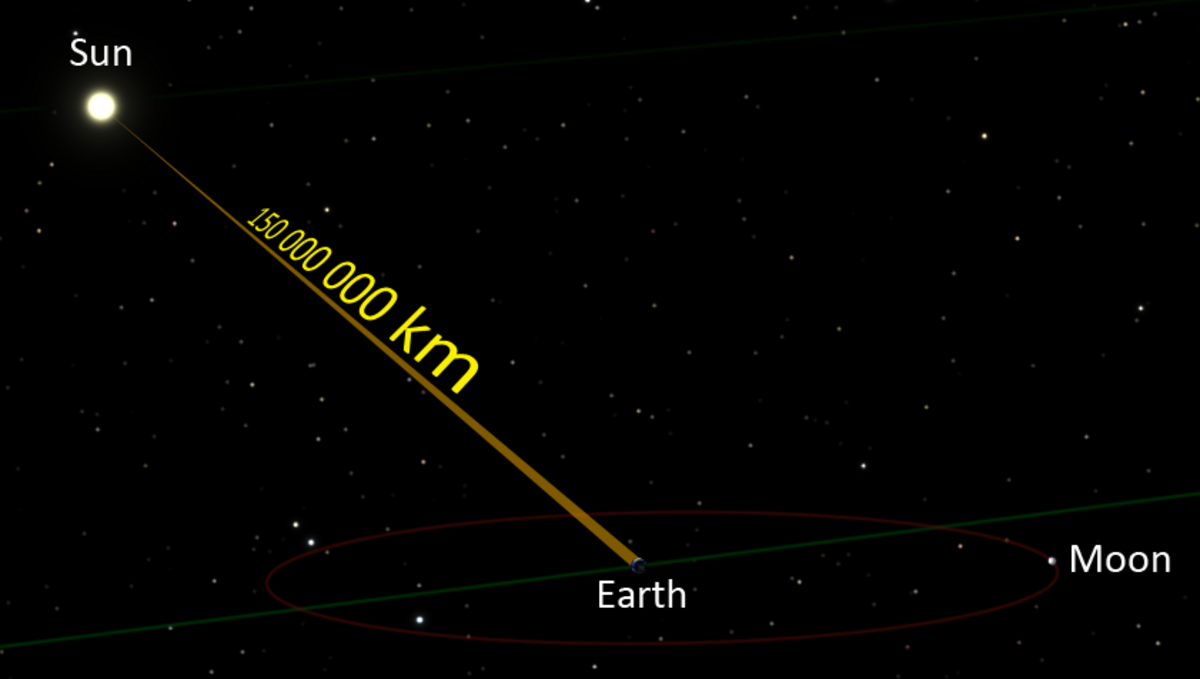
The Sun is 93 million miles away. Light takes about eight minutes to bridge that gap. If the Sun vanished instantly, we wouldn't feel the gravity shift or see the darkness for eight full minutes.
A diagram illustrates the distance between the Sun and Earth in space, showing a yellow line labeled "150 000 000 km" connecting the Sun to the Earth. LucasVB, Public domain, via Wikimedia Commons
We live in a universe where the present is always delayed. You are never seeing the world as it is right now; you are seeing it as it was.
The cosmic limit
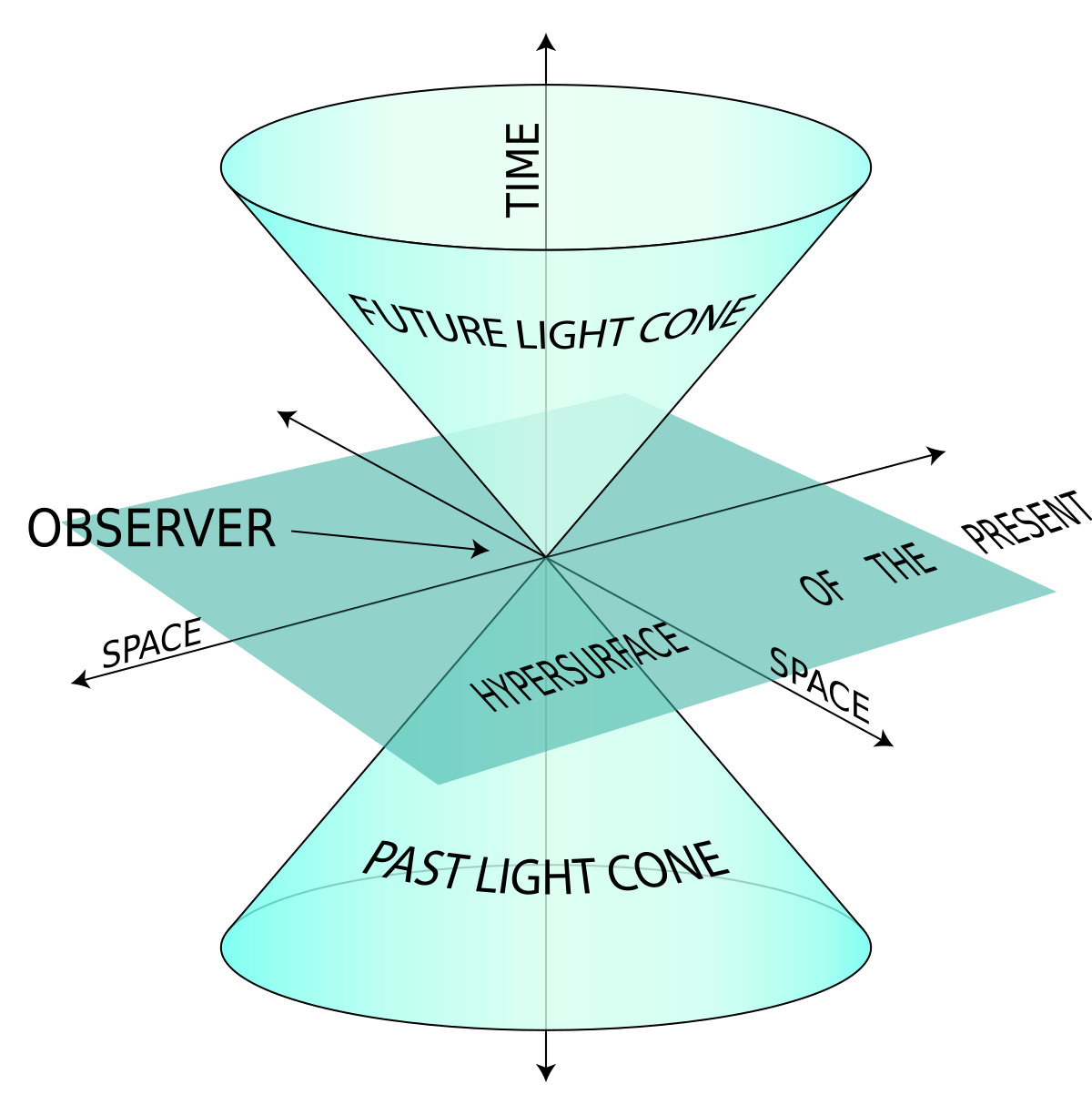
The speed of light is not just a velocity. It is the absolute speed limit for causality. Nothing, no signal, no particle, no radio wave, can influence an event faster than light can travel.
Diagram of a spacetime light cone, illustrating the concepts of future and past light cones relative to an observer. SVG version: K. Aainsqatsi at en.wikipedia Original PNG version: Stib at en.wikipedia, CC BY-SA 3.0, via Wikimedia Commons
This is why space feels so impossibly big. It is not just physical distance; it is a time barrier that prevents the universe from reacting all at once.
The first measurement
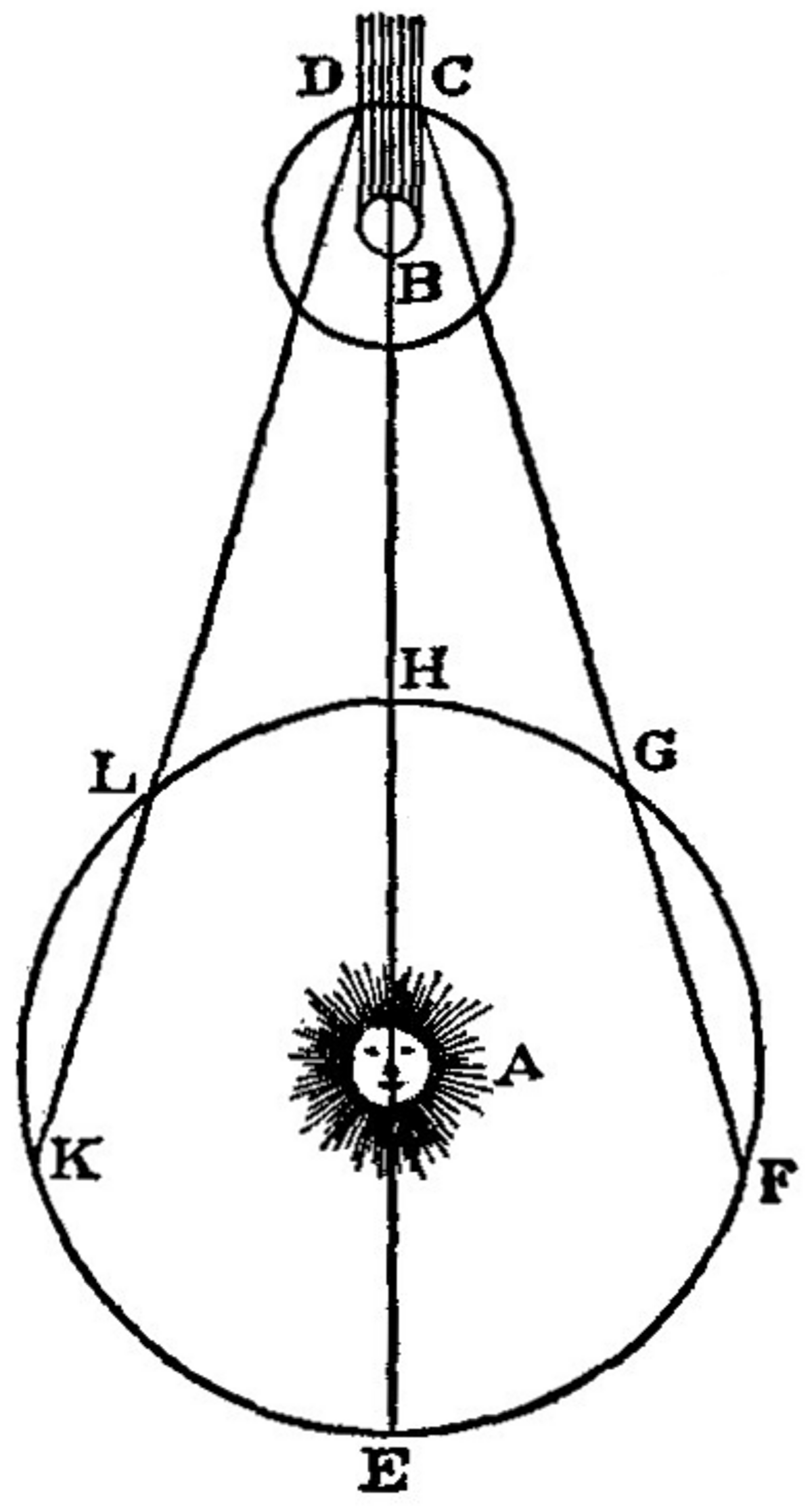
For centuries, people assumed light traveled instantaneously. In 1676, astronomer Ole Rømer proved it wasn't by watching the moons of Jupiter.
A 1676 illustration depicts Ole Rømer's method for measuring the speed of light using observations of Jupiter's moon Io. Ole Rømer, Public domain, via Wikimedia Commons
He noticed the moons were 'late' to their eclipses when Earth was further away in its orbit. He realized the delay was the time it took light to cross the extra distance, finally proving that light has a measurable speed.
Why is the speed of light exact?
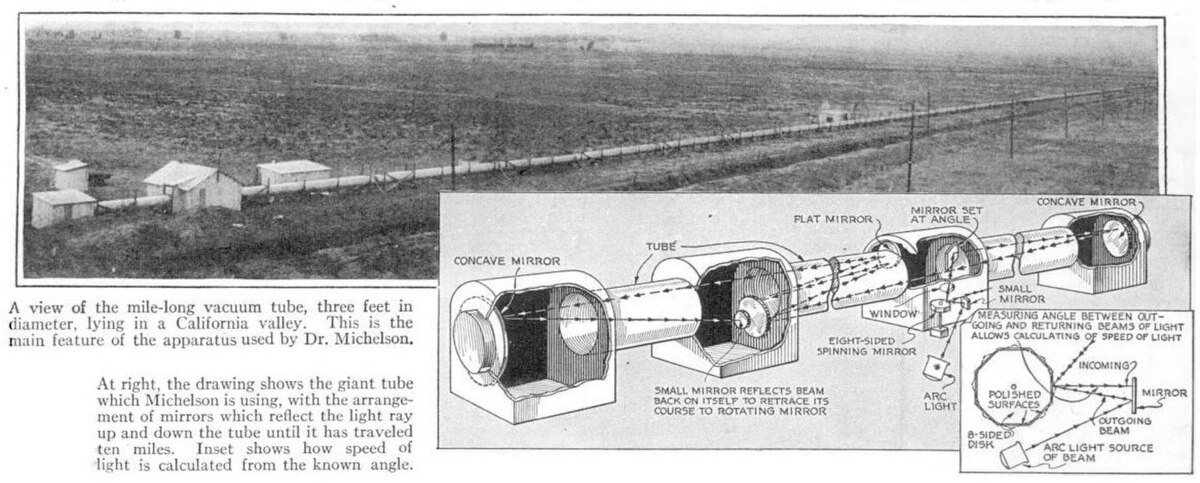
In the International System of Units, the speed of light in a vacuum is not a measured estimate: it is defined as exactly 299,792,458 meters per second. Scientists inverted the standard measurement relationship in 1983. Instead of defining the meter independently and measuring how fast light crosses it, the meter is defined as the distance light travels through empty space in 1/299,792,458 of a second.
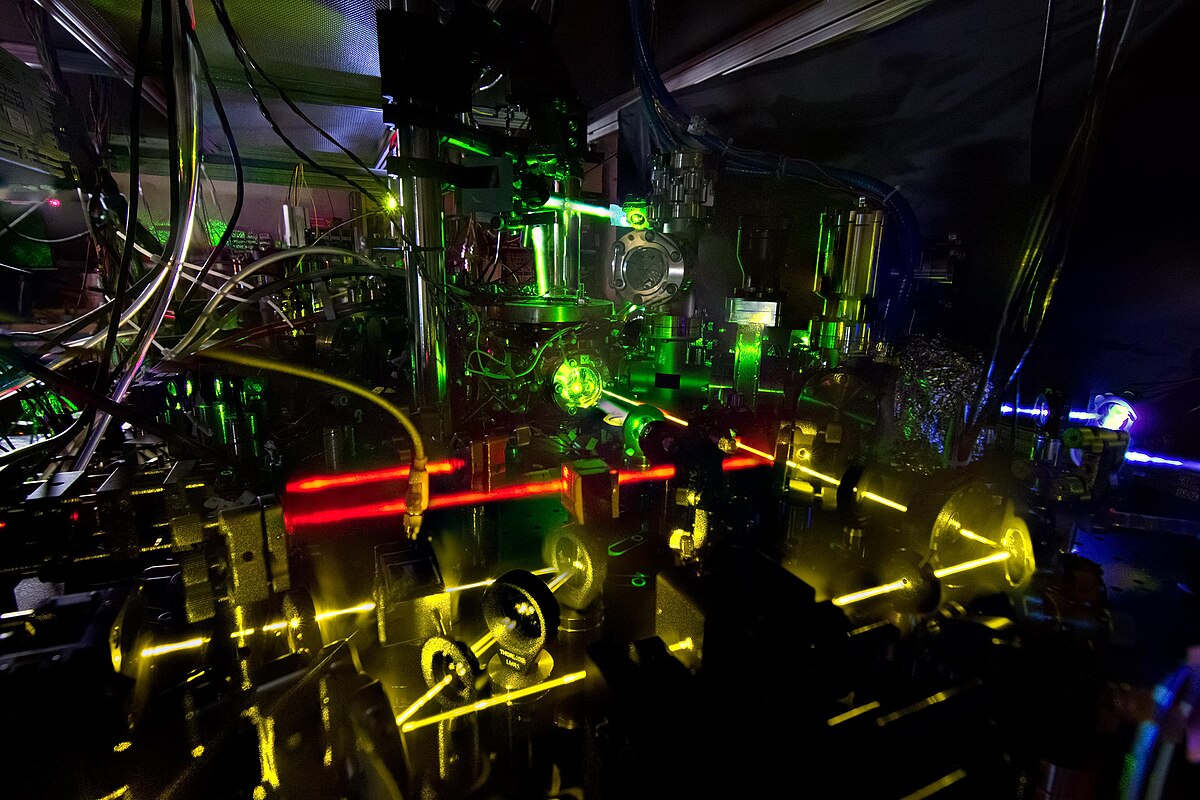
The second itself is determined by measuring 9,192,631,770 cycles of radiation emitted by a caesium-133 atom. Combining this precise measurement of time with the fixed numerical value of the speed of light yields the exact standard length for a meter.
How does light move through materials?
Light travels at its maximum speed only through a vacuum. When electromagnetic radiation enters a transparent material like glass, water, or air, it slows down.
The ratio between light speed in a vacuum and its speed inside a medium is called the refractive index. Air has an index of about 1.0003, slowing light by roughly 90 kilometers per second (56 miles per second). Glass has an index around 1.5, which reduces the speed of light to roughly 200,000 kilometers per second (124,000 miles per second).
What are the practical consequences of light speed?
The speed of light is approximately one foot per nanosecond (around 186,282 miles per second). In computing, this finite rate sets an absolute physical floor for signal latency. Computer scientist Grace Murray Hopper gave out foot-long pieces of wire in the late 1960s to show why components had to be smaller to make computers faster.
A beam of light takes 1.255 seconds to travel across the mean orbital distance between the Earth and the Moon. Dr. James O'Donoghue, under YouTube alias "Interplanetary", CC BY 3.0, via Wikimedia Commons
Over astronomical distances, this delay becomes immense. Communicating with distant space probes takes hours because radio signals travel at light speed. Across the solar system, it dictates how long information takes to cross space: light takes about 1.255 seconds to travel between the Earth and the Moon, and about eight minutes to arrive from the Sun.
Test yourself
How does light speed limit cause and effect?
Influences cannot travel faster than light. A cause can affect a distant event only after a signal reaches it; no signal can outrun light in a vacuum.
A star 100 light-years away suddenly changes. What can Earth observe now?
The star as it was 100 years ago. Light takes 100 years to cross 100 light-years, so Earth cannot observe the change until that signal arrives.
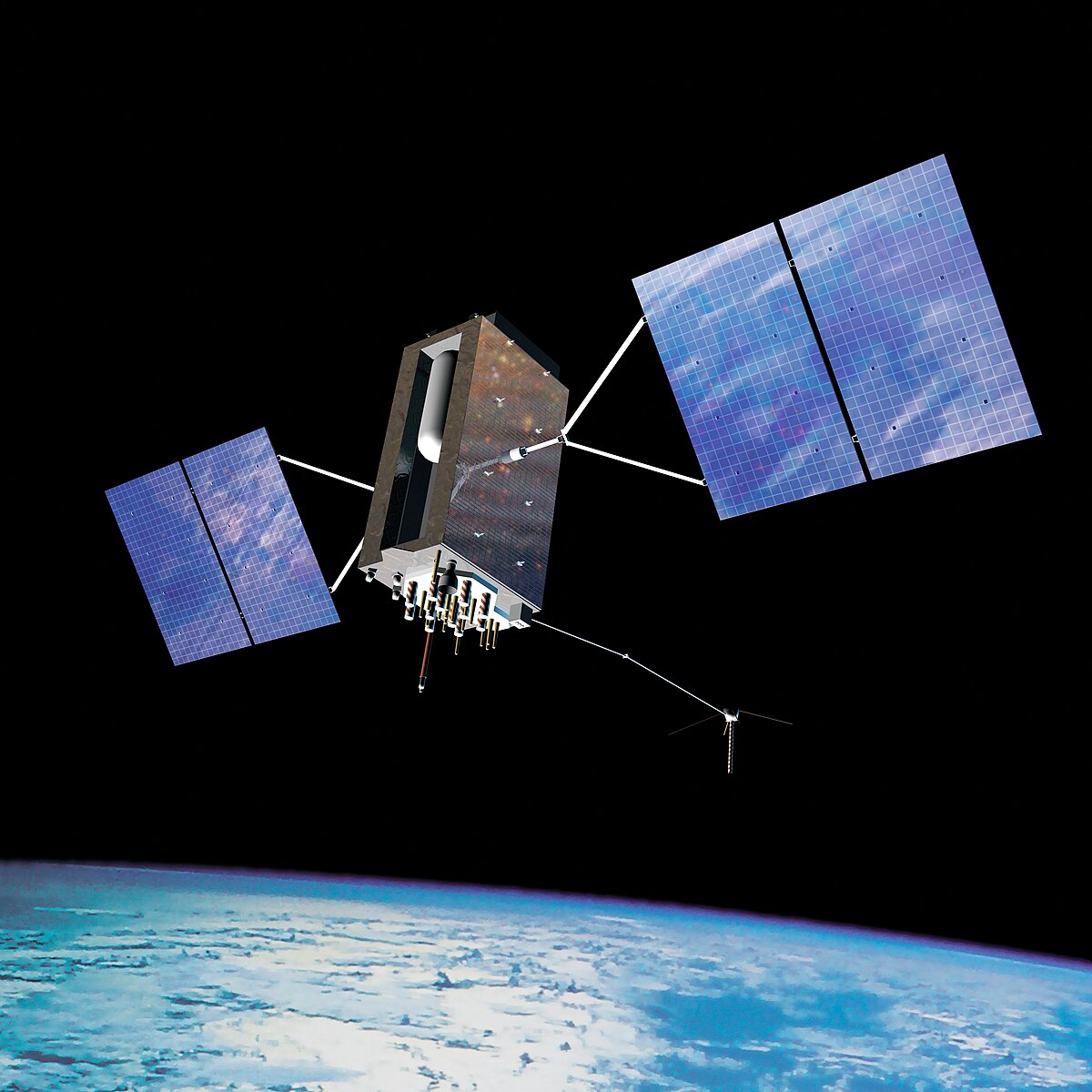
Why does a GPS receiver need a fourth satellite?
To solve for its own clock error. Three distances would fix position if the phone's clock were perfect. A fourth lets it solve for the clock error as well, so all the spheres meet at one point.
Play the lesson in edgi and the card is yours. It lands on your Map next to the ideas it connects to, and turns from matte to foil to gold as you learn more around it.
Why is the speed of light denoted by the letter c?
The symbol c likely originates from the Latin word celeritas, which means swiftness or celerity. Early physicists used various symbols, including V, before Max Abraham and Albert Einstein standardized c in the early twentieth century.
Can objects with mass reach the speed of light?
No object with nonzero rest mass can ever reach the speed of light. Such particles can be accelerated closer and closer to that velocity, but light speed in a vacuum is attainable only by massless particles and field perturbations like gravitational waves.
How does the speed of light relate to Einstein's mass-energy formula?
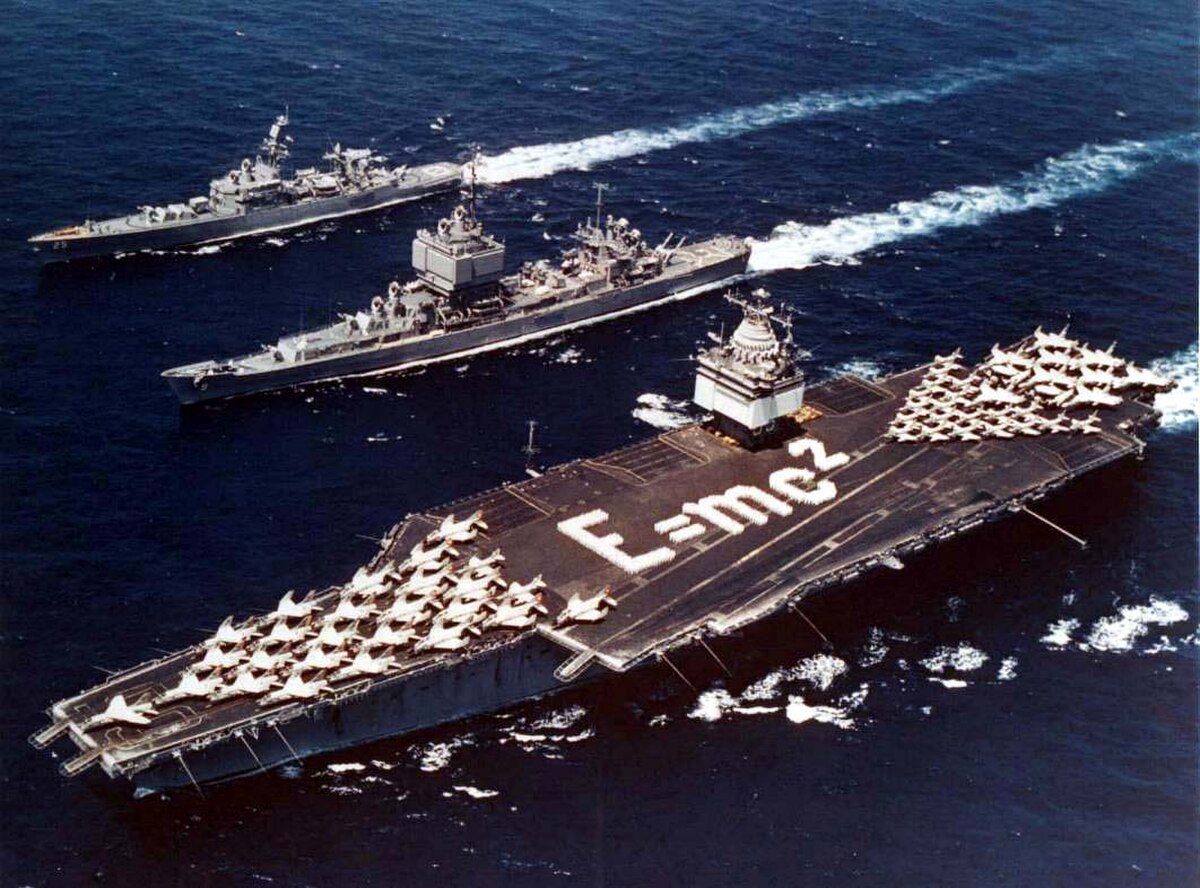
The speed of light c serves as the conversion factor connecting mass and energy in the formula E = mc2. Albert Einstein showed through relativity that this constant governs the structure of space and time, extending its significance far beyond light itself.