Attachment in adults is a psychological framework explaining how people approach trust, intimacy, and emotional bonds in their adult relationships based on early childhood care. Romantic partners often function like early caregivers, providing a secure base that helps people handle everyday challenges. Research shows these relationship styles remain consistent for decades, though major life events can alter them.
By the edgi team We find the most surprising true thing about an idea and build a 60-second lesson around it.
Attachment research had focused on babies for thirty years. In 1987 Cindy Hazan and Phillip Shaver asked whether the same system might still matter in adults. They used a quiz in the Rocky Mountain News. Readers chose the paragraph that matched how they felt in relationships, then described their most important love affair.
The three paragraphs described infant attachment styles, secure, avoidant, and anxious, in adult terms. Most readers chose the secure paragraph. Avoidant came next and anxious was smallest, the same order and roughly the same proportions reported for American babies.
The system, still running
The proportions mattered. So did what the three groups said about their own relationships. Readers with secure attachment called their biggest relationship friendly and trusting, and theirs had lasted longest. Avoidant readers reported fear of closeness; anxious readers reported jealousy and sharp swings.
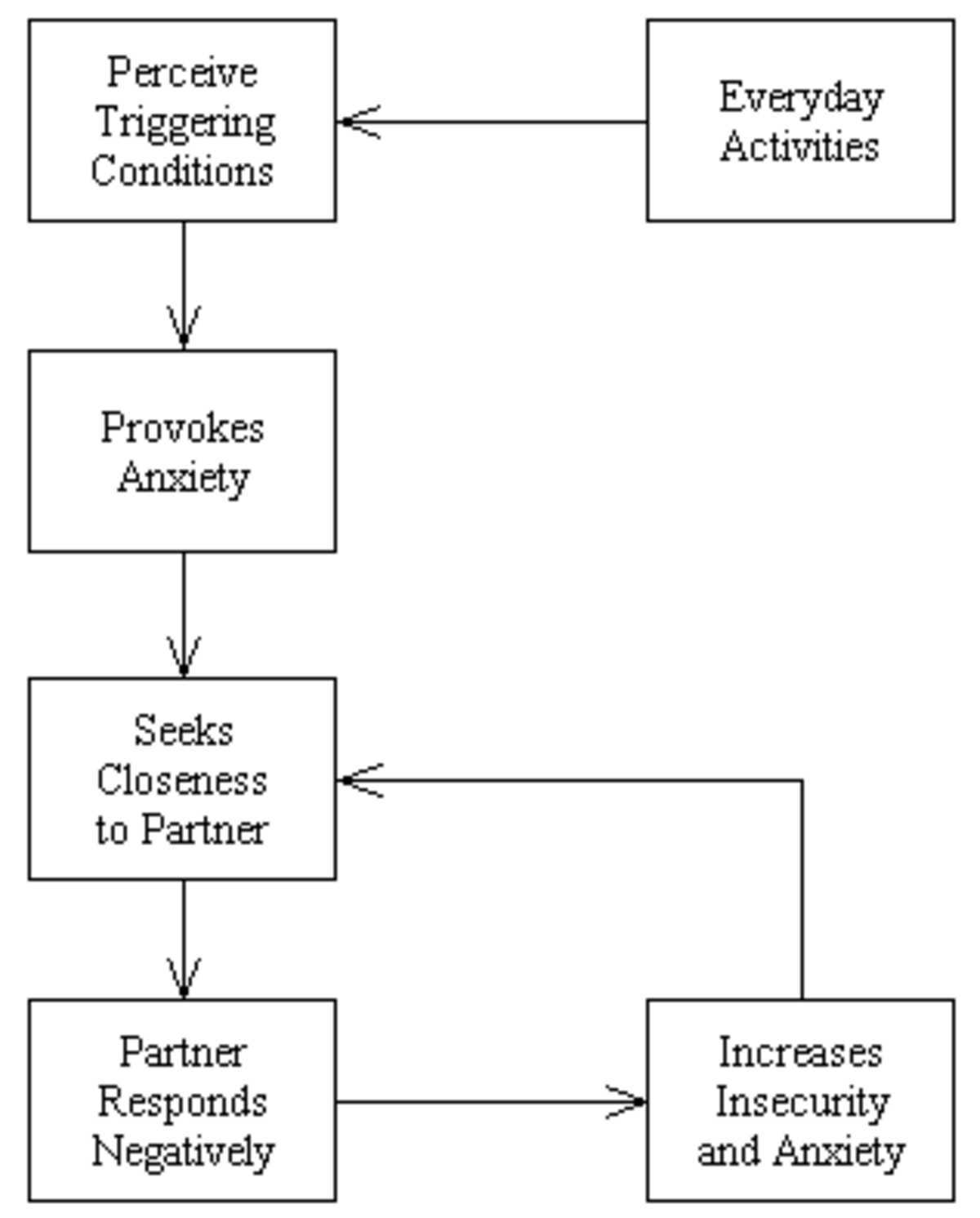
Flowchart illustrating the hyperactivation strategy of affect regulation within adult attachment theory. Kc62301 at English Wikipedia, Public domain, via Wikimedia Commons
Hazan and Shaver proposed that an adult partner can serve as an attachment figure, with some of the protective functions a parent once served.
Whether it moves
Everett Waters classified fifty babies as secure or insecure at twelve months, then interviewed them again at twenty. Seventy-two percent were on the same side two decades later. Waters used a different measure for adults, the Adult Attachment Interview, which classified people secure or insecure rather than sorting three quiz styles.
The pattern was not fixed. Forty-four percent of people who reported a negative life event changed classification, compared with 22 percent of people who did not. The Adult Attachment Interview does not score whether childhood was good. It scores how coherently someone can tell its story.
A difficult childhood alone does not determine the score. The interview asks for concrete memories and scores whether the account remains coherent.
How childhood patterns persist in adult relationships
Modern attachment theory originated with John Bowlby and Mary Ainsworth, who studied how infants responded to their caregivers. In the 1980s, Sue Johnson brought attachment into therapy settings, while Cindy Hazan and Phillip Shaver showed that adult romance mirrors childhood attachment. Adults feel comforted when an attachment figure is near, but experience heightened anxiety or loneliness when they are absent.
A study by Everett Waters tracked infants from twelve months old to age twenty. Seventy-two percent retained their original secure or insecure classification two decades later. Changes still occurred: forty-four percent of people who experienced negative life events shifted classifications, compared to only twenty-two percent of those without negative events.
The four adult attachment styles
Psychologists Bartholomew, Horowitz, Pietromonaco, and Barrett organized adult attachment into four main categories based on self-perception and views of others: secure, anxious-preoccupied, dismissive-avoidant, and fearful-avoidant.
Secure adults maintain high self-esteem and positive views of others, forming long-lasting relationships without fear of abandonment. Anxious-preoccupied adults view themselves negatively and others with uncertainty; they crave intimacy, seek constant validation, and worry about rejection. Dismissive-avoidant adults hold a positive view of themselves but distrust others, suppressing emotions and choosing strict independence over closeness.
Test yourself
Two adults had hard childhoods. Who is more likely to score secure?
The one who tells a coherent account. The interview scores the account, not whether childhood was easy. A difficult history can still be classified secure when it is told as a coherent account with concrete memories.
A person's long-stable attachment style shifts after a painful breakup or loss. What usually happens to that disruption over time?
It can persist without being fixed. A durable pattern can still change. In the 20-year study, people reporting a negative life event changed classification more often than people who did not.
Play the lesson in edgi and the card is yours. It lands on your Map next to the ideas it connects to, and turns from matte to foil to gold as you learn more around it.
How does the Adult Attachment Interview measure attachment?
The Adult Attachment Interview classifies adults as secure or insecure based on how coherently they discuss concrete childhood memories. It does not score whether a person had a pleasant childhood, but rather how consistently and clearly they tell their story.
Can adult attachment styles change over time?
Yes, attachment styles are not entirely fixed throughout life. Research shows that experiencing significant negative life events causes people to change attachment classifications at twice the rate of those without such events.