Imprinting: why ducklings will court humans for life
Imprinting is a rapid learning process that happens during a specific window of early development, permanently shaping an animal's behavior. Birds and other animals use it to instantly learn the features of their parents or a suitable mate. Because this early template cannot be overwritten, a hatchling that imprints on a human will direct its adult mating behaviors toward people years later.
By the edgi team We find the most surprising true thing about an idea and build a 60-second lesson around it.
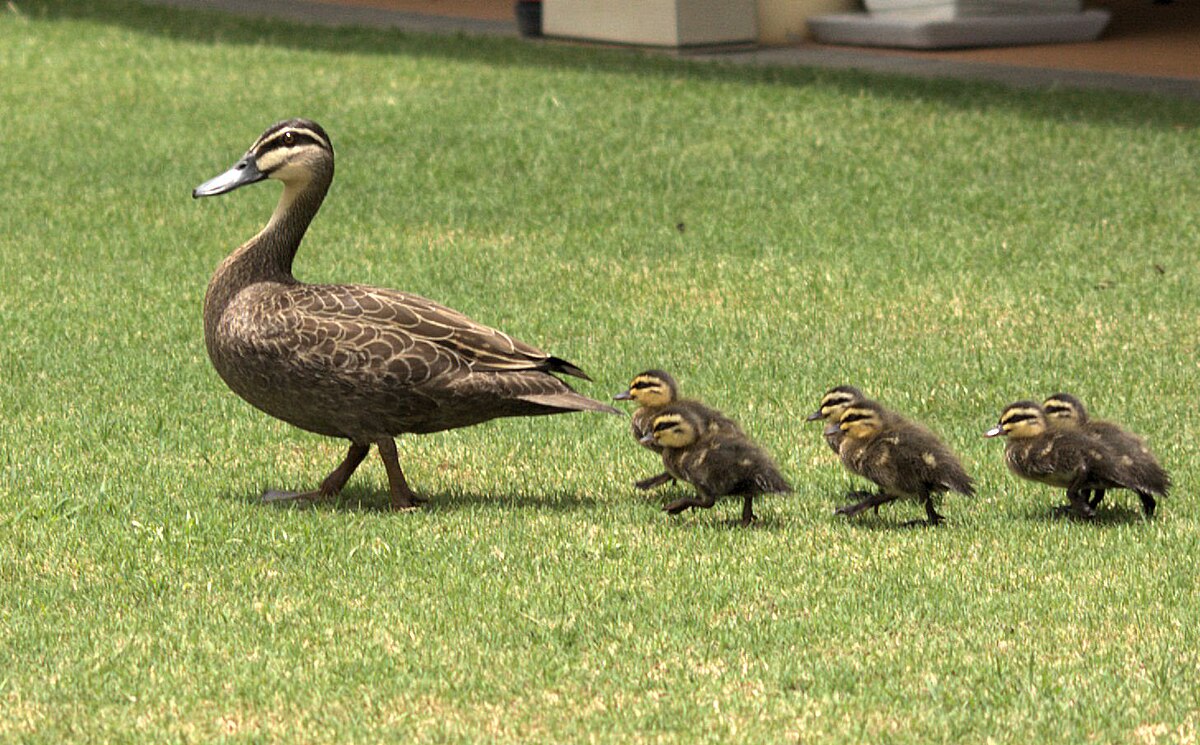
You have seen the photograph: a line of ducklings marching behind a pair of boots. They are not confused. They are doing exactly what the rule tells them. A gosling hatches able to walk and the flock moves within a day. It has hours to identify its mother, so the rule is crude: follow the first big thing that moves. In a nest that is always her.
A mother duck leads a line of four ducklings across a grassy lawn. Paula M Wolter, CC BY-SA 3.0, via Wikimedia Commons
Konrad Lorenz proved it in 1935. He split a clutch of greylag goose eggs, hatching half under the goose and half in an incubator with himself standing over them. He marked them, mixed both groups under an upturned box, and lifted it. The goslings split cleanly, half to the goose and half to Lorenz. That is imprinting.
The picture and the window
Ramsay and Hess measured when imprinting is strongest. They raised mallard ducklings in isolation, showed each one its first moving object at a different age, and scored how hard it followed. The answer was hours. A duckling shown its first moving object at thirteen to sixteen hours old follows it hardest. Wait a day and it barely follows at all.
What gets stamped in that window is more than who to follow. The bird keeps a picture of what its own kind looks like, and it uses that picture years later to pick a mate. The goslings that imprinted on Lorenz lived out their lives among real geese, and at breeding age they courted the humans anyway. A whole life among geese was laid over the picture. It did not erase it.
Why you did not imprint
A human baby is carried for a year and walks nowhere. There is no day-one deadline to identify anybody, so nothing selects for a fast lock. Attachment builds over months instead, and it stays open. Children adopted years after infancy still form real attachments to the new parents. A bird past its window cannot form a new one at all.
A gosling gets hours and one shot at its template. You got years to build yours, and those same years are why it can still be edited.
How filial imprinting works
In birds that leave the nest immediately after hatching, filial imprinting limits social preferences to the first moving object they encounter. Konrad Lorenz demonstrated that goslings hatched in an incubator would treat him, or even a box riding on a model train, as their mother if seen during a critical window between 13 and 16 hours after hatching.
This learning mechanism occurs primarily in the limbic structures of the brain, which store long-term memories shaped by early experiences. While birds require this fast lock because they move immediately, human attachment builds over months and remains flexible, allowing adopted children to form bonds long after infancy.
How sexual imprinting directs adult mating
Imprinting does more than guide young animals to follow a guardian: sexual imprinting determines the physical traits an animal desires in a mate later in life. Male zebra finches, for instance, prefer mates that match the appearance of the female bird that reared them.
When hand-reared by humans, animals direct these adult mating instincts toward people rather than their own species. Chi Chi, a female giant panda at the London Zoo, refused to mate with a male panda named An An at the Moscow Zoo, instead displaying full sexual self-presentation to a human zookeeper. Falconers use this trait in captive breeding by letting male imprint raptors copulate with specialized hats to collect semen for breeding.
Using imprinting for flight and conservation
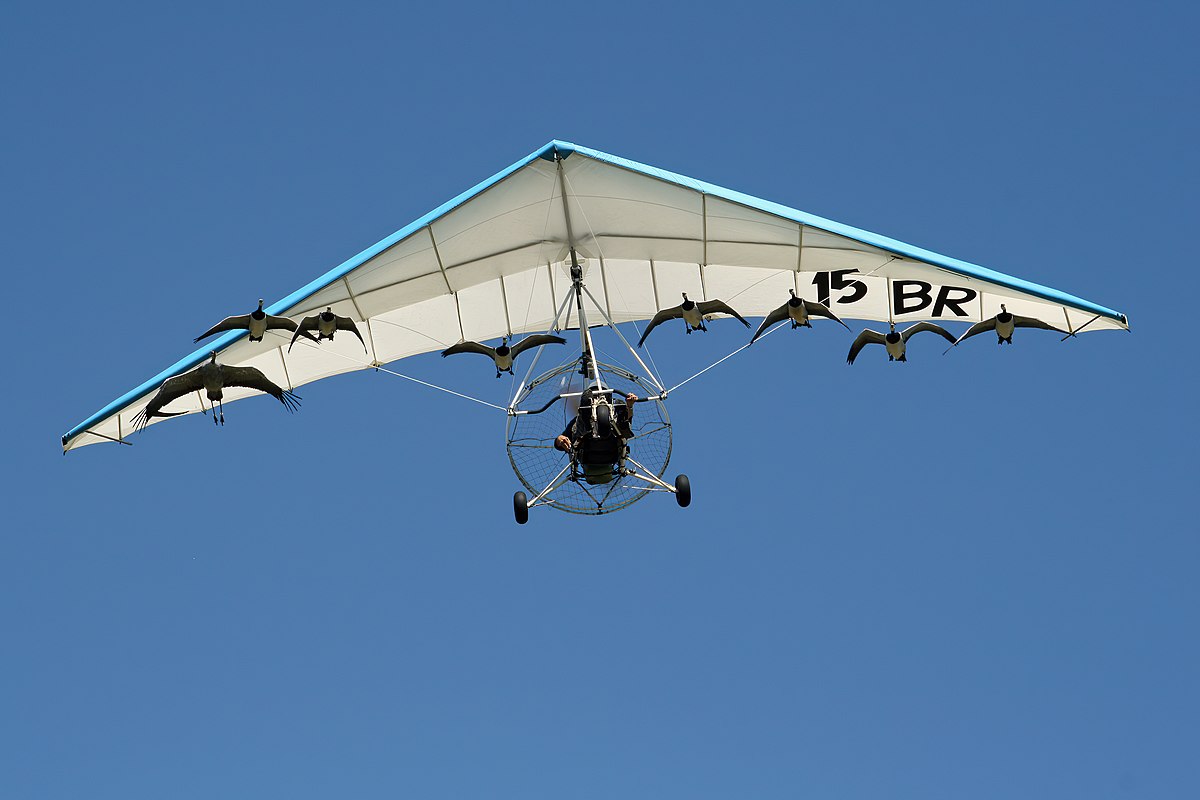
Biologists and pilots use filial imprinting to teach captive-born birds how to survive in the wild. Because captive chicks lack parents to show them migration paths, handlers wear distinct clothing and use horns to imprint the birds on ultralight aircraft and hang-gliders.
Imprinted birds follow an ultralight aircraft across long distances because they treat the craft and its handler as their flock leader. Superbass, CC BY-SA 4.0, via Wikimedia Commons
Hang-glider pilot Angelo d'Arrigo hatched chicks under his glider's wing and used thermal updrafts to lead eagles across the Sahara, over the Mediterranean to Sicily, and over Mount Everest. Similar ultralight methods were used to guide orphaned Canada geese along their migration routes and to film migratory birds for the documentary Winged Migration.
Test yourself
What distinguishes rapid species imprinting from slower, prolonged social attachment processes?
A strict deadline and permanent template. Imprinting relies on a narrow time-limited window that permanently locks in a target, whereas slower attachment allows for ongoing revision over years.
Does a critical window limit when an animal template can be permanently stamped?
Yes. Imprinting occurs during a strict developmental window, after which the behavioral template becomes largely fixed and resistant to later revision.
A hawk hand-reared by people often cannot be released to the wild. Why?
It stored humans as the picture of its own species. Hunting can be trained and wariness can partly return. What does not come back is the species template, laid down early and used years later to pick a mate. A bird that filed humans as its own kind will court people and ignore its own species for life.
Play the lesson in edgi and the card is yours. It lands on your Map next to the ideas it connects to, and turns from matte to foil to gold as you learn more around it.
Yes. American coot mothers imprint on visual and vocal cues from the very first chick that hatches in their nest. This allows the mother to identify her own offspring and reject parasitic chicks laid by other birds.
Can animals imprint on places as well as living things?
Yes. Peregrine falcons imprint on specific nesting structures during their early development. As adults, they show a strong preference for breeding on the same types of locations where they grew up, such as cliff sides and bridges.
How has imprinting been used to study animal intelligence?
Researchers used imprinting to show that young domestic chicks have basic counting abilities. After imprinting chicks on plastic balls, researchers hid groups of balls behind screens and discovered the chicks consistently chose to approach the screen hiding the larger number of balls.