The strange situation is a standard laboratory procedure used to observe the attachment relationship between a caregiver and a child between 9 and 30 months old. It places the child through a sequence of brief separations, stranger introductions, and reunions to observe how the child manages stress. The test showed that the child's reaction upon the parent's return, rather than how hard the child cries when left alone, reveals the pattern of their relationship.
By the edgi team We find the most surprising true thing about an idea and build a 60-second lesson around it.
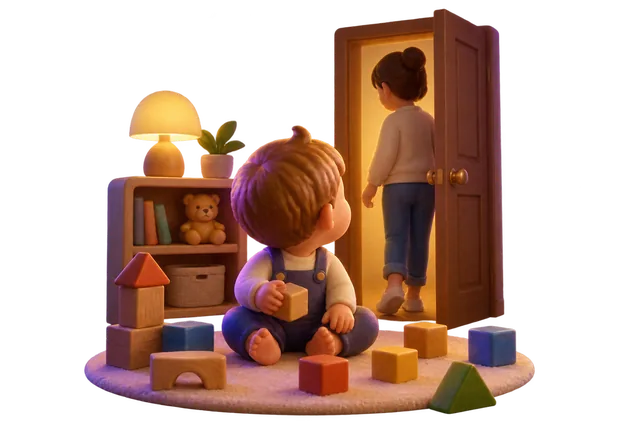
Mary Ainsworth had years of notes on mothers and babies in their own living rooms in Baltimore. But every home is different, so no two babies could ever be compared. So she built a room where every baby gets the same twenty minutes. The strange situation puts a one-year-old among unfamiliar toys, and it gets harder as it goes.
A stranger comes in. Twice the mother walks out, and twice she comes back. The second time she goes, the stranger is gone too, and the baby is alone in the room. Upsetting the baby is the point, not a side effect. A settled one-year-old just plays, and a baby that is playing has no reason to reach for anybody.
The tell is the return
The obvious thing to score is how hard the baby cries when the mother leaves. Nearly every baby that age cries, so the crying separates nobody. What separates them is the thirty seconds after she comes back. One baby goes straight to her, gets picked up, calms, and is back in the toys within a minute. Another arches away in her arms, angry and unsettleable. A third glances up and keeps playing.
Everyone gets upset. The information is in what the baby does about being upset, and whether it goes to the mother.
Secure with one parent, avoidant with the other
Those reunions became the attachment styles: secure, anxious and avoidant. Ainsworth published the procedure at the end of the 1960s and it is still the standard test. A fourth turned up later. Some babies start toward the mother and stop dead, or reach for her with their face turned away. That pattern is called disorganized, and it is the one with no strategy in it.
Run the same baby a month later with the father and the classification often comes out different. Secure with one parent, avoidant with the other, in the same house. So what the test scores is a relationship, not a child.
How the procedure works
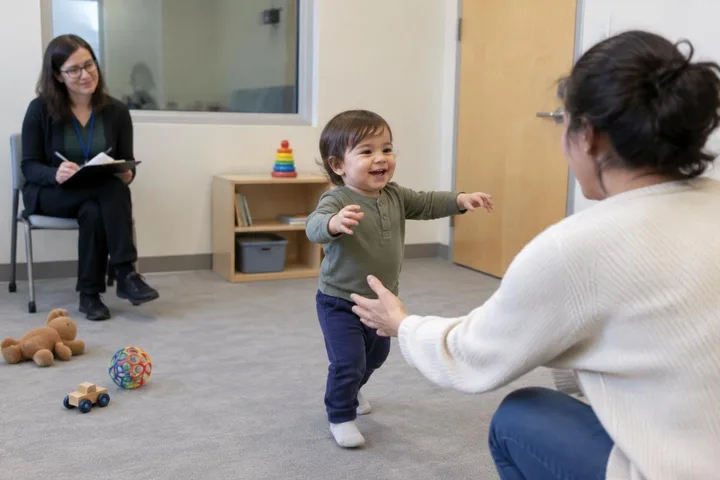
The entire observation takes about 21 minutes in an unfamiliar playroom with toys. A parent and baby enter, and a stranger later joins them. The parent leaves the room twice: once leaving the baby with the stranger, and once leaving the baby entirely alone before the stranger returns.
Observers track four specific behaviors: how much the child explores the toys, the reaction when the parent leaves, anxiety around the stranger, and how the baby responds during the reunions. The test intentionally creates mild stress to activate attachment behavior, because a settled baby playing quietly has no immediate need to seek comfort.
The four attachment patterns
Ainsworth originally identified three main responses. Securely attached infants (Group B) use the caregiver as a base to explore, show happiness when the caregiver returns, calm quickly, and resume playing. This is the most common pattern across societies.
Insecure infants handle reunions differently. Anxious-avoidant infants (Group A) show little visible emotion when the parent leaves and actively ignore or turn away upon reunion, though heart-rate studies later showed this calm demeanor masks physical distress. Anxious-ambivalent infants become angry or difficult to soothe. Later, Mary Main, Erik Hesse, and Judith Solomon identified a fourth pattern, disorganized attachment, where infants display contradictory or confused actions, such as freezing or approaching while turning their faces away.
Test yourself
What does the strange situation procedure primarily measure?
The quality of a specific relationship. Because a baby can show secure attachment to one parent and avoidant to another, the procedure measures the dynamic of a specific relationship rather than a fixed trait of the child.
Why does the strange situation procedure intentionally cause distress to the infant?
To reveal how the child seeks comfort. Nearly all babies cry when left alone, so the distress itself is not the metric. The diagnostic value lies entirely in observing how the infant reacts and seeks comfort upon reunion.
Which age does the test sort better, a one-year-old or a four-year-old?
The one-year-old, who cannot wait it out. The procedure needs a separation the child cannot manage alone. By four a child understands that a parent will be back shortly and simply waits, so the reunion stops carrying information. The test is aimed at the age where being left is genuinely unmanageable.
Play the lesson in edgi and the card is yours. It lands on your Map next to the ideas it connects to, and turns from matte to foil to gold as you learn more around it.
Does the strange situation measure a child's personality?
No. The procedure evaluates the specific relationship between a caregiver and child, not an inherent trait of the baby. The same infant can receive different classifications when tested separately with the mother and the father.
What age group is the strange situation designed for?
The procedure is designed for infants and toddlers between 9 and 30 months of age. At this stage of development, children actively use caregivers as a secure base while exploring new surroundings.