Harry Harlow was an American psychologist who studied maternal separation, dependency, and social isolation in rhesus monkeys. He proved that infant attachment stems from physical warmth and touch, known as contact comfort, rather than merely associating a caregiver with food. His work overturned the belief that affection was just a by-product of feeding and influenced modern theories of child development.
By the edgi team We find the most surprising true thing about an idea and build a 60-second lesson around it.
In 1950s psychology, love had a simple explanation. A baby needs food, one person brings it, and the baby learns to want that person. Affection was a by-product of feeding. Harry Harlow thought the explanation was wrong, and built a way to pull the two apart. He raised infant rhesus monkeys with two fake mothers.
A rhesus macaque mother walks on a paved surface next to a body of water, with her baby clinging to her back. Shadow Ayush, CC BY-SA 4.0, via Wikimedia Commons
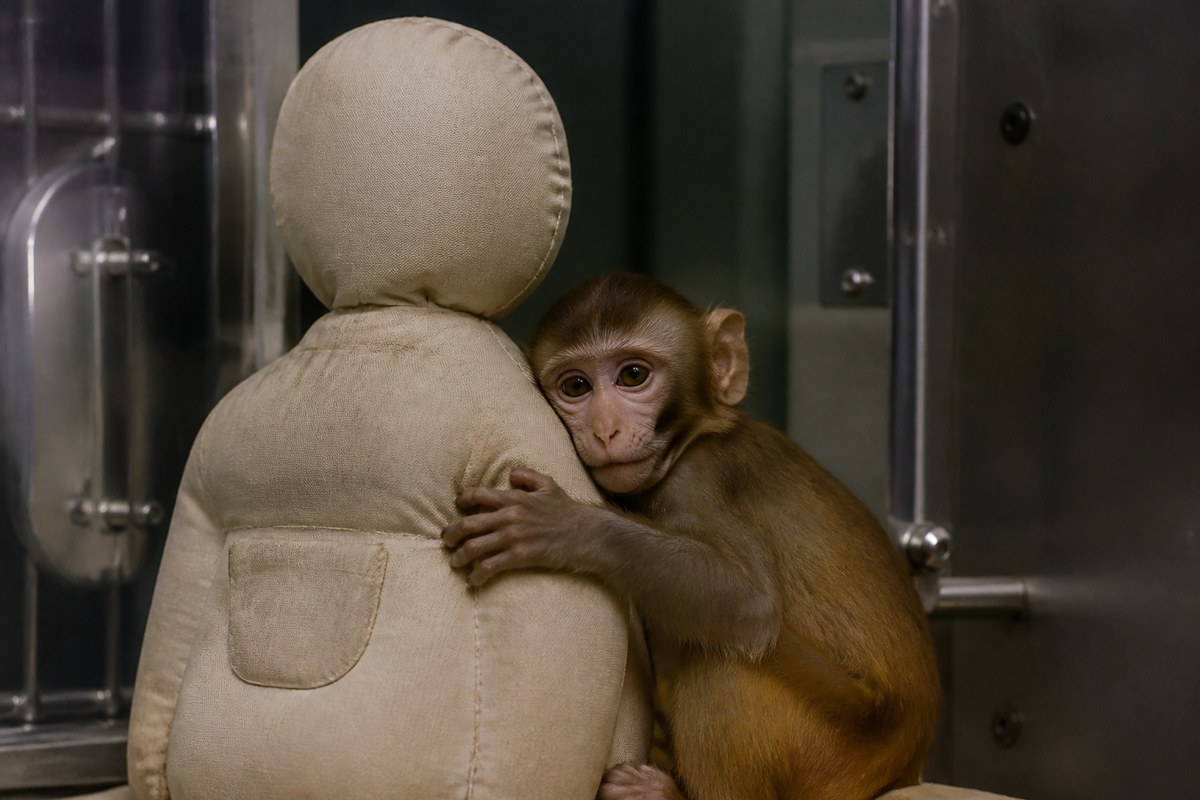
One was bare wire with a bottle of milk fixed in it. The other was a block of wood padded with sponge rubber and covered in terry cloth, with no food. A light bulb warmed both, so the difference was texture. The monkeys fed at the wire mother and lived on the cloth one. Seventeen or eighteen hours a day clinging to the cloth, and under an hour a day at the milk.
The drumming bear
Then Harlow raised the stakes. He put a wind-up teddy bear that banged a drum into the cage, and the infants screamed, ran past the milk, and threw themselves onto the cloth mother. Holding her, they settled. Then they started leaving her to go and inspect the bear, coming back to touch her, going out again.
With no cloth mother in the room, the same infants froze in a corner and rocked, and never went near the toy. Something to hold is what made the rest of the room approachable.
The other end of the experiment
Harlow's name for what the cloth mother supplied was contact comfort, a need in its own right and as basic as food. That ended the feeding explanation, and John Bowlby built it into attachment theory. Harlow then tested the same claim from the other end, in a much crueller experiment. He raised infant monkeys alone in bare steel chambers, some of them for a year, with nothing to hold at all.
They came out unable to live with other monkeys, to mate, or to raise their own young, and most never recovered. Contact was not a comfort they were missing. It was what they needed to become monkeys.
What did the surrogate mother experiments show?
In his laboratory at the University of Wisconsin-Madison, Harlow presented infant rhesus monkeys with two artificial surrogates. One surrogate was made of bare wire and held a nursing bottle with milk. The second was a block of wood padded with sponge rubber and covered in soft terry cloth, offering no nourishment at all.
The infant monkeys chose the cloth mother almost entirely, spending seventeen to eighteen hours a day clinging to the soft fabric and visiting the wire surrogate for under an hour only when hungry. Even when a frightening wind-up teddy bear was introduced, the infants rushed to the cloth surrogate for security before gaining the confidence to inspect the toy. Harlow called this primary drive contact comfort.
How did total isolation affect primate development?
To test the absolute limits of maternal and social deprivation, Harlow placed infant monkeys into bare steel isolation chambers for periods of up to 24 months. These studies were partly funded by the CIA and Project MK-Ultra as research into psychological torture techniques during the Cold War.
Monkeys raised in total isolation emerged severely disturbed. They were unable to interact normally with peers, mate, or care for their offspring. The extreme psychological distress inflicted on the animals made Harlow's experiments ethically controversial and helped spur the American animal liberation movement.
What was Harlow's theory of learning sets?
Before his maternal deprivation work, Harlow designed the Wisconsin General Test Apparatus at the Henry Vilas Zoo to study primate cognition. He noticed that monkeys developed problem-solving strategies over repeated trials, a phenomenon he called learning sets or learning to learn.
This discovery bridged a major divide in mid-century psychology. Harlow showed that learning starts as simple trial and error, but as an animal encounters similar problems over time, it develops the capacity for rapid, insightful solutions.
Test yourself
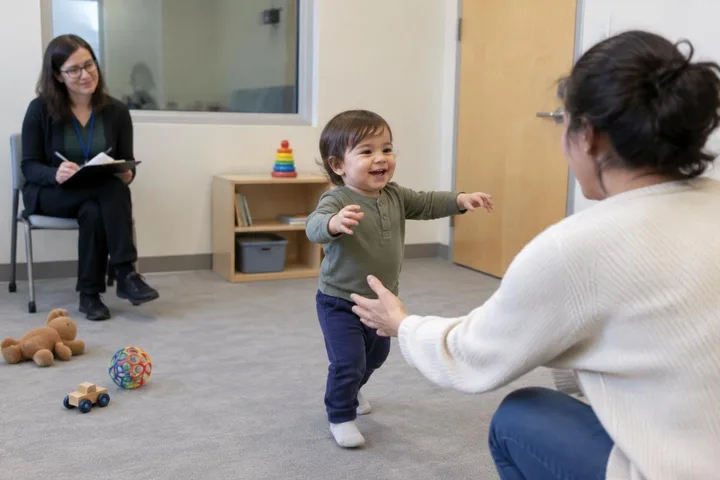
A frightened toddler in an unfamiliar room runs back to grab a parent's leg. What function does the parent serve?
It provides a base to explore. Having something secure to hold is what makes the rest of the unknown room approachable, turning anxiety into curiosity.
An infant animal chooses a soft surface over a feeding bottle. Why?
Touch is a primary biological need. Touch is not merely a by-product of being fed; contact comfort is a fundamental requirement in its own right, just as basic as food.
Two nurseries feed and clean children identically. One holds them, one does not. What differs?
The held children develop better in almost every way. Contact is not a bonus on top of calories. Institutions that got nutrition and hygiene right and handling wrong produced children who failed to thrive physically as well as socially, which is why handling rules changed once the evidence arrived.
Play the lesson in edgi and the card is yours. It lands on your Map next to the ideas it connects to, and turns from matte to foil to gold as you learn more around it.
Harlow studied at Stanford University under Lewis Terman, the developer of the Stanford-Binet IQ Test. Terman also prompted him to change his birth surname from Israel to Harlow to avoid anti-Semitic prejudice.
How did Harlow's work impact modern psychology?
Harlow's findings on contact comfort provided empirical evidence for John Bowlby's attachment theory. A 2002 survey in the Review of General Psychology ranked Harlow as the 26th most cited psychologist of the 20th century.