Averageness describes the physical attractiveness that occurs when facial features of people of the same gender and age are mathematically averaged together. Blending multiple faces cancels out individual flaws and unusual proportions to produce a smooth, appealing result. While the word suggests ordinary or common, an averaged face is actually perceived as unusually good-looking.
By the edgi team We find the most surprising true thing about an idea and build a 60-second lesson around it.
In 1878, Sir Francis Galton wanted to find the visual signature of a criminal. He used a technique called compositing, overlaying portraits of various convicts to create a single, unified image.
He expected to see a distorted, sinister face. Instead, he was shocked: the result was handsome and remarkably normal.
Why the math works
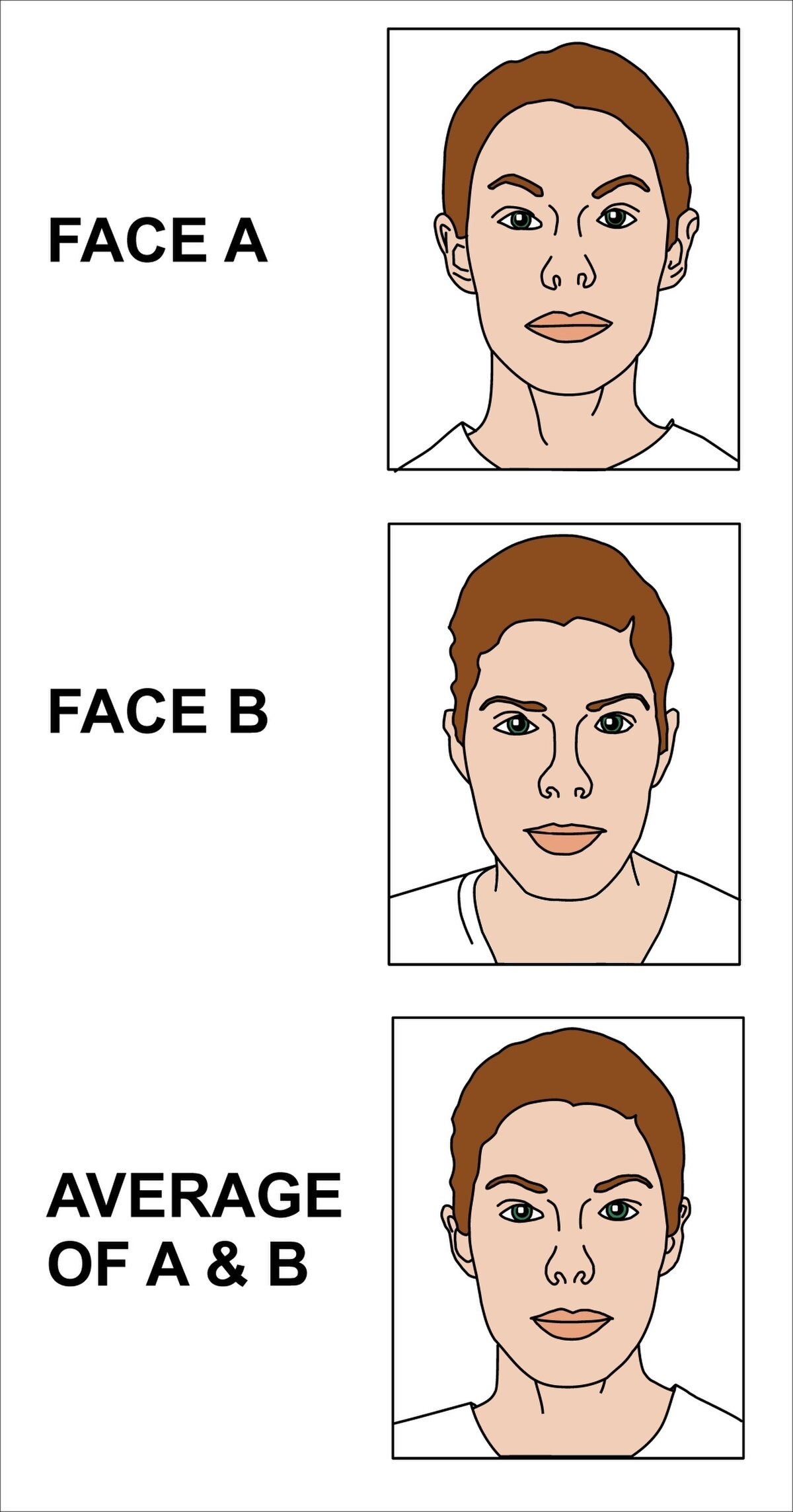
When you morph faces, you are calculating the mathematical mean of features. Individual asymmetries, skin blemishes, and odd proportions cancel each other out.
A diagram illustrating the concept of averageness in facial attractiveness, showing two distinct female faces (FACE A and FACE B) and a third face labeled "AVERAGE OF A & B". Cruithne9, CC BY-SA 4.0, via Wikimedia Commons
The result is a smooth, symmetrical face that our brains interpret as healthy and familiar.
The evolutionary anchor
This isn't just a quirk of photography; it's a byproduct of sexual selection. Throughout history, "average" features signaled that a mate was free from rare genetic mutations or developmental issues.
A peacock in flight, showcasing its long, elaborate tail feathers extended behind it, against a blurred natural background. Servophbabu, CC BY-SA 3.0, via Wikimedia Commons
We evolved to find stability attractive, so we naturally gravitate toward the mean.
The math behind composite faces
In 1990, psychologists Langlois and Roggman scanned 192 faces and used computers to build composites from groups of 2, 4, 8, 16, and 32 people. When 300 judges rated the results, the 32-face composite scored highest in attractiveness. The more faces added into the digital blend, the more attractive the composite became.
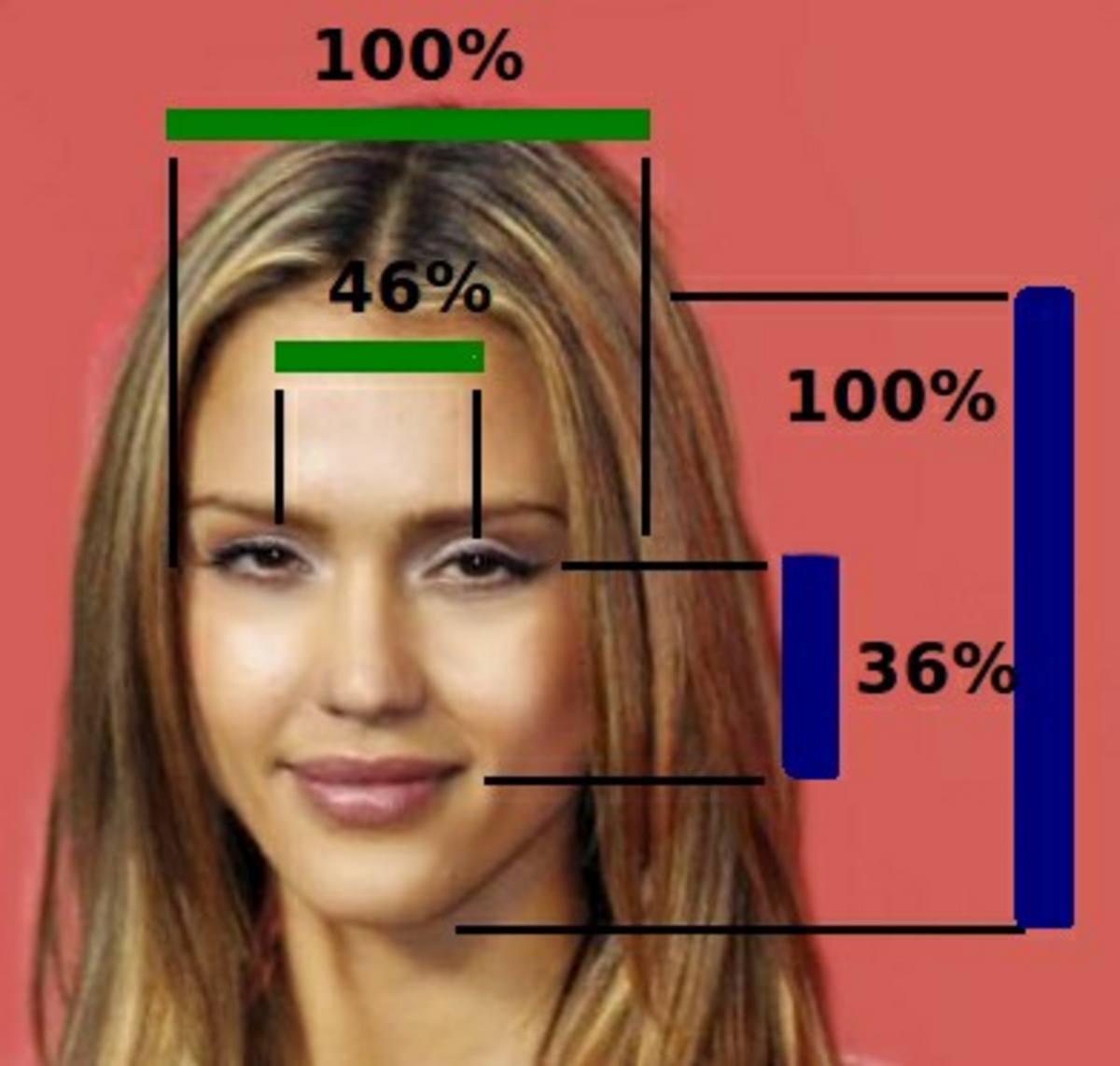
Celebrity portraits often align with averaged facial proportions because the composite shape represents an appealing mathematical mean. Jessica_Alba_Cropped2.png: pinguino k from North Hollywood, USA derivative work: Tomwsulcer (talk), CC BY 2.0, via Wikimedia Commons
Averaging works on the level of individual pixels and mathematical means. Unique facial asymmetries, unusual proportions, and skin blemishes cancel each other out across the sample. Highly attractive models, such as Jessica Alba, often possess facial proportions that line up closely with these mathematical composites.
Why averageness is an evolutionary cue
Biologists explain this preference through koinophilia, the evolutionary tendency for sexually reproducing animals to seek mates with average traits. Extreme or uncommon physical traits often signal disadvantageous genetic mutations or developmental issues, so brains evolved to treat the population mean as a sign of health.
Hadza hunter-gatherers preferred mathematically averaged faces of their peers over individual faces from their own community. Idobi, CC BY-SA 3.0, via Wikimedia Commons
This response appears early in human development and crosses cultural boundaries. Studies show that six-month-old infants can extract the average from sets of natural faces and treat averaged faces the same way they treat attractive ones. When researchers tested the isolated Hadza hunter-gatherers of Tanzania, the tribe members consistently rated averaged Hadza faces as more attractive than individual tribal faces.
Test yourself
Mathematical averageness is generally less attractive than perfect symmetry.
False. Averageness is often more attractive than perfect symmetry because it hides harmful mutations.
Play the lesson in edgi and the card is yours. It lands on your Map next to the ideas it connects to, and turns from matte to foil to gold as you learn more around it.
Does an averaged face mean it looks common or unremarkable?
No. In this context, average strictly means the mathematical mean of all features, not ordinary. Averaged faces appear familiar and representative of human faces, but observers consistently rate them as exceptionally good-looking.
Can a face be more attractive than a standard average composite?
Yes. Research by David Perrett showed that averaging already-attractive faces, and then exaggerating those specific features to create a slimmer jaw and larger eyes, produced faces rated as even more appealing than a basic population average.
Why didn't the Hadza prefer average European faces?
The Hadza lacked visual experience with European faces, so their brains had not built an internal baseline for that group. The mental rule that prefers average features is innate, but the brain requires environmental exposure to establish what the average looks like.