Benjamin LibetBrain activity before conscious choice
Benjamin Libet was an American neuroscientist who studied human consciousness at the University of California, San Francisco. In 1983, he showed that unconscious brain signals start hundreds of milliseconds before a person consciously decides to move. This finding challenged traditional ideas about free will by suggesting that our conscious mind does not initiate our actions.
By the edgi team We find the most surprising true thing about an idea and build a 60-second lesson around it.
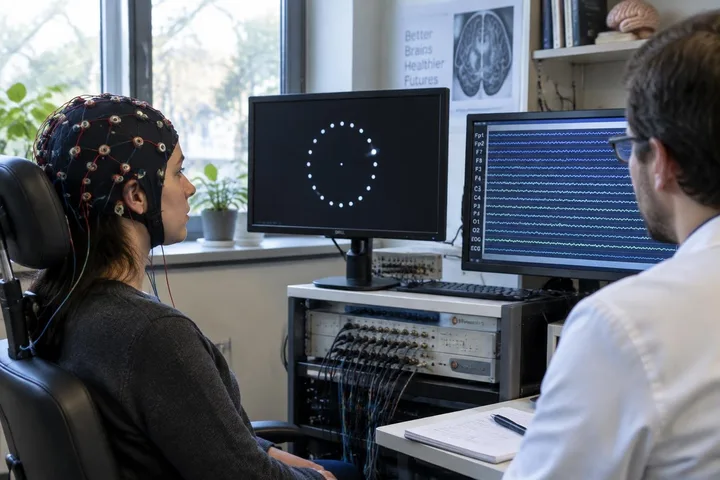
In 1983, neuroscientist Benjamin Libet asked volunteers to flick their wrists whenever they felt the urge while watching a high-speed clock. They noted the exact moment they felt the conscious intention to move. Meanwhile, Libet measured their brain activity using an EEG.
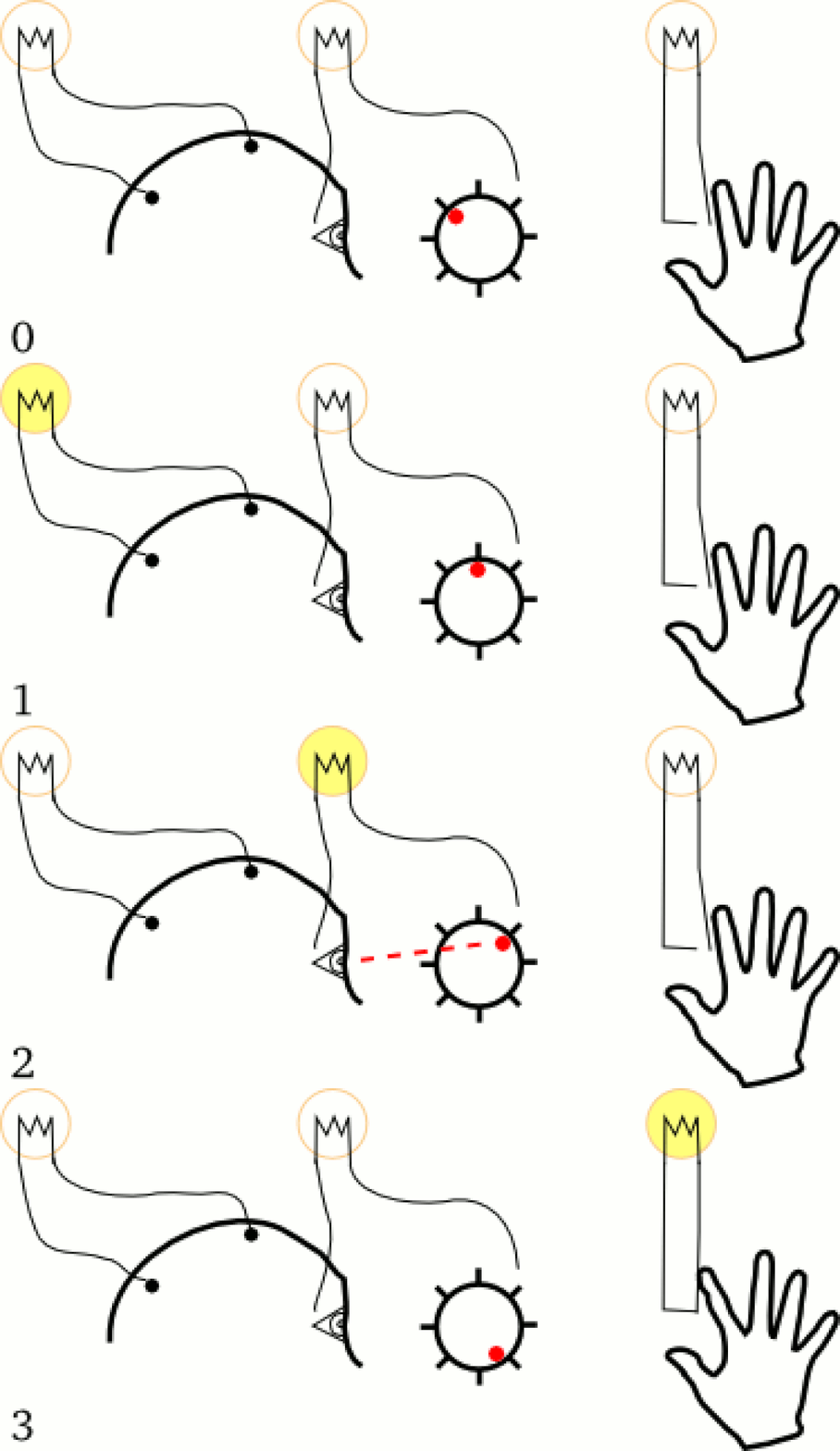
Diagram illustrating Libet's experiment on free will, showing three stages: EEG measures Readiness potential at -500 ms, a person notes the position of a dot when deciding at -200 ms, and the act… Createaccount, CC BY-SA 3.0, via Wikimedia Commons
The brain's head start
A specific neural signal, the Bereitschaftspotential or readiness potential, appeared in the brain 550 milliseconds before the movement. But the subjects only reported the conscious urge to move 200 milliseconds before the action.
The brain was acting 350 milliseconds before the conscious mind knew about it. The decision was made in the dark, long before we felt like we were choosing.
The veto power
This discovery sent shockwaves through the Neuroscience of free will, suggesting that our sense of Voluntary action might be an illusion generated after the fact. Libet wasn't ready to abandon Free Will entirely. He argued that even if we cannot initiate the impulse, we have the power to stop it.
He called this 'free won't', a split-second window to veto an impulse before it becomes a physical reality.
How the clock experiment tracked the brain
Libet set up a cathode ray oscilloscope as an ultra-fast timer, displaying a dot that revolved in a circle like a clock hand. Participants sat at a desk and were told to flex their wrist or press a button whenever they felt the spontaneous urge.
To sync the timeline, Libet used three separate measurements: an electroencephalogram (EEG) to track cortical brain activity, an electromyograph (EMG) on the forearm to mark the exact moment of muscle movement, and the participant's recall of where the oscilloscope dot was when they first felt the conscious intention to act.
Readiness potential and the veto
Unconscious electrical activity, called Bereitschaftspotential or readiness potential, built up in the brain roughly 500 to 550 milliseconds before the muscle moved. However, subjects reported their conscious awareness of the urge to act only about 200 milliseconds before the movement.
Because the brain began preparing the action around 300 to 350 milliseconds before conscious awareness, Libet suggested that unconscious neuronal processes initiate volitional acts. Rather than abandoning voluntary control entirely, he proposed that consciousness retains a veto power (referred to as 'free won't') to halt an action in the 200 milliseconds before it occurs.
Test yourself
You press a button on a whim. When does your brain actually set the motion in action?
Before you feel the conscious urge. Neural activity kicks off hundreds of milliseconds before we consciously realize we want to move. The conscious mind is reacting to decisions the brain already made.
When does the brain initiate the urge to move compared to conscious awareness?
Before the conscious urge. We feel like our conscious mind starts the movement, but the brain's readiness signal shows that the work of preparation happens well before we are aware of any intent.
Play the lesson in edgi and the card is yours. It lands on your Map next to the ideas it connects to, and turns from matte to foil to gold as you learn more around it.
Readiness potential (Bereitschaftspotential) was discovered in 1965 by researchers Lüder Deecke and Hans Helmut Kornhuber. Libet later applied their discovery to study the precise timing of conscious awareness.
What did later studies find about unconscious brain activity?
A 2008 study found that brain activity in the prefrontal and parietal cortex could reflect the outcome of an upcoming decision up to 7 seconds before the person became consciously aware of it.
Where in the brain was the early activity located?
The initiation of action recorded by the EEG electrodes was primarily centered in the secondary motor cortex. EEG electrodes place on the scalp measure differences in voltage across regions of the cortex to track this activity.