Laplace's Demon is a thought experiment about a hypothetical intellect that knows the exact position and motion of every particle in existence. By applying the laws of classical physics to that data, this entity could calculate the entire past and future with perfect certainty. It represents causal determinism, the concept that every event is an unavoidable result of prior causes rather than chance.
By the edgi team We find the most surprising true thing about an idea and build a 60-second lesson around it.
In 1814, mathematician Pierre-Simon Laplace proposed a thought experiment to prove that the universe is entirely predictable. He imagined an intellect that knew the precise position and momentum of every particle in existence.
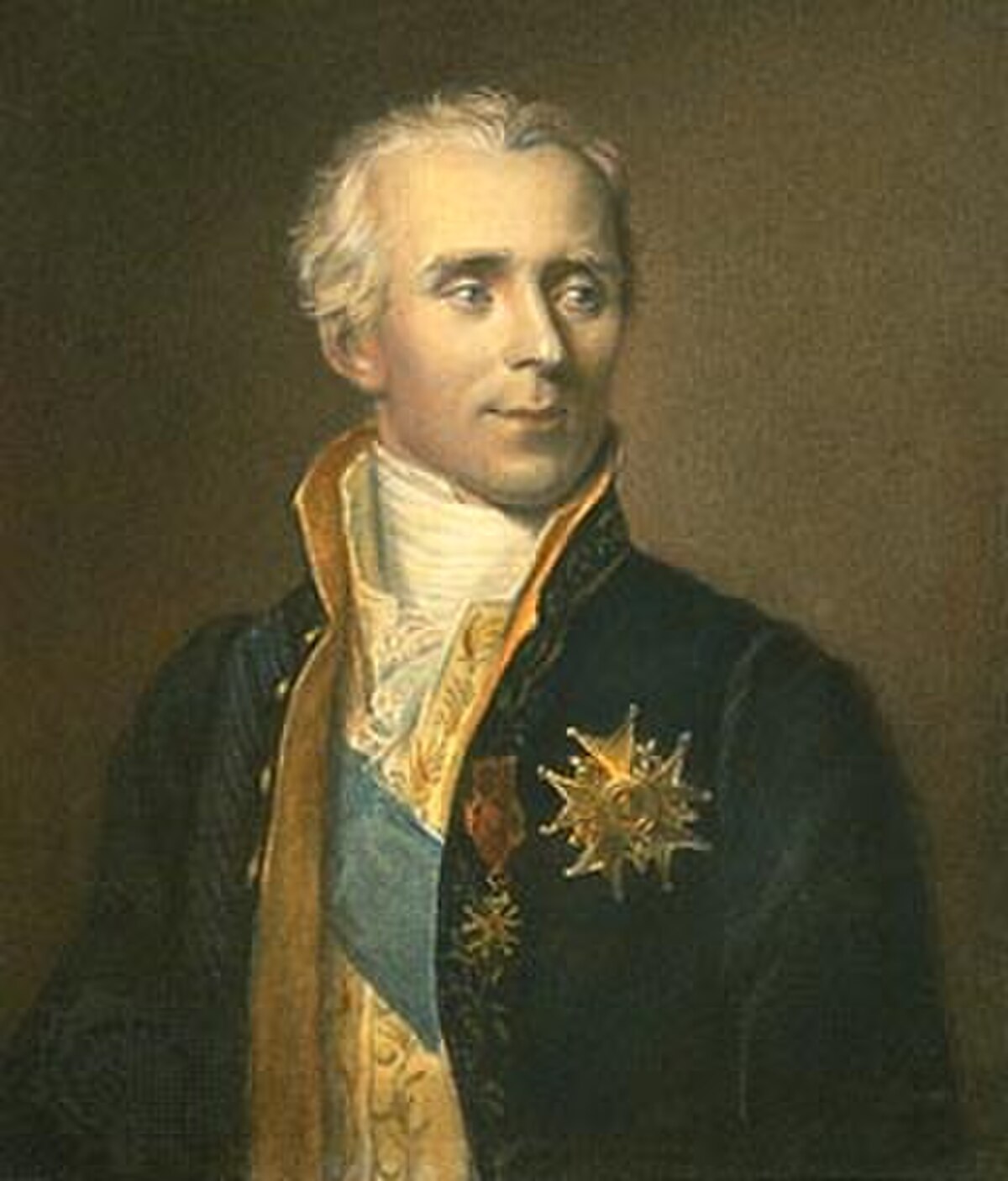
Portrait of French scholar Pierre-Simon de Laplace (1749–1827), depicted in formal attire with a blue sash and a medal on his chest. James Posselwhite, Public domain, via Wikimedia Commons
Using the rigid laws of Classical Mechanics, this demon could calculate the entire history of the cosmos and map out every future second with flawless accuracy.
The death of chance
To Laplace, uncertainty was not a feature of reality; it was simply a symptom of our own ignorance. If you could account for every atom, you would realize that every choice, disaster, and sunrise is just a consequence of the state that preceded it.
A line of dominoes falling, with several already toppled and others in the process of falling, illustrating the domino effect. Kurt:S, CC BY 2.0, via Wikimedia Commons
In this view, the future is essentially a movie that has already been filmed.
Why the demon failed
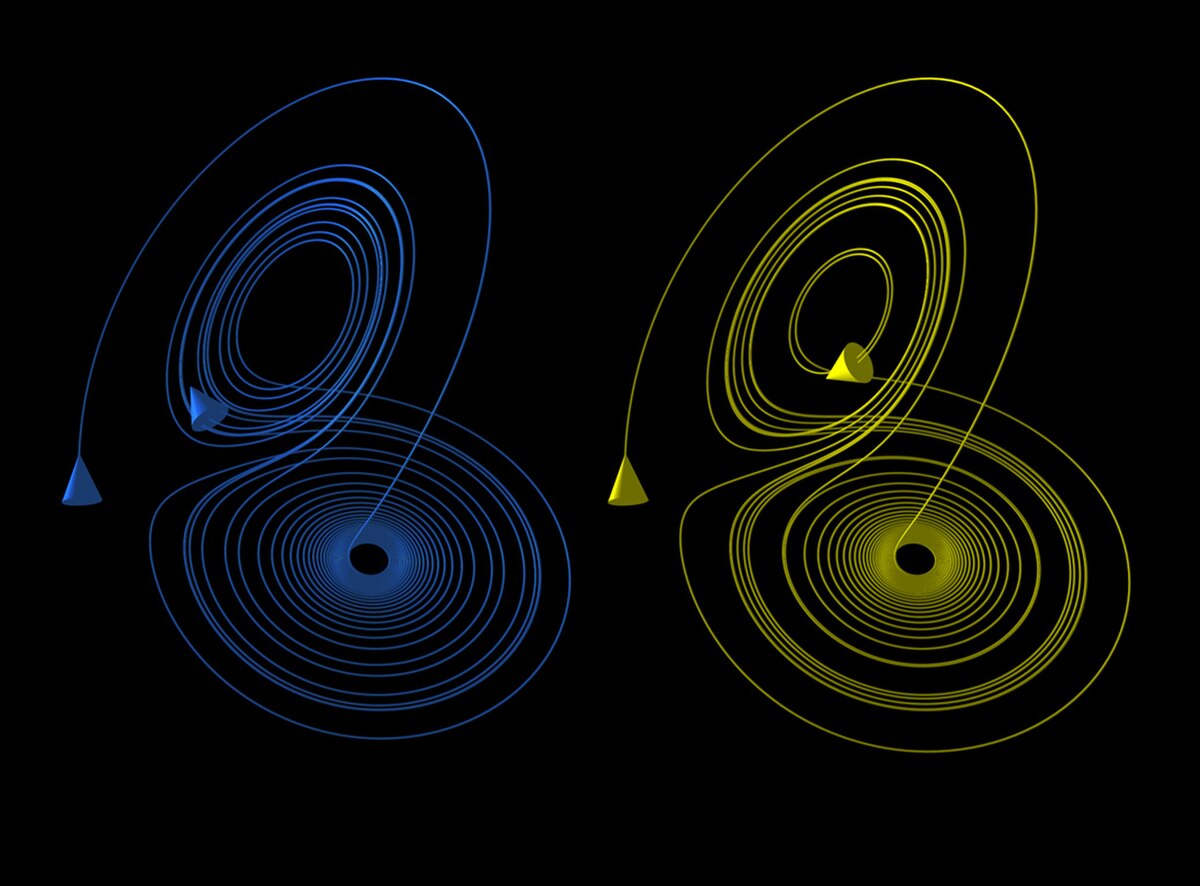
The demon's dream eventually collided with the messy reality of the world. Chaos Theory showed us that tiny, unmeasurable variations can cause massive deviations, making long-term prediction impossible.
Two Lorenz attractor orbits, one blue and one yellow, demonstrating sensitive dependence on initial conditions. Hellisp (assumed), CC BY 2.5, via Wikimedia Commons
Later, Quantum Mechanics proved that some subatomic events are fundamentally probabilistic, meaning the universe contains a level of randomness that no demon can calculate.
How Laplace's calculating intellect worked
Pierre-Simon Laplace first articulated the core of this idea in 1773 and published it in 1814, though he never actually used the word demon. He described an intelligence vast enough to submit the positions and forces of all natural items to mathematical analysis. In this framework, the present state of the cosmos is purely the effect of its past and the cause of its future.
Similar versions of a super-calculating entity had already circulated widely in 18th-century Europe. Thinkers such as Maupertuis in 1756, Roger Joseph Boscovich in 1758, Nicolas de Condorcet in 1768, and Baron D'Holbach in 1770 all explored comparable concepts before Laplace gave the idea its most enduring formulation.
Why modern physics rejects the demon
Thermodynamics presented an early obstacle to the demon through the second law and irreversible processes. As chemical engineer Robert Ulanowicz pointed out, if natural processes cannot run backward, the demon cannot reconstruct past states from present physical measurements alone.
Quantum mechanics dealt an even sharper blow through the Copenhagen interpretation, which treats physical events at the subatomic scale as fundamentally indeterminate. Even if deterministic interpretations like many-worlds or de Broglie-Bohm hold, modern computational limits remain fatal. In 2000, Seth Lloyd calculated that the universe has an upper limit of around 10^120 bits of computational capacity, making infinite calculations physically impossible.
Test yourself
Why does a clockwork-style prediction eventually break down?
Tiny errors snowball over time. Even simple systems can defy long-term prediction because microscopic starting variations explode into massive, unpredictable divergences.
A coin toss lands on heads. Is the result fundamentally random or just practically unknown?
It depends on if physics has inherent chance. The debate hinges on whether reality is governed by strict determinism or if genuine probability is baked into the subatomic world.
If we knew the position of every atom, would the future be perfectly predictable?
No, because some events are random. Laplace imagined a universe like clockwork, but physics has since shown that small-scale chaos and inherent quantum randomness make perfect, long-term prediction impossible.
Play the lesson in edgi and the card is yours. It lands on your Map next to the ideas it connects to, and turns from matte to foil to gold as you learn more around it.
Did Laplace believe humans could build this calculating system?
No, Laplace explicitly stated that the human mind would always remain infinitely removed from such a vast intelligence. Authors like Stephen Hawking and James Gleick have presented this as an optimistic goal for human prediction, but Laplace framed it strictly as a theoretical concept.
What is the computational argument against the demon?
In 2008, David Wolpert used Cantor diagonalization to show that no two computational devices can completely predict each other. In 2012, Iegor Reznikoff advanced a logical proof arguing that the demon cannot predict its own future memory state.
What other names does Laplace's Demon go by?
Laplace himself simply referred to it as an intelligence. Philosopher Hans Reichenbach later referred to the concept as Laplace's Superman.