CapsaicinWhy birds cannot taste the heat in chili peppers
Capsaicin is a chemical compound produced by chili peppers that triggers heat receptors in mammals, creating a burning sensation in any tissue it touches. The molecule tricks the brain into detecting a physical thermal burn above 109 degrees Fahrenheit even though no real heat exists. Plants evolved it to stop mammals from crushing their seeds while letting birds eat them unharmed.
By the edgi team We find the most surprising true thing about an idea and build a 60-second lesson around it.
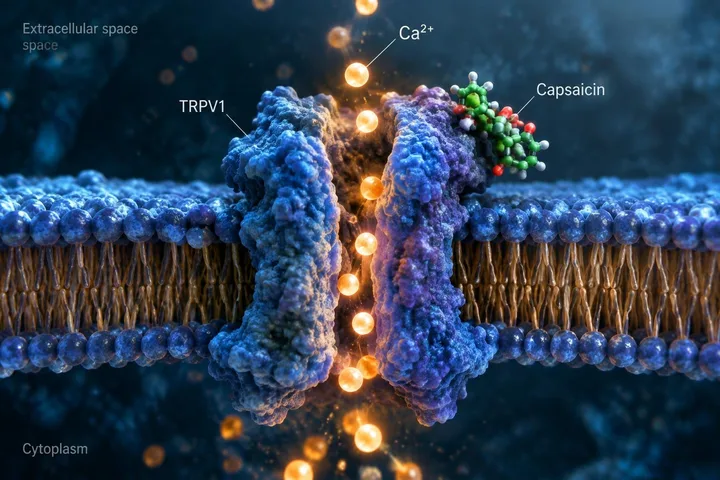
Capsaicin is a molecule that binds to TRPV1 receptors on your tongue. These sensors are designed to detect real heat, specifically temperatures above 109 degrees Fahrenheit.
A chemical structure diagram of capsaicin, showing its molecular arrangement with a benzene ring, a methoxy group, a hydroxyl group, an amide linkage, and an unsaturated alkyl chain. Pyrovalerone, CC0, via Wikimedia Commons
When capsaicin latches on, it sends a 'fire' signal to your brain. There is no actual heat, but your brain cannot tell the difference.
The emergency response
Your body treats the signal as a genuine thermal burn. It triggers a physical emergency response: your skin flushes, you start to sweat, and your eyes may water to cool you down.
To cope with the pain, your brain releases a flood of endorphins, which is why spicy food can actually make you feel a rush.
A close-up view of young chili pepper plants with vibrant green leaves growing in a pot. Princz Solomon, CC BY-SA 4.0, via Wikimedia Commons
The evolutionary flop
Chili peppers evolved this compound as a defense mechanism to stop mammals from eating their seeds. It works perfectly on squirrels, but humans are the only species that actively seeks out the pain for the thrill.
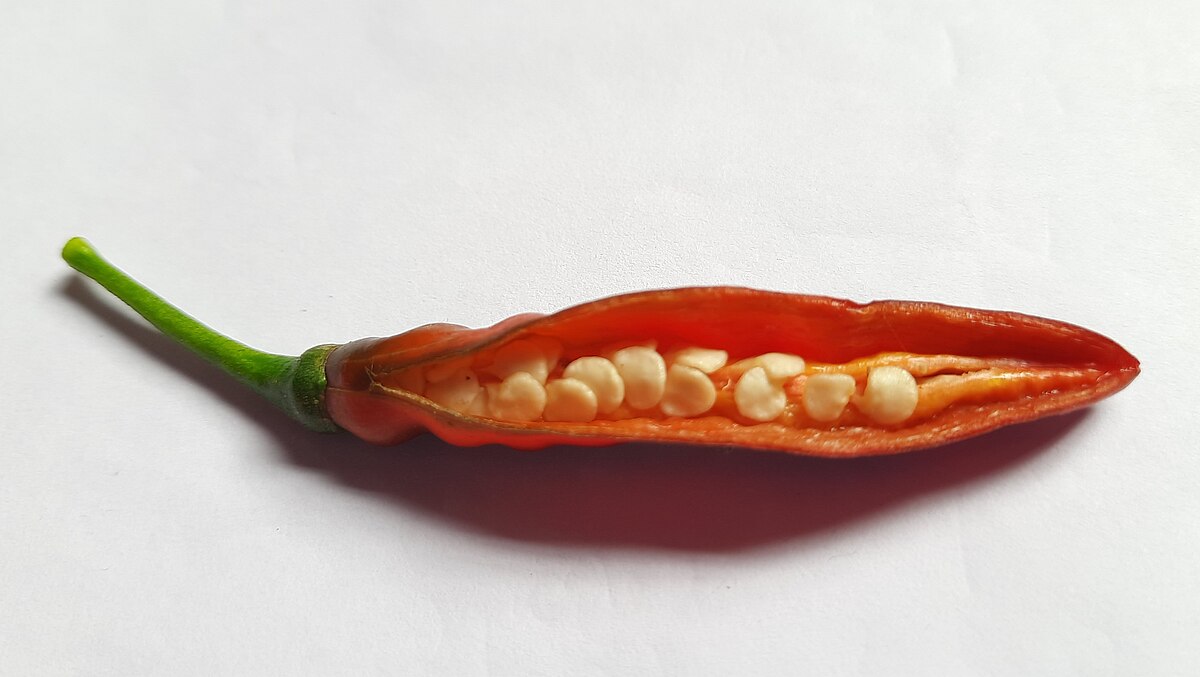
A red chili pepper is cut lengthwise, revealing its internal structure with numerous white seeds arranged along the central placenta. Plague, CC BY-SA 4.0, via Wikimedia Commons
We even invented the Scoville scale to measure exactly how hard we can trick our own brains.
Why chili peppers produce capsaicin
Chili pepper seeds do not actually make capsaicin. The highest concentration lives in the white pith of the pepper's inner wall and internal membranes where the seeds attach.
Plants in the genus Capsicum produce capsaicin as an evolutionary defense against mammals and fungal pathogens like Fusarium. Mammalian molars crush and destroy chili seeds during chewing. Birds, however, possess a TRPV1 receptor channel that does not react to capsaicin. They eat the peppers without feeling any burn and excrete the seeds intact, allowing the plant to spread and germinate.
Everyday uses and medical applications
Capsaicin appears in everything from spices like paprika to riot-control pepper spray. Because pure capsaicin is a hydrophobic crystalline solid, it causes severe burning, tearing, and breathing difficulty on contact with eyes and mucous membranes.
High-dose prescription patches (Qutenza) provide pain relief for post-herpetic neuralgia, HIV-neuropathy, and diabetic neuropathy by exhausting local nerve receptors. Because capsaicin deters mammals, farmers add it to birdseed to keep rodents away and plant chili barrier crops to discourage elephants from eating fields.
The substance is banned in equestrian sports due to its hypersensitizing and pain-relieving effects. Four horses were disqualified from the 2008 Summer Olympics after testing positive for capsaicin.
Test yourself
Why does spicy food trigger sweating even in an air-conditioned room?
The brain mistakes the signal for real heat.. The body initiates standard cooling mechanisms like sweating because sensory neurons report thermal danger, regardless of actual room temperature.
Does capsaicin physically damage tissue like boiling water?
No, it only tricks thermal sensors.. Capsaicin does not raise tissue temperature or destroy cells. It simply binds to heat receptors, sending a false alarm to the brain.
Does capsaicin physically burn and damage tissue like hot soup?
No, it is purely a nerve illusion. Capsaicin doesn't raise the temperature of your mouth or burn tissue. It simply tricks your heat sensors into firing a false alarm.
Play the lesson in edgi and the card is yours. It lands on your Map next to the ideas it connects to, and turns from matte to foil to gold as you learn more around it.
Because capsaicin is hydrophobic, plain water is generally ineffective at removing it from skin or surfaces. Capsaicin is soluble in alcohol, which can be used to clean contaminated items.
Do other animals use the same pain mechanism as capsaicin?
Yes. The venom of the Trinidad chevron tarantula (Psalmopoeus cambridgei) contains vanillotoxins that activate the exact same pain pathway in mammals that capsaicin triggers.
How does cooking affect the heat of capsaicin?
Capsaicin sublimates at 115 degrees Celsius. Precautions are necessary when cooking dry or with fats to avoid vaporizing the compound and to preserve pungency in spicy dishes.