A social norm is a shared standard of acceptable behavior within a group. Unlike private beliefs or personal habits, norms dictate what people ought to do in specific situations. They shape daily choices through expectations of social approval, disapproval, or formal rules.
By the edgi team We find the most surprising true thing about an idea and build a 60-second lesson around it.
You know you aren't supposed to stand facing the back wall of an elevator. There is no law against it, and no fine for doing it wrong. Yet, you never do it. These are social norms: unwritten standards we absorb through observation rather than instruction.
The interior of an Otis Elevator Company express elevator, featuring golden walls and ceiling, serving the upper floors of the 875 North Michigan Avenue building. Mike Steele, CC BY 2.0, via Wikimedia Commons
The stare experiment
In the 1960s, Stanley Milgram proved how easily we conform. He had actors stand on a busy sidewalk and stare at a blank spot in the sky. As the group size increased, passersby felt a magnetic pull to stop and look up too.
They weren't following a law; they were feeling the power of social influence, showing how quickly a collective behavior becomes a temporary rule.
The cost of deviance
Norms aren't enforced by police, but by the social cost of being different. A raised eyebrow, a cold shoulder, or a whispered comment keeps the group aligned. When we collectively decide to ignore those costs, the norm dies.
This is how yesterday's scandal becomes today's tradition, shifting the definition of deviance over time.
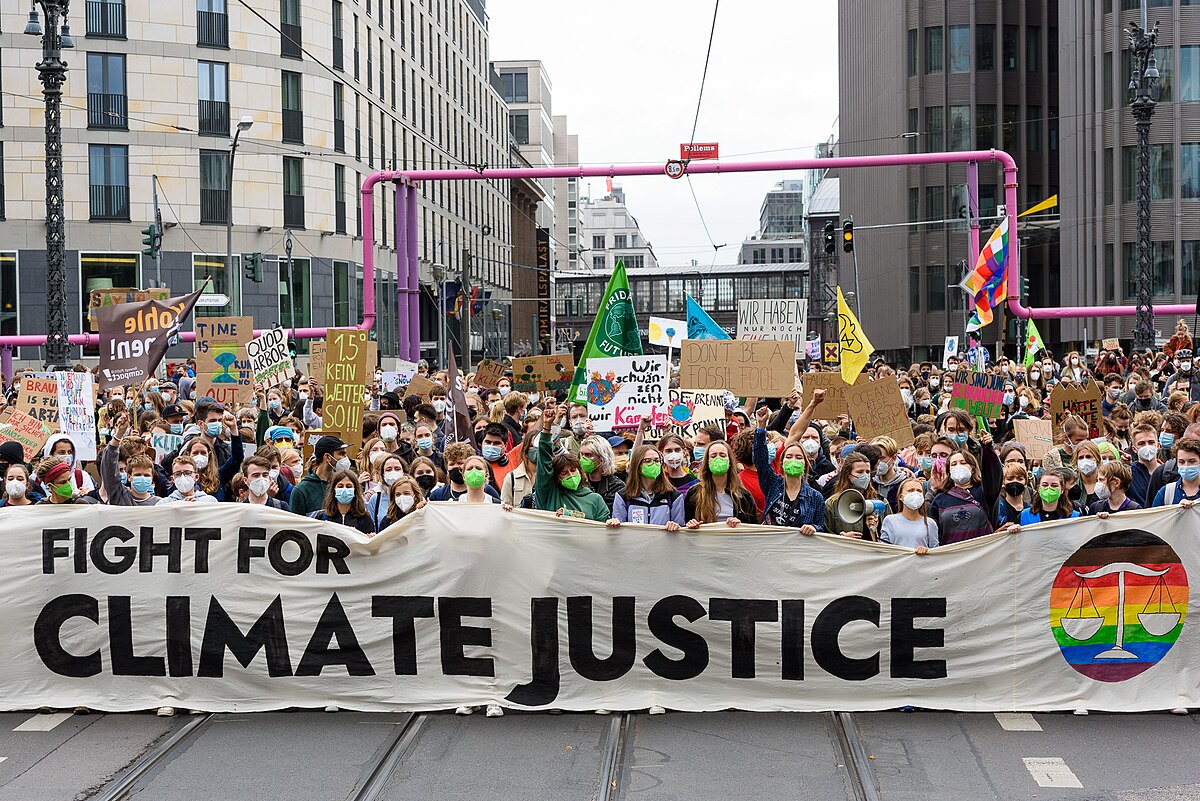
A large crowd of people, including Greta Thunberg and Luisa Neubauer, are gathered at a Fridays for Future demonstration in Berlin in September 2021, holding signs and a large banner that reads… Stefan Müller (climate stuff, 1 Mio views), CC BY 2.0, via Wikimedia Commons
How do social norms work?
Social norms rely on two types of expectations: empirical expectations (what you believe other people are doing) and normative expectations (what you believe others think you ought to do). When people expect everyone else to conform, conforming becomes self-enforcing.
Shaking hands after a sports match shows how groups follow an unwritten standard of appropriate conduct. kance, CC BY 2.0, via Wikimedia Commons
Scholars categorize norms by their function. Regulative norms constrain actions, constitutive norms shape basic interests, and prescriptive norms dictate what group members ought to do. People follow them either through a logic of appropriateness (doing what fits the social context) or a logic of consequences (calculating the personal costs and benefits of compliance).
How do norms spread and change?
Norms often evolve spontaneously through repeated everyday interactions rather than top-down design. When new standards arise intentionally, they follow a three-stage life cycle: emergence, cascade, and internalization.
In the emergence stage, norm entrepreneurs try to persuade others to adopt a behavior. Once the standard reaches a tipping point, a norm cascade occurs, spreading broad acceptance across society. In the final stage, internalization, the norm becomes so deeply ingrained that people take it for granted, making violations rare.
Test yourself
At a quiet gathering, one person speaks loudly and others exchange disapproving looks. What does this show about social norms?
Group reactions can discourage behavior without formal penalties. Disapproving looks are informal social pressure. They can enforce a group's expectations without proving the behavior is illegal or universally unacceptable.
What mainly enforces social norms when no formal rule applies?
Informal social reactions to behavior. Social norms are maintained through reactions like disapproval or exclusion, not necessarily through laws or formal penalties.
How do social norms primarily maintain group behavior without formal laws?
Through informal social costs. Social norms are enforced through subtle social costs like raised eyebrows rather than formal punishments or laws, keeping people aligned through invisible pressure.
Play the lesson in edgi and the card is yours. It lands on your Map next to the ideas it connects to, and turns from matte to foil to gold as you learn more around it.
Laws are formal, codified versions of norms backed by official legal penalties. Informal norms are unwritten standards enforced through social approval or disapproval, and they can sometimes conflict with written laws.
How do norms differ from personal values?
Personal values and ideas can be held privately and do not require collective agreement. Social norms are always shared across a group and directly concern outward behavior.
What happens to people who violate social norms?
Individuals who refuse to conform are categorized as deviants by the group. They face informal social costs, such as disapproval or third-party punishment, which stabilize and protect the norm.