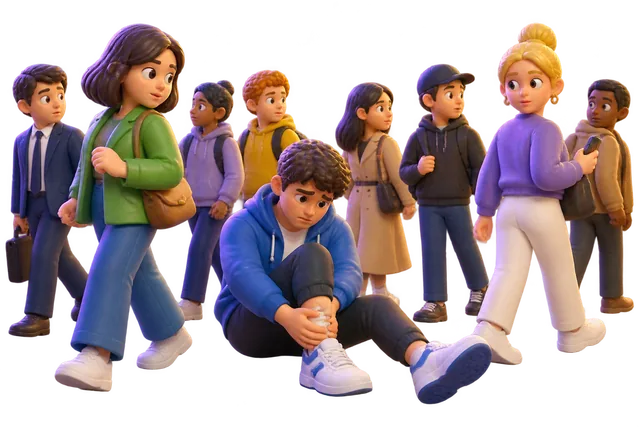
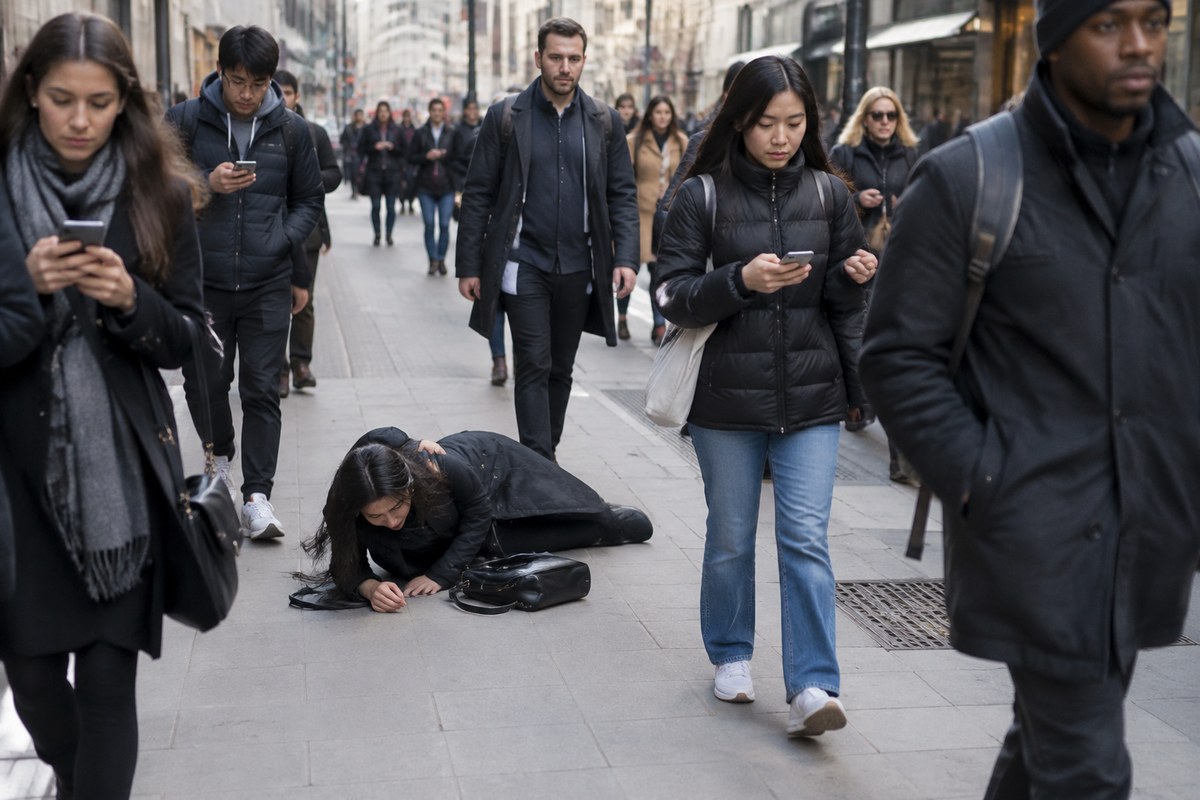
The bystander effect is a social psychology theory stating that individuals are less likely to offer help to a victim when other people are present. Instead of creating a safety net, larger crowds dilute personal responsibility and cause people to look to others before acting. While lab experiments show that groups slow down intervention, modern real-world footage reveals that in actual emergencies, at least one bystander almost always steps in.
By the edgi team We find the most surprising true thing about an idea and build a 60-second lesson around it.
In 1964, the New York Times reported that 38 neighbors watched the Murder of Kitty Genovese without calling for help. It shocked the nation and birthed the bystander effect. Later investigations revealed the story was exaggerated; many people did call, but the narrative of urban apathy stuck forever.
The smoke experiment
Psychologists Bibb Latané and John Darley tested this by filling a room with smoke while participants worked. When alone, 75% of people reported the smoke immediately. When with two calm actors pretending to ignore it, that number dropped to just 10%.
We subconsciously scan others to define reality. If they aren't panicking, we assume we shouldn't either, relying on social proof.
Breaking the spell
This isn't about cruelty; it is about the diffusion of responsibility. We wait for a leader to define the situation. To break the spell, you must assign a specific role. Don't shout 'Help!' at the crowd.
Point to one person and say: 'You in the blue shirt, call 911.' By singling them out, you force them out of the crowd and into action.
Why does the presence of others stop people from helping?
In 1968, social psychologists John M. Darley and Bibb Latané demonstrated that people go through five distinct cognitive steps before intervening: they must notice that something is happening, interpret the event as an emergency, feel a degree of personal responsibility, choose a form of assistance, and implement that action. Being around others disrupts several of these steps.
The first delay happens at the noticing stage. In public spaces, social etiquette discourages staring or looking idly around, making people keep their attention to themselves. In Latané and Darley's smoke experiments, people working alone noticed smoke entering the room within five seconds, while those in groups took up to twenty seconds.
The second delay involves social proof and diffusion of responsibility. If an individual is assigned a task alone, their sense of responsibility is strong. When a group is present, individuals feel a weaker sense of responsibility and look to others to gauge the danger. If nobody else reacts, bystanders assume the situation is not an emergency.
Does the bystander effect happen in real emergencies?
Laboratory studies frequently show that groups inhibit action, but real-world evidence paints a different picture. A 2011 meta-analysis found that the bystander effect is most likely to occur in non-dangerous emergencies, but it does not occur in dangerous emergencies where danger is obvious. High bystander competence and the presence of male bystanders in dangerous settings also reduce the effect.
A 2019 study by Philpot and colleagues analyzed over 200 real-life surveillance video recordings of public conflicts across the United Kingdom, the Netherlands, and South Africa. They found that intervention was the norm: in over 90% of conflicts, one or more bystanders intervened to provide help. In those real-world recordings, a larger crowd actually increased the overall likelihood that someone would step in.
Test yourself
In the bystander effect, why can witnesses be slower to help when others are present?
Each expects someone else to take responsibility.. Witnesses may read others’ calmness as a sign nothing is wrong, while shared responsibility makes each person less likely to act.
What is the primary driver of the bystander effect?
Diffusion of responsibility. The effect is not caused by cold-heartedness or apathy, but by the assumption that another person will take action. Spreading this responsibility across a crowd causes everyone to hesitate.
Play the lesson in edgi and the card is yours. It lands on your Map next to the ideas it connects to, and turns from matte to foil to gold as you learn more around it.
How does the bystander effect appear in the workplace?
Studies show that the bystander effect generalizes to workplace settings. In group environments, subordinates frequently refrain from informing managers about their ideas, concerns, and opinions because responsibility is shared across the team.
How does asking for help change bystander behavior?
Providing context increases the chances of receiving help. In field experiments by Latané and Darley, students asking for a dime received assistance only 34% of the time, but that figure rose to 72% when they gave a reason, such as saying their wallet had been stolen.