Asch Conformity ExperimentThe power of one dissenter
The Asch conformity experiment is a classic psychology study designed by Solomon Asch in 1951 to test whether people would agree with an obviously incorrect group opinion. When faced with unanimous groups of actors giving wrong answers, nearly three quarters of participants conformed at least once. However, introducing just one dissenting voice slashed this conformity rate by 80 percent.
By the edgi team We find the most surprising true thing about an idea and build a 60-second lesson around it.
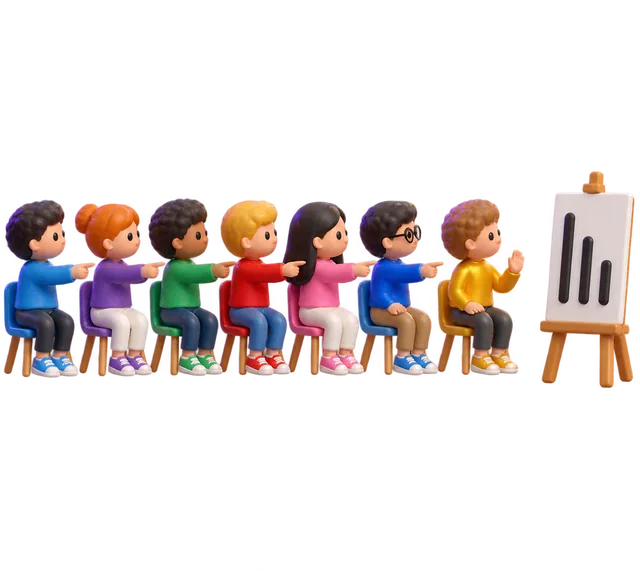
In the 1950s, psychologistSolomon Asch sat students in a room and asked them to match the length of simple lines on a card. Everyone in the room except for one person was an actor instructed to confidently name the wrong line.
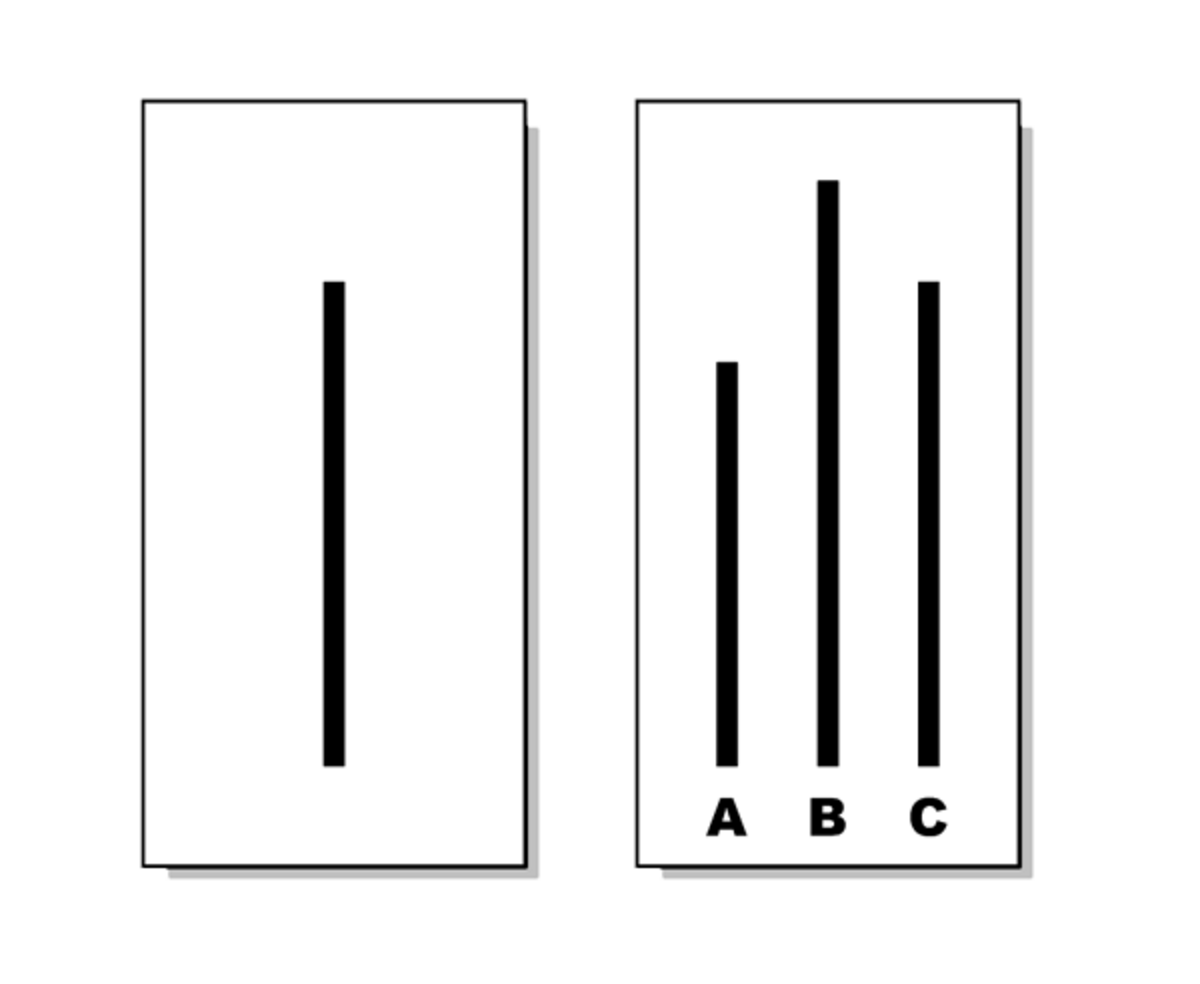
Diagram illustrating the Asch conformity experiment, showing a reference line on the left and three comparison lines (A, B, C) on the right. CC BY-SA 3.0, via Wikimedia Commons
The lone subject would visibly sweat, fidget, and squint at the lines before finally sighing and repeating the group's blatant lie.
The power of one
We aren't just being polite when we do this; our brains actually start to doubt our own senses when we lack social support. Yet Asch found that if even one other person in the group gave the right answer, the subject's conformity dropped by 80%.
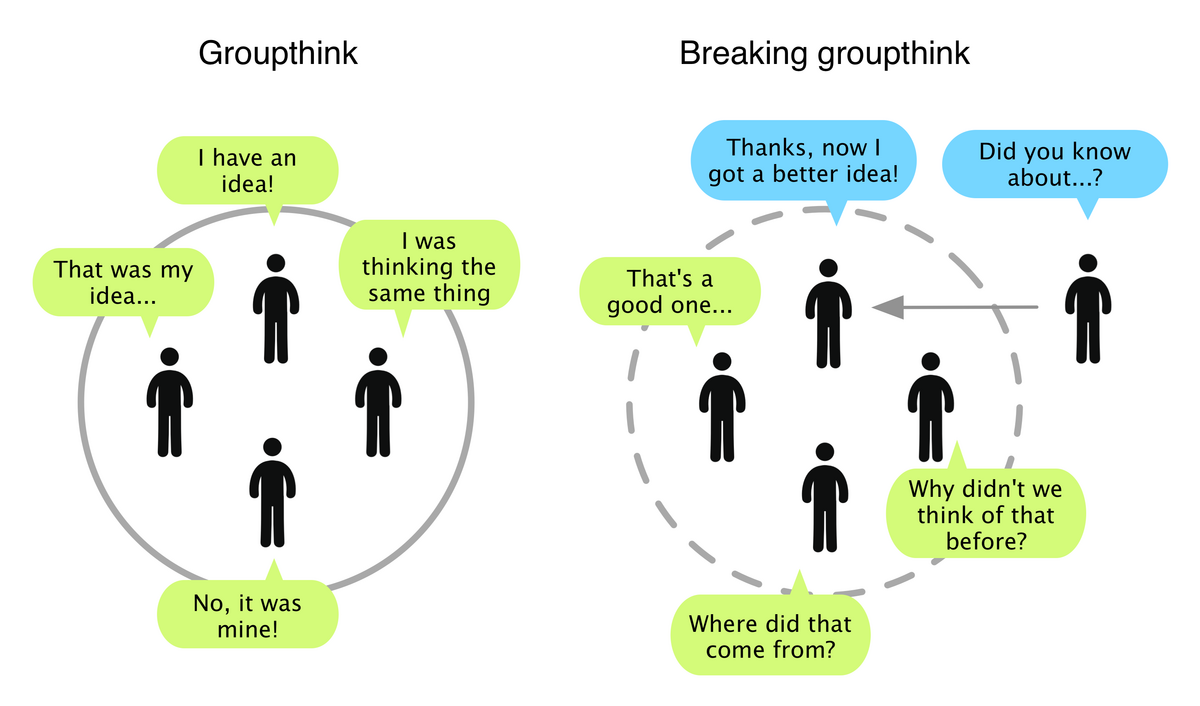
A comparative diagram illustrating "Groupthink" versus "Breaking groupthink." The "Groupthink" side shows five figures in a circle with similar ideas, while "Breaking groupthink" shows an outsider… Oscar Berg, CC BY 2.0, via Wikimedia Commons
This suggests that the most powerful weapon against groupthink isn't a smarter crowd, but a single dissenting voice.
How the experiment was run
In 1951 at Swarthmore College, Solomon Asch seated groups of eight male college students together for what appeared to be a simple visual judgment test. In reality, seven of the men were actors instructed on how to answer, and the remaining student was the only real subject.
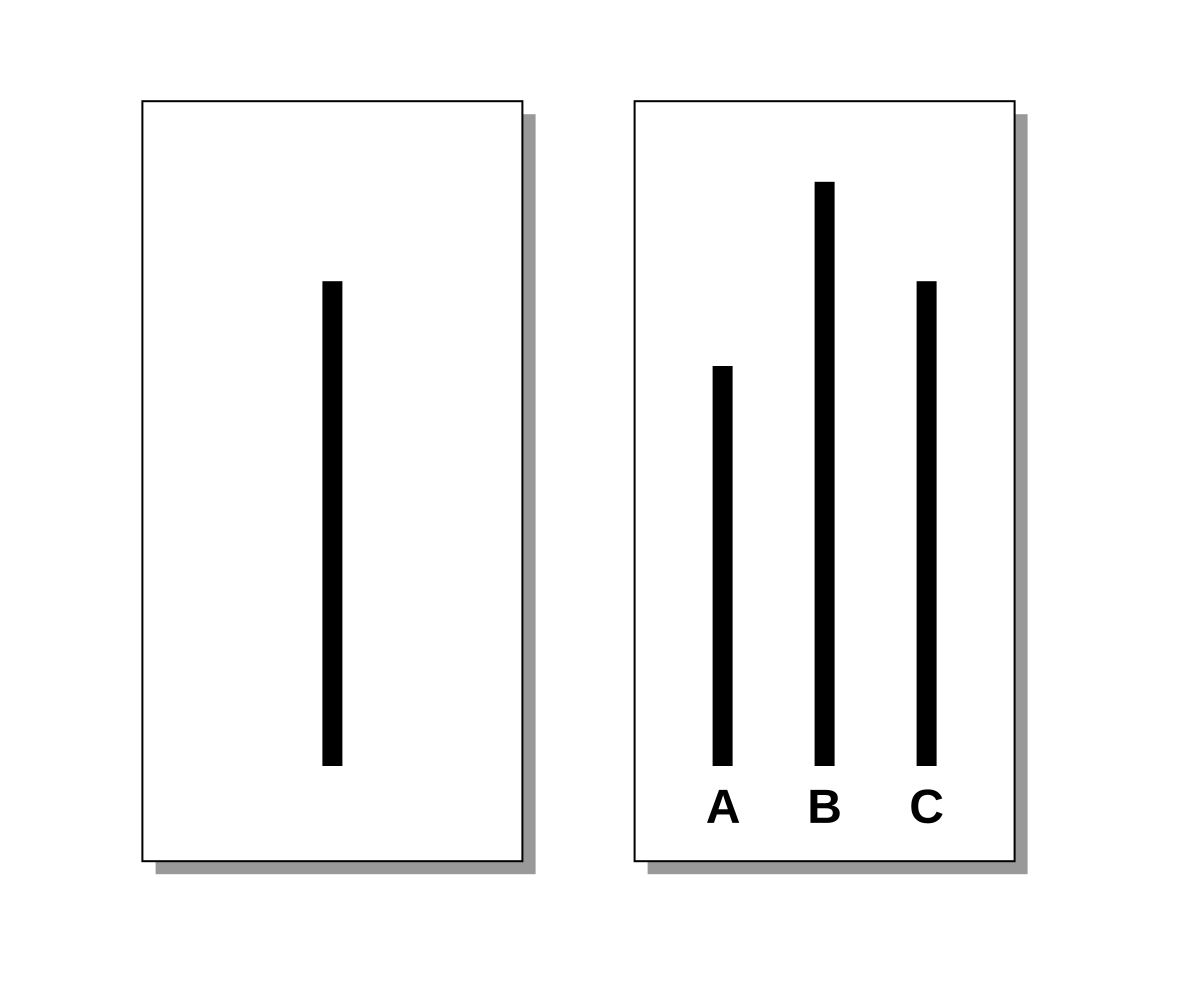
Participants matched a reference line on the left card against three comparison lines on the right card. Fred the Oyster, CC BY-SA 4.0, via Wikimedia Commons
The task was deliberately easy. Participants looked at a card showing a reference line, followed by a second card with three comparison lines labeled A, B, and C. One comparison line matched the reference line exactly, while the other two were visibly different lengths. The real subject was always seated to answer last, after hearing all seven actors give their answers aloud.
Each session involved 18 trials. On the first two trials, everyone gave the obvious, correct answer. Starting on the third trial, the actors unanimously chose the wrong line on 12 critical trials. When tested alone in a control group without actors, participants made errors less than 0.7 percent of the time.
What the results revealed about group pressure
Across all critical trials, 74 percent of participants conformed to the group's incorrect answer at least once, and about one third of all critical trial responses matched the wrong majority. Only 26 percent of participants remained completely independent and defied the actors on every single trial, while 12 percent yielded on almost every test.
Post-experiment interviews revealed differing internal reactions among the participants. Some independent subjects stayed confident or felt no conflict, while others experienced deep self-doubt yet forced themselves to report what they actually saw. Among those who yielded, many stated they simply went along to avoid standing out, while a small minority experienced genuine doubt in their own sensory perceptions.
Test yourself
In an Asch Conformity Experiment scenario, what is the most effective way to reduce groupthink?
Introduce a single dissenting voice. Having even one other person agree with the truth causes conformity to drop dramatically by 80 percent.
In the Asch Conformity Experiment, subjects conform to the group because
their brains actually doubt their senses. Social pressure makes people actively doubt their own perceptions, not just fake agreement for politeness.
The primary takeaway of the Asch Conformity Experiment regarding human behavior is that
people frequently yield to unanimous pressure. Most people will abandon the evidence of their own eyes when faced with a unanimous incorrect majority.
Play the lesson in edgi and the card is yours. It lands on your Map next to the ideas it connects to, and turns from matte to foil to gold as you learn more around it.
Asch wanted to test conformity without the direct influence of an experimenter. Earlier studies on suggestibility risked recording the Hawthorne effect, where participants merely gave researchers the answers they expected to hear.
What happens when a single ally is added to the group?
When even one actor in the group gave the correct answer instead of following the incorrect majority, participant conformity dropped by 80 percent. A single dissenting voice proved sufficient to break the power of group consensus.
How is the Asch methodology used today?
Researchers continue to use the Asch paradigm to evaluate how social conformity changes across different variables. These include variations in age, sex, culture, and the perceived importance of the task.