ObedienceWhy ordinary people follow harmful orders
Obedience is a form of social influence where a person follows direct orders from an authority figure. It is a vertical relationship driven by hierarchy rather than peer pressure. Research shows that ordinary people will routinely follow harmful or immoral commands simply because a perceived legitimate authority told them to do so.
By the edgi team We find the most surprising true thing about an idea and build a 60-second lesson around it.
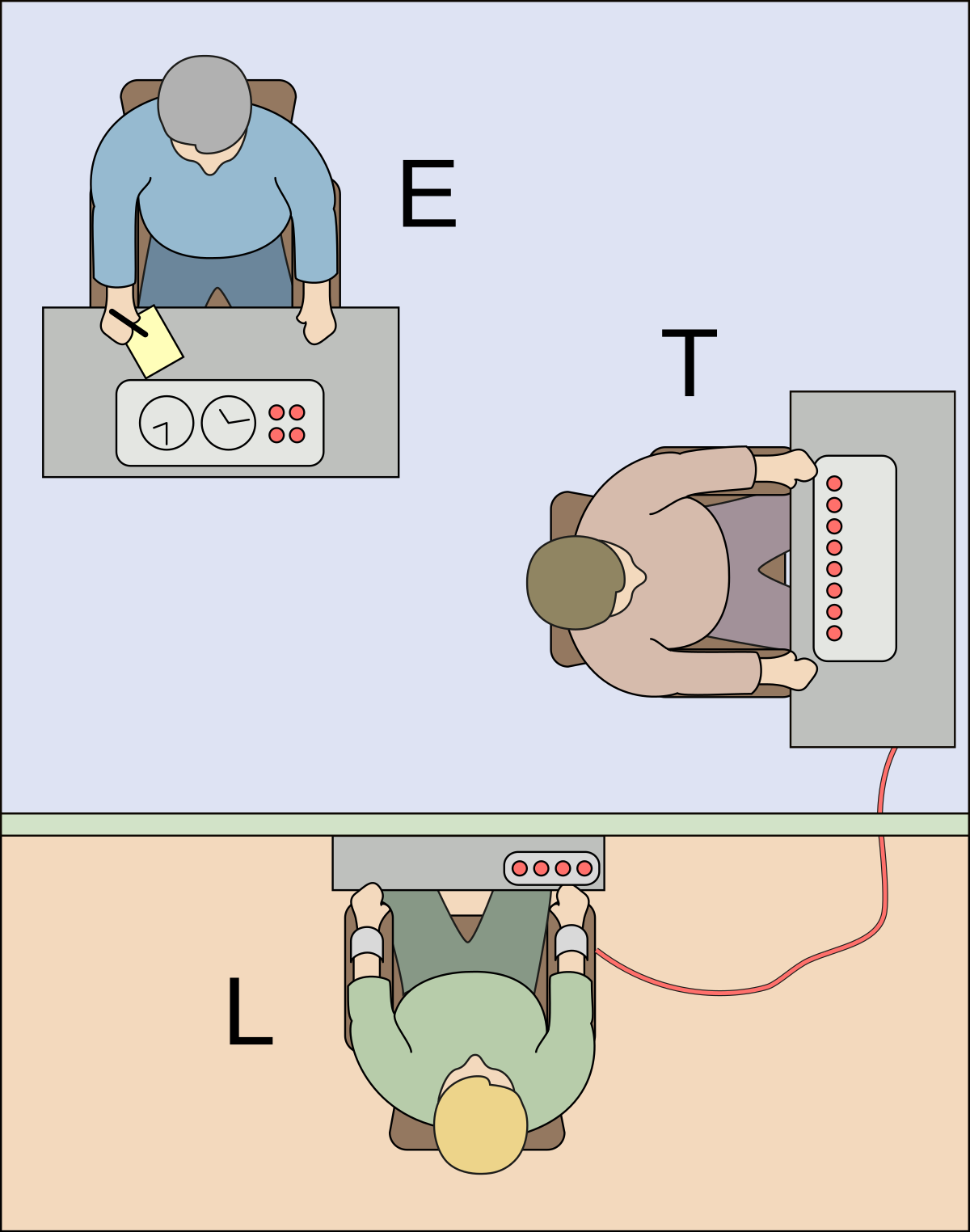
In 1961, psychologist Stanley Milgram recruited ordinary people for what they thought was a memory test. Participants were instructed to deliver electric shocks to a 'learner' in another room for every wrong answer.
Diagram illustrating the setup of the Milgram experiment, showing the experimenter (E) and teacher (T) in one room, and the learner (L) in an adjacent room. Fred the Oyster, CC BY-SA 4.0, via Wikimedia Commons
The shocks were fake, but the participants heard screams of agony. Despite this, 65% continued to the maximum, lethal voltage because the researcher said, 'The experiment requires that you continue.'
The agentic state
Milgram concluded that these participants entered what he called an agentic state. In this state, you stop viewing yourself as a person responsible for your own actions.
Instead, you see yourself as an instrument for someone else's will. You aren't the author of the act; you are just the delivery mechanism.
Not conformity
Obedience is a distinct type of social influence, often confused with conformity. Conformity is about matching the behavior of your peers to fit in.
Obedience is about yielding to a vertical hierarchy. It doesn't matter what your peers do; it matters what the person with the authority says.
How authority changes personal responsibility
In psychological research, obedience is tested by placing people in direct conflict with their own morals. Stanley Milgram found that roughly two thirds of everyday participants were willing to administer what they believed were lethal electric shocks to an innocent person simply because a researcher directed them to proceed.
Soldiers following orders from superior officers represent a standard example of hierarchical obedience in society. US Air Force, Public domain, via Wikimedia Commons
Milgram explained this behavior through what he called the agentic state. When people enter this mindset, they no longer view themselves as responsible for the consequences of their actions. They see themselves purely as instruments carrying out another person's wishes, transferring moral responsibility directly to the authority figure.
Obedience also creates extreme internal conflict. Participants in Milgram's experiments exhibited severe emotional strain, and three even suffered uncontrollable seizures while continuing to obey.
How obedience differs from compliance and conformity
Obedience is distinct from other social behaviors like conformity and compliance. Conformity involves altering behavior to match the actions or opinions of a peer group to fit in. Compliance refers to responding positively to a general request or peer influence without an explicit hierarchy.
Obedience strictly requires a perceived legitimate authority giving explicit instructions. It does not depend on what peers are doing. In Philip Zimbardo's Stanford prison experiment during the 1970s, college students randomly assigned as guards obeyed systemic authority and turned aggressive within days, forcing the study to end after just six days.
Modern findings on obedience
Modern replications demonstrate that high obedience rates persist under more ethical laboratory conditions. Psychologist Jerry Burger replicated Milgram's experiments while introducing safety measures, including a two-step screening process to protect participants from adverse psychological effects.
Burger capped the maximum shock level at 150 volts because Milgram's data showed that most extreme distress occurred after that threshold. Testing both men and women across identical conditions, Burger confirmed that obedience to authority remains a consistent human response across genders.
Test yourself
How does Milgram's concept of obedience differ from conformity?
Obedience involves yielding to authority. Obedience requires a vertical hierarchy where you follow orders from an authority figure, whereas conformity is about matching peers to fit in.
In Milgram's obedience experiments, participants followed orders because they feared social rejection from their peers.
False. Obedience is distinct from conformity; participants followed orders due to the perceived authority of the researcher rather than a desire to fit in with peers.
In Milgram's variations, having a(n) ___ peer who refused to obey caused the participant's obedience to drop to 10%.
disobedient. Social support for rebellion is one of the most powerful tools for breaking the cycle of blind obedience.
Play the lesson in edgi and the card is yours. It lands on your Map next to the ideas it connects to, and turns from matte to foil to gold as you learn more around it.
Why did Stanley Milgram originally study obedience?
Milgram designed his 1960s experiments to investigate how Nazi authorities managed to convince ordinary citizens to participate in the mass murders of the Holocaust. His findings demonstrated that obedience to authority was the standard human response rather than an isolated exception.
Is obedience inherently immoral?
Depending on the context, obedience can be moral, immoral, or amoral. Milgram noted that authority systems are a basic requirement for all communal living, meaning obedience is a fundamental part of social structures rather than a strictly negative trait.