Mind wandering is the flow of spontaneous thoughts that are unrelated to your current task and disconnected from your immediate surroundings. Instead of going quiet when you stop focusing, the brain activates a high-energy circuit called the default mode network. This shift allows the brain to engage in prospection, simulating future scenarios and making creative connections that linear focus misses.
By the edgi team We find the most surprising true thing about an idea and build a 60-second lesson around it.
In 2001, neuroscientist Marcus Raichle made a startling discovery while watching brain scans. He expected activity to drop when subjects stopped focusing on a task. Instead, he saw the exact opposite.
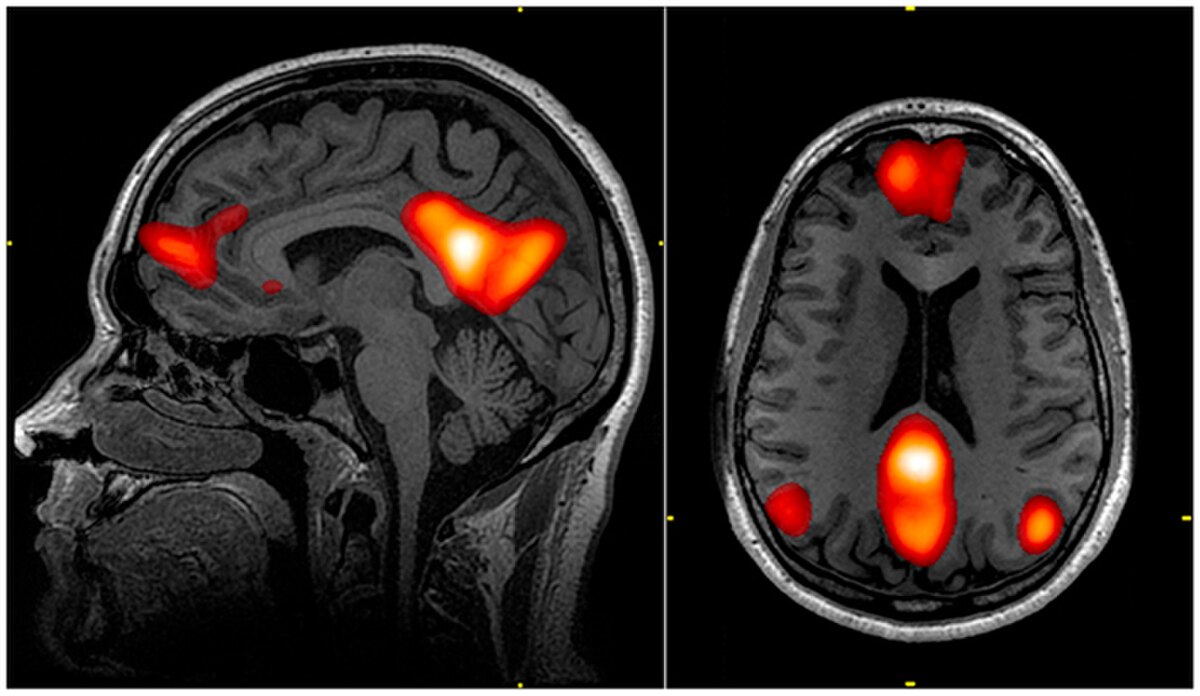
A specific network of brain regions lit up like a Christmas tree the moment the subjects' minds began to drift.
Two fMRI scans showing activity in the default mode network of the brain. John Graner, Neuroimaging Department, National Intrepid Center of Excellence, Walter Reed National Military Medical Cent, Public domain, via Wikimedia Commons
The default setting
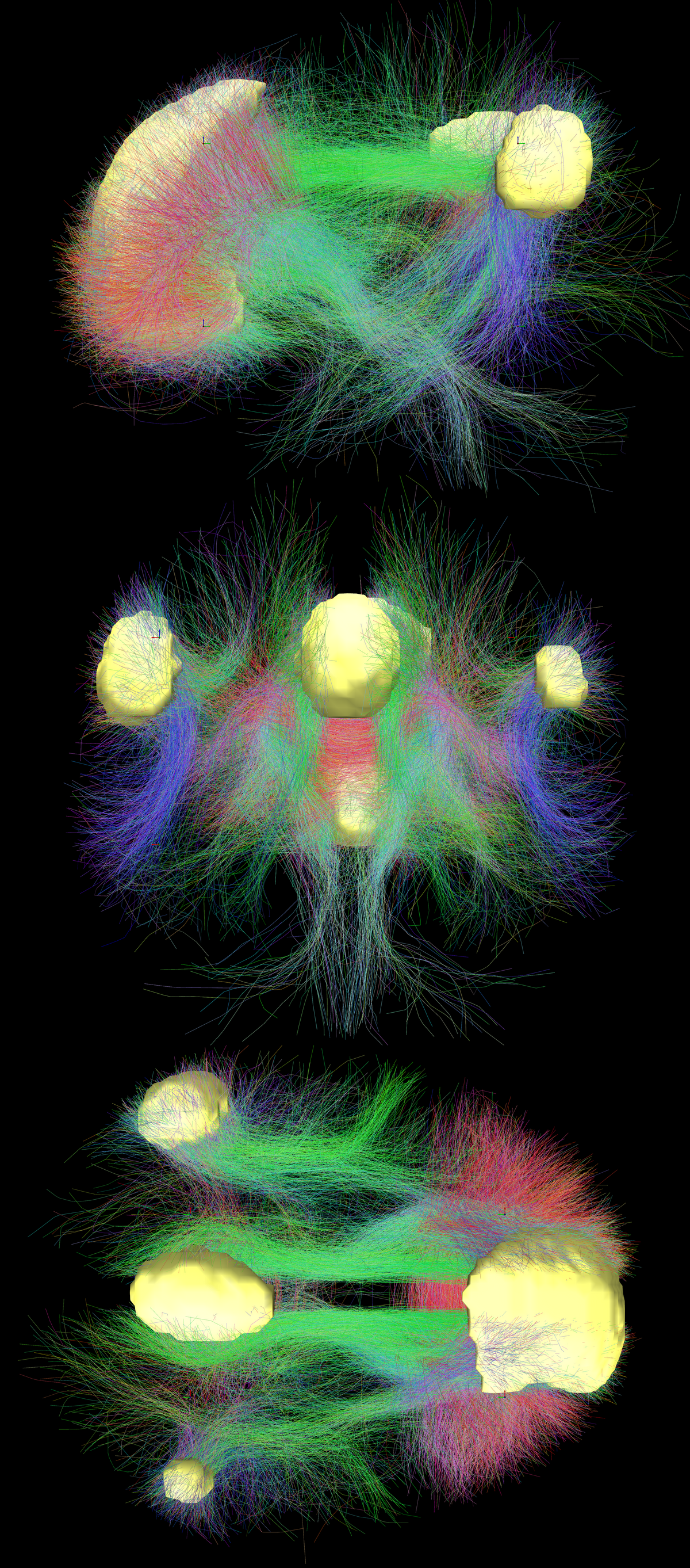
This circuit is now known as the Default Mode Network. It is your brain’s idle state, but it is anything but quiet. It is a high-energy, complex system dedicated entirely to self-reflection and mental time travel.
Three views (top, front, side) of the default mode network connectivity in the brain, showing main regions in yellow and connectivity between regions color-coded by structural traversing direction… Andreashorn, CC BY-SA 4.0, via Wikimedia Commons
Why we wander
Mind wandering is a survival mechanism called prospection. By simulating future scenarios, your brain prepares you for problems before they happen. It is the engine of creativity, making the distant, stochastic leaps that linear focus simply cannot reach.
How the brain decouples from the real world
When your mind wanders, your brain actively reduces its processing of incoming sensory information. Event-related potential studies show that the brain processes both relevant and irrelevant external stimuli with far less detail during drift. This effect is known as the decoupling hypothesis.
Driving on an open road is a classic trigger. Because optimal driving becomes automatic, it demands minimal engagement from the task positive network, the system active during focused tasks. Your attention shifts inward to the default mode network in the medial frontal and medial parietal cortex. Because vigilance drops, you may drive for miles without remembering the physical environment you passed through.
Mind wandering is both a temporary state and a stable personal trait. When internal focus completely overrides environmental demands, it can cause performance failures in labs and real-world hazards like car accidents.
The three subtypes and future bias
Spontaneous thought is not uniform. In the 1960s, John Antrobus and Jerome L. Singer developed the Imaginal Processes Inventory, identifying three distinct subtypes: positive constructive daydreaming, guilty fear of failure, and poor attentional control. Thought content often reflects mood, with task-unrelated thoughts being particularly common in states of low or depressed affect.
Human mind wandering exhibits a strong prospective bias. People spend substantially more time mentally exploring the future than recalling the past. This mental simulation functions as an incubation stage for creative problem-solving and prepares the brain for upcoming challenges before they happen.
How scientists measure wandering thoughts
Researchers track task-unrelated thoughts using thought sampling experiments like the sustained attention to response task. In this setup, words appear rapidly on a screen for 300 milliseconds. When target words appear, participants press a key. Roughly 60 percent of the time, the software interrupts the test with a thought probe to check if the participant was focused on the task or drifting.
Scientists also use the experience sampling method in daily life. Participants carry digital devices that beep throughout the day, prompting them to log their current state of thought control, thought content, and context. These methods, combined with functional magnetic resonance imaging, allow researchers to track how the brain generates spontaneous streams of consciousness.
Test yourself
Why do people frequently daydream about future social encounters?
To rehearse and prepare responses. Daydreaming is a survival mechanism called prospection, actively simulating future scenarios to prepare you before they happen.
What does brain activity do when you stop focusing on a task?
Shifts to an internal network. Stopping a task does not power down the brain; it activates a specialized circuit dedicated to self-reflection.
An inventor suddenly solves a stubborn design problem while doing dishes. Why?
Idle simulating finds distant links. Stepping away from direct focus allows the brain's idle network to make unexpected leaps that linear attention misses.
Play the lesson in edgi and the card is yours. It lands on your Map next to the ideas it connects to, and turns from matte to foil to gold as you learn more around it.
Yes. Studies show that consuming alcohol increases the frequency of mind wandering by impairing attentional control.
Can meditation work with mind wandering instead of fighting it?
Nondirective meditation techniques like Acem Meditation work by utilizing spontaneous mind wandering rather than forcing strict concentration. These methods are often less mentally demanding than concentration-based meditation styles.
Is mind wandering completely random?
Not necessarily. Brain scans show periods of mind wandering can activate both the default mode network and executive control systems simultaneously, suggesting that many wandering thoughts are actually goal-oriented.