The cocktail party effect is your brain's ability to focus on a single speaker while filtering out competing background noise. It splits incoming sound into separate streams and suppresses the ones you choose to ignore. At the same time, it keeps a subconscious scan running, letting high-priority sounds like your name break into your awareness.
By the edgi team We find the most surprising true thing about an idea and build a 60-second lesson around it.
You are in a crowded, noisy room, yet you can follow one friend's voice perfectly. Your brain is performing auditory scene analysis, separating the wall of sound into distinct streams.
A crowded cocktail bar is bustling with people dressed in formal attire, many holding drinks and engaging in conversation. Financial Times, CC BY 2.0, via Wikimedia Commons
It doesn't just ignore the noise; it actually suppresses the neural response to the people you aren't listening to.
The air traffic origin
The effect was named in 1953 by scientist Colin Cherry while studying air traffic controllers. He needed to know how pilots could track multiple instructions at once.
The interior of the Seattle–Tacoma International Airport control tower, showing air traffic controllers at their stations with radar displays and other equipment. Jelson25, CC BY 3.0, via Wikimedia Commons
He used a dichotic listening test, playing different audio into each ear, to prove that we cannot consciously process two streams of speech simultaneously.
The name exception
Even with the volume turned down on background noise, your brain never fully stops listening. It keeps a low-level security scan running on every ignored conversation.
That is why you can be deep in a boring chat and instantly hear your name mentioned from across the room.
The gatekeeper
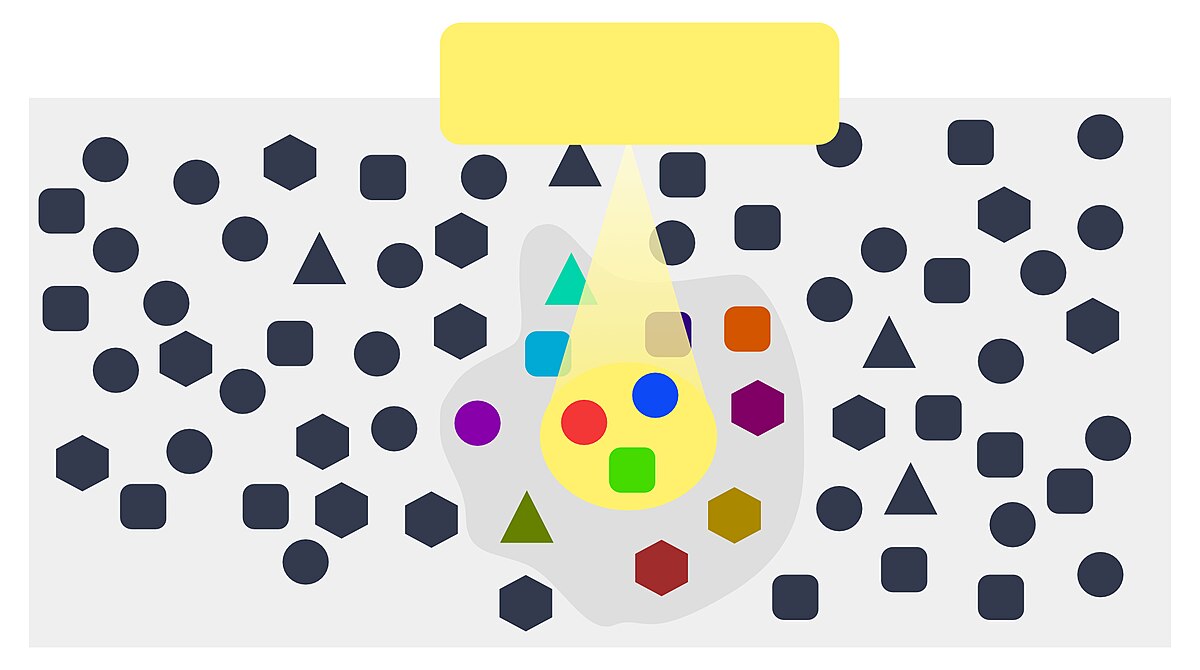
This filtering relies on your working memory to act as a gatekeeper for sensory input. For people with ADHD, that gate is often harder to latch, making it difficult to silence the background chaos.
An abstract diagram illustrating working memory shows a spotlight of attention focusing on a subset of diverse shapes and colors within a larger field of uniform dark shapes. Blacktc, CC BY-SA 4.0, via Wikimedia Commons
The effect is a constant, invisible labor your auditory cortex performs to keep you sane.
How the brain separates sound
Your brain relies on binaural hearing, which means listening with both ears, to isolate a voice from background chatter. Using two ears lets the auditory system locate where sounds originate in space. Once it pins down a location, it extracts the relevant voice through two processes: better-ear listening, which picks the ear with the clearer signal, and binaural unmasking, which combines signals from both ears to pull speech out of noise.
This processing occurs mainly in the left hemisphere of the superior temporal gyrus, a region of the auditory cortex. A fronto-parietal network involving the inferior frontal gyrus and parietal sulci manages attention control and shifts your focus. Brain scans show that both target and background sounds travel along the same pathways, but the brain actively allocates higher neural attention to the chosen speaker.
Why your name breaks through
In 1953, cognitive scientist Colin Cherry coined the term while studying how air traffic controllers separated competing pilot transmissions over a single loudspeaker. Cherry tested this using dichotic listening tasks, where participants wore headphones playing different audio streams to each ear and repeated only one stream out loud.
Cherry and later researcher Neville Moray found that participants blocked out almost everything from the ignored ear, with one major exception: personally relevant words. When a participant's own name was spoken in the unattended stream, it broke through the block. The brain continuously evaluates the salience, or subjective importance, of background sounds without your conscious effort.
How selective hearing changes with age
Selective attention begins in early development. Infants as young as five months old turn toward familiar speech, and the ability to detect their own name amidst noise develops by 13 months. Babies also consistently show a preference for baby talk over adult speech tones.
The capacity to filter competing auditory streams peaks in young adulthood. Older adults experience greater difficulty tuning into a single speaker when competing conversations contain meaningful or distracting words.
Test yourself
If you try to listen to two different audio tracks at the exact same time, what happens?
The brain rapidly alternates between them. Conscious processing cannot handle two streams of speech at once; instead, the brain switches attention back and forth in rapid succession.
How can someone instantly hear their name called from across a loud, chaotic room?
A background security scan runs constantly. Ignored streams are never truly dead. A low-level filter stays active in the background, specifically primed to catch high-priority triggers like your name.
When focusing on one voice in a crowd, what does the brain do to the rest?
Physically suppresses neural activity. You aren't merely ignoring the noise by choice. Your brain literally dials down the neural signals of competing voices before they register.
Play the lesson in edgi and the card is yours. It lands on your Map next to the ideas it connects to, and turns from matte to foil to gold as you learn more around it.
What happens when someone cannot filter background noise?
A person who struggles to separate speech from background noise is often described as having the cocktail party problem or cocktail party deafness. In clinical terms, this condition is known as King-Kopetzky syndrome or auditory processing disorder.
What acoustic clues help you focus on one speaker?
Colin Cherry's research showed that the brain uses physical traits of sound to tell voices apart. Key factors include the physical location of the speaker, their vocal pitch, their speaking rate, and whether the speaker is male or female.
Does having single-sided hearing affect this ability?
Yes. People with only one functioning ear face much more distraction from background sounds because the brain needs input from two ears to localize sound sources and perform binaural unmasking.