Diversification: getting safer returns with no trade-off
Diversification is the strategy of spreading money across different investments so a portfolio is not exposed to the risk of any single asset. Because independent assets rarely fall in price at the exact same time, holding a variety of them lowers overall volatility. In many cases, it makes a portfolio less volatile than even its single safest investment.
By the edgi team We find the most surprising true thing about an idea and build a 60-second lesson around it.
Diversification works because different assets rarely react to the exact same news in the exact same way. When one investment takes a hit, an uncorrelated asset often zags in the opposite direction to cushion the blow.
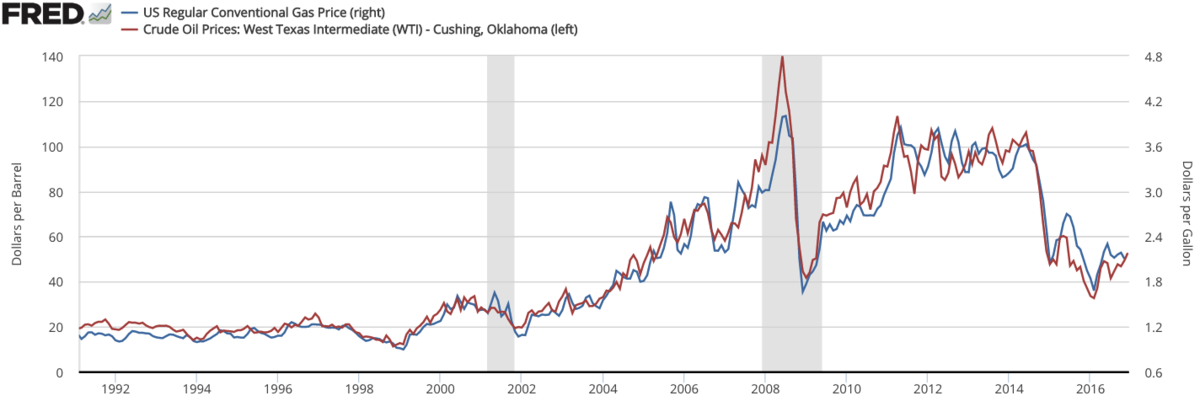
A dual-axis line graph from FRED plots "US Regular Conventional Gas Price" (right Y-axis, dollars per gallon) and "Crude Oil Prices: West Texas Intermediate (WTI), Cushing, Oklahoma" (left Y-axis,… Wikideas1 Wikideas1 (talk) (Uploads), Public domain, via Wikimedia Commons
Economists call it the only free lunch because it reduces investment risk without necessarily hurting your returns.
The nobel prize
Before 1952, investors simply tried to pick the single best individual stocks based on gut feeling and prestige. Then an economist named Harry Markowitz published a paper that turned investing from an art into a hard science.
The NYSE's stock exchange traders floor in 1963 shows numerous traders in suits, with one man in the foreground raising a piece of paper. Thomas J. O'Halloran, Public domain, via Wikimedia Commons
He proved that a basket of mediocre stocks could actually be safer if their prices moved independently of one another. He later won a Nobel Prize for showing that a stock's isolated risk matters far less than how it fits into the whole group.
Putting it into practice
Achieving low correlation across individual stocks used to require a massive bank account and a team of math whizzes. Today, an index fund lets anyone own thousands of global companies instantly with a single click.
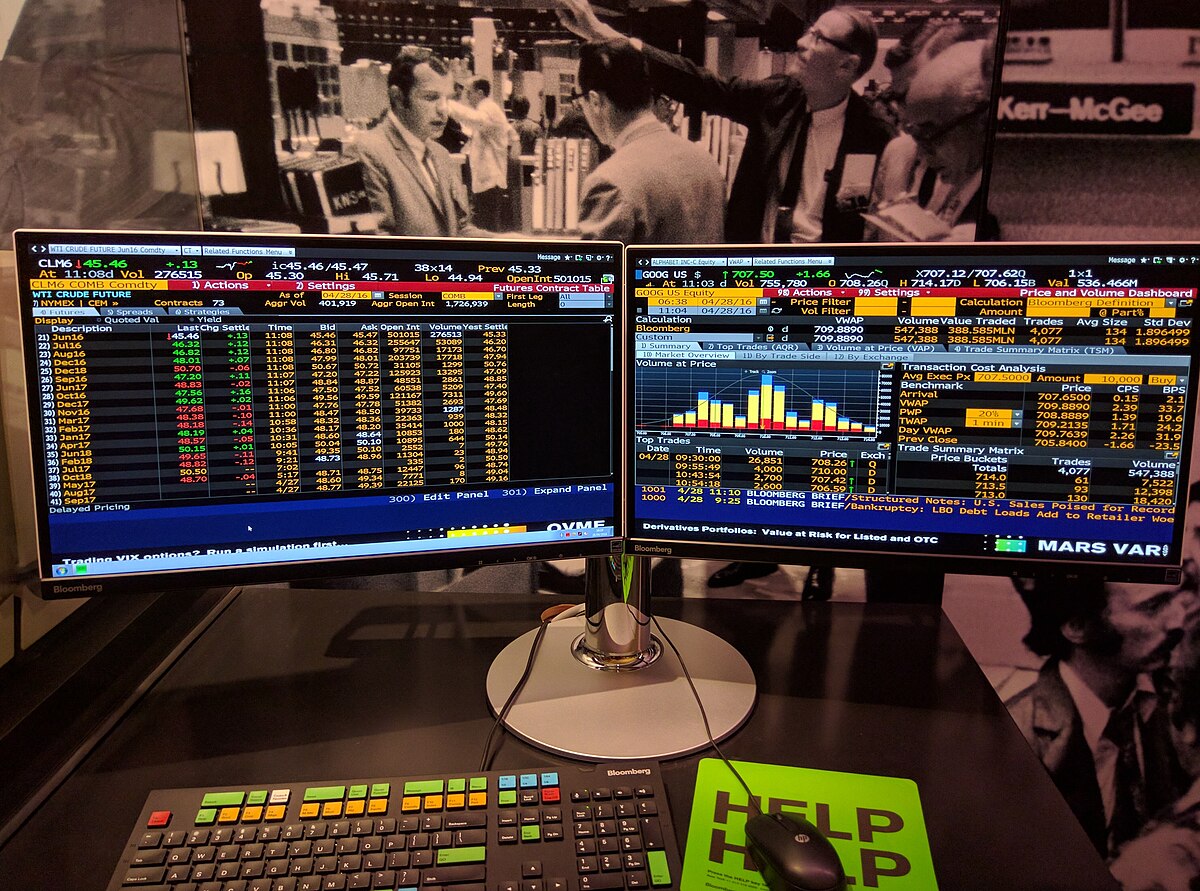
A Bloomberg Terminal setup is displayed with two monitors showing financial data and charts, and a specialized keyboard with color-coded keys. Travis Wise, CC BY 2.0, via Wikimedia Commons
Through smart asset allocation and tools like mutual funds, everyday investors can build bulletproof portfolios in seconds.
How does diversification reduce investment risk?
A diversified portfolio can actually have lower volatility than the least volatile asset inside it. When investments do not move in perfect sync, the drops in one asset are offset by stability or gains in another.
Holding only one stock is dangerous because a single company's shares can easily drop 50% in a year. Holding 20 stocks chosen across different industries, company sizes, and asset types makes a 50% crash far less likely because broad industry downturns get diluted across the rest of the basket.
How many assets make a portfolio diversified?
Most of the mathematical benefit of diversification comes from the first 15 to 20 different stocks. While some sources cite 30 stocks as a rule of thumb, a portfolio can be diversified with as few as 10 carefully chosen holdings.
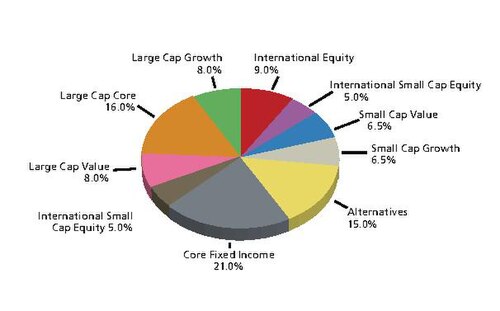
This chart shows how splitting capital across distinct asset classes creates a balanced portfolio rather than relying on one investment. Keithbob (talk) (Uploads), CC0, via Wikimedia Commons
Diversification can keep expanding as long as more uncorrelated assets are available. The capital asset pricing model suggests buying a pro-rata share of all available assets, which is the exact theory behind modern index funds. Beyond buying whole markets, investors also use geographic diversification to tap into emerging markets in Asia and Latin America or balance assets using risk parity strategies.
What happens to expected returns?
Diversification narrows the range of potential outcomes without necessarily lowering your expected return. The return of a diversified portfolio will never beat the single best-performing asset in the group, but it will always beat the worst-performing one.
You trade away the possibility of striking gold on one single winner to protect yourself from total ruin. By eliminating extreme losses on the bottom end, it creates a much more stable financial result over time.
Test yourself
A diversified portfolio holds several assets that all fall after the same news. What’s the key limitation?
The assets may be too correlated to cushion losses. Many holdings may still offer little diversification if they react alike; the mix’s co-movement matters more than the number of assets.
How does diversification lower a portfolio’s risk?
By combining assets that don’t move in lockstep. Assets that respond differently to events can offset one another, reducing total portfolio risk without requiring every holding to be safe.
Does financial diversification reduce portfolio risk by eliminating the risk of every individual asset?
No, it offsets losses through uncorrelated assets.. Diversification does not make individual assets safer. Instead, it combines holdings that react differently to events so that losses in one are balanced by gains or stability in another.
Play the lesson in edgi and the card is yours. It lands on your Map next to the ideas it connects to, and turns from matte to foil to gold as you learn more around it.
What is the other main technique for reducing investment risk?
Hedging is the other primary method alongside diversification. While diversification spreads capital across different assets, hedging uses strategic positions to directly offset potential losses.
What is risk parity?
Risk parity is an allocation method that weights assets in inverse proportion to their individual risk. It gives each asset class an equal amount of total risk in the portfolio.
Can holding too many baskets create any disadvantages?
Managing a very large number of separate investments can increase overall costs. While adding uncorrelated assets lowers volatility, holding many individual positions can bring operational and transaction expenses.