Efficient Market HypothesisWhy the market is hard to beat
The Efficient Market Hypothesis is an economic theory stating that asset prices always reflect all available information. If prices already absorb what is known, no investor can consistently beat the broader market on a risk-adjusted basis, because prices should move only when genuinely new information arrives.
By the edgi team We find the most surprising true thing about an idea and build a 60-second lesson around it.
Imagine a company discovers a massive gold mine. The stock price doesn't wait for you to read the news; it jumps the millisecond the information becomes public. By the time you open your trading app, the 'deal' is already gone. The price has already adjusted to reflect the new reality.
This is the core of the Efficient Market Hypothesis: asset prices always reflect all available information.
The collective brain
Economist Eugene Fama formalized this idea in the 1960s. He argued that because the market is a giant, hyper-connected machine, it is smarter than any single investor. If all known info is already priced in, the only things that move prices are 'new' events, and by definition, those are unpredictable.
A portrait of Eugene Fama, a Nobel laureate in economics, smiling and looking to the right. Bengt Nyman, CC BY 2.0, via Wikimedia Commons
This is called a random walk. If you can't predict the news, you can't predict the price.
The passive shift
If you can't beat the market, why pay a fund manager to try? This theory helped trigger the massive shift toward low-cost index funds. Critics in behavioural finance argue that the market isn't a perfect machine, but a stampeding herd prone to bubbles and irrational panic.
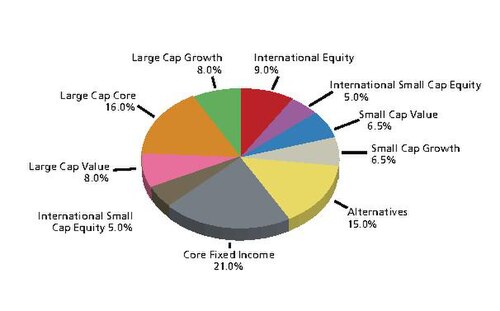
Pie chart illustrating an example investment portfolio with diverse asset allocation. Keithbob (talk) (Uploads), CC0, via Wikimedia Commons
They point to arbitrage, trading on price errors, as proof that the market is occasionally, spectacularly wrong.
How information sets define market efficiency
In his 1970 review, economist Eugene Fama grouped market efficiency tests into three categories based on the information reflected in prices: weak-form, semi-strong-form, and strong-form.
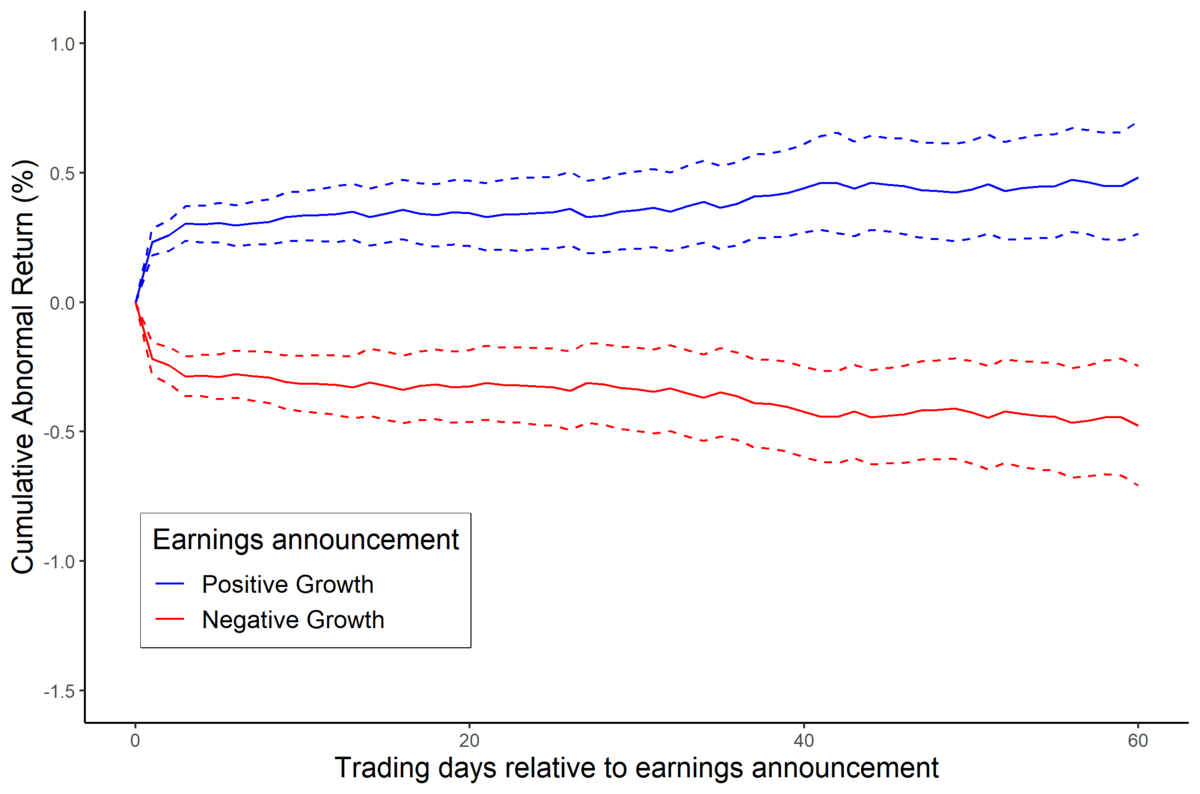
Stock prices adjust rapidly to new earnings announcements, which makes it hard to profit by trading on them. Econwikiworker, CC BY-SA 4.0, via Wikimedia Commons
Weak-form tests focus purely on historical prices to see if past trends predict future returns. Semi-strong-form tests examine all publicly available information beyond past prices, such as company mergers or earnings reports. Strong-form tests evaluate whether prices reflect private or insider information as well.
When valuable information becomes public, traders act on it immediately. Their buying or selling shifts the asset price until that data no longer offers an advantage.
Why prices behave like a random walk
The mathematical foundation of market efficiency connects to the absence of arbitrage, which means there is no risk-free way to make a profit. Under the fundamental theorem of asset pricing, a stock price equals the discounted expected value of its future price and dividends.
If the discount factor remains constant and no dividend is paid over a short window, the logarithm of stock prices follows a random walk with drift. That result depends on those assumptions, but studies from the 1930s to the 1950s did find that US stock prices followed a random walk in the short term.
Test yourself
Under the Efficient Market Hypothesis, what should an investor expect after public news about a company is released?
The price adjusts, and future moves remain unpredictable.. If the news is already reflected in the price, it does not reliably predict future returns; later price moves depend on new, unpredictable information.
Under the Efficient Market Hypothesis, why is public news hard to use for a lasting trading edge?
Prices adjust as public information becomes available.. Public information is quickly reflected in prices, so acting on it after release usually does not provide a lasting advantage.
How does new information end up in a stock's price?
Traders buy or sell on it. Prices move when traders buy or sell on what they believe the news means. Their trades settle at a new price, so no official has to change it.
Play the lesson in edgi and the card is yours. It lands on your Map next to the ideas it connects to, and turns from matte to foil to gold as you learn more around it.
Who first developed the idea of market efficiency?
The concept traces back to researchers like Louis Bachelier in 1900, Benoit Mandelbrot in 1963, and Paul Samuelson in 1965. It is most closely associated with Eugene Fama, partly because of his influential 1970 review of the research.
Do professional investors consistently beat the market?
Research by Alfred Cowles in the 1930s and 1940s suggested that professional investors were generally unable to outperform the overall market. The hypothesis helped drive the shift toward low-cost index funds.
What are market anomalies?
Because the hypothesis must be paired with a specific model of risk to make testable predictions, financial researchers look for market anomalies. These are real-world price deviations from specific risk models.