Freudian UnconsciousRepressed ideas that push back
The Freudian unconscious is the part of the mind holding hidden thoughts, drives, and memories that a person cannot inspect directly. Sigmund Freud argued that pushing anxiety-producing conflicts out of awareness through repression does not destroy them. Instead, these hidden ideas stay active and exert constant pressure on conscious behavior.
By the edgi team We find the most surprising true thing about an idea and build a 60-second lesson around it.
Freud used the unconscious for wishes, memories, and conflicts kept out of awareness but still active in a person's life. In his account, repression did not make a conflict disappear. It could return indirectly in a dream, a symptom, or a slip of the tongue.
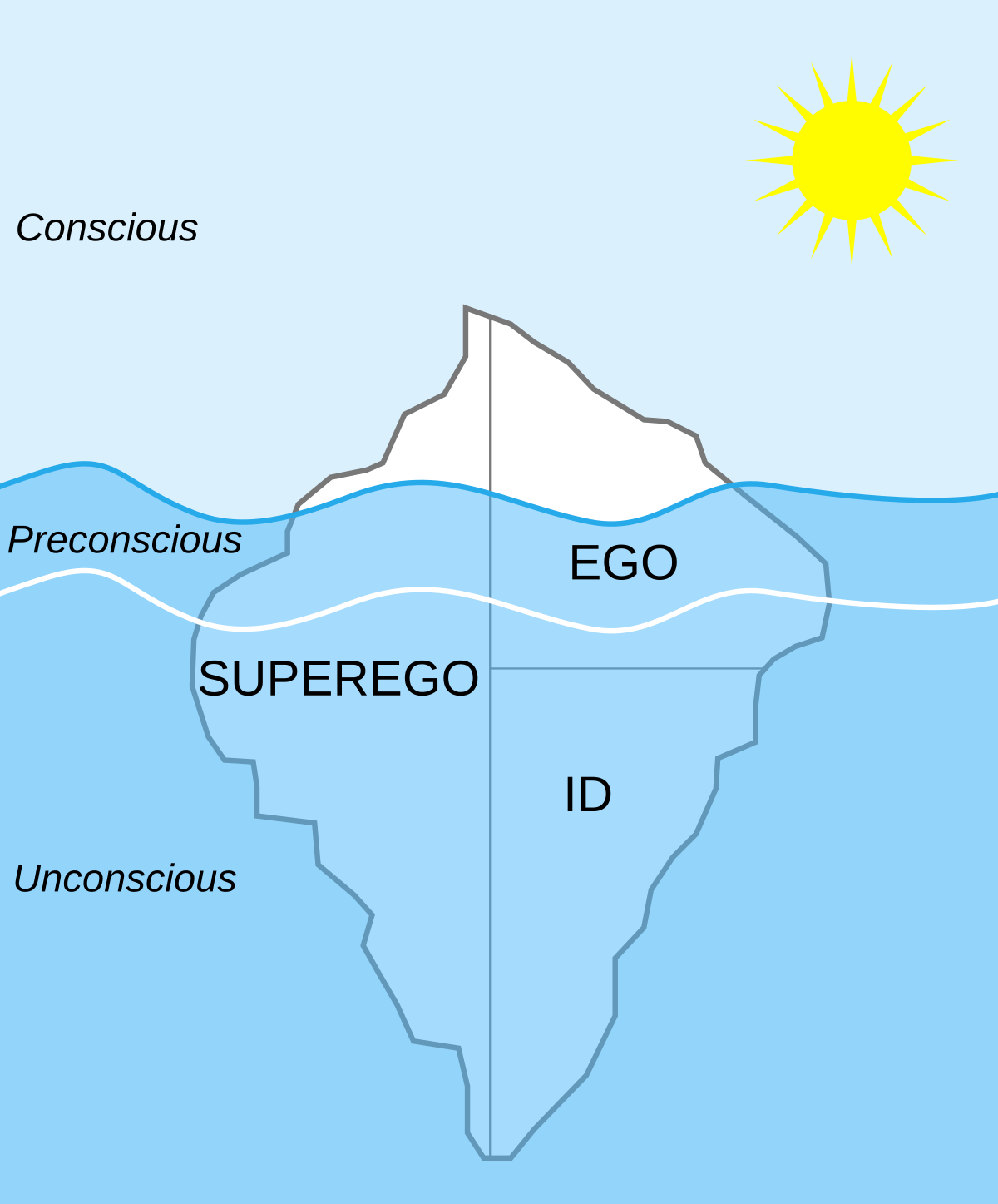
Diagram illustrating the iceberg metaphor for Freud's theory of the human mind, showing the Conscious, Preconscious, and Unconscious levels. historicair, Public domain, via Wikimedia Commons
That is a dynamic unconscious: material is hidden, but it still presses for expression. It is more specific than simply doing something without noticing.
A memory test without memory
In a famous study, people with amnesia had trouble recalling or recognizing a word list they had just seen. The same people were shown three-letter beginnings and asked for the first word that came to mind. They completed more of the earlier words than chance would predict.
Implicit memory names that pattern. A past experience changed a present response despite the person's impaired ability to bring the experience back to mind.
Two different claims
Both ideas concern effects outside awareness, but they answer different questions. Implicit memory asks whether past exposure changes a response without recall. Freud's unconscious asks how a conflict or wish might keep working when a person cannot acknowledge it directly.
Keeping the two apart lets the word unconscious stay useful instead of turning every habit, dream, or familiar feeling into the same thing.
How repression drives unconscious material
Repression actively forces threatening childhood drives and anxiety-producing thoughts out of conscious reach. Unlike thoughts that are merely forgotten or latent in the preconscious, repressed ideas cannot be recalled through normal introspection. They remain dynamic, constantly pushing for an outlet.
Because conscious awareness blocks direct expression, unconscious drives break through in disguised or distorted forms. They surface in everyday life as neurotic symptoms, dreams, jokes, and slips of the tongue. Psychoanalysis treats these conscious slip-ups and symptoms as clues to interpret the underlying conflict.
Freud later refined this view by organizing unconscious processes into a structural model of the mind. In this framework, unconscious drives and forces are described through the interactions of the id, ego, and superego.
The origin of the unconscious concept
Freud popularized the unconscious in modern culture, but he did not invent the word or the core concept. The German philosopher Friedrich Schelling coined the term unbewusst in the 18th century, and Samuel Taylor Coleridge later introduced it into English. Ancient Hindu texts known as the Vedas recorded unconscious mental influences thousands of years earlier.
By the nineteenth century, unconscious cerebration was widely recognized across psychology and philosophy. Figures like Arthur Schopenhauer, Eduard von Hartmann, William James, and Wilhelm Wundt wrote extensively about processes operating beneath conscious thought before psychoanalysis emerged.
Freud transformed these philosophical roots into a clinical tool for explaining mental illness. He distinguished between the descriptive unconscious, which merely names anything outside awareness, and his dynamic unconscious, where repressed material actively shapes human life.
Test yourself
An old song pops into your head. What likely triggered it?
Past exposure left a trace without recall. Implicit memory shows past experiences can shape present thoughts even when you cannot consciously recall them, requiring no deep psychological conflict.
You solve a puzzle faster after seeing a similar one earlier, despite not remembering it. Why?
Prior experience primed a present response. This demonstrates implicit memory at work: past exposure changes a present response without the person needing to bring the original experience back to mind.
A patient has impaired recall of words but completes their beginnings. What does this show?
Past exposure guides a response without recall. This is the pattern called implicit memory: earlier experience affects a response even when a person cannot consciously recall it.
Play the lesson in edgi and the card is yours. It lands on your Map next to the ideas it connects to, and turns from matte to foil to gold as you learn more around it.
What is the difference between the preconscious and the unconscious?
The preconscious holds latent thoughts and memories that are currently out of mind but easily recalled at will. The unconscious contains repressed material that is barred from awareness and cannot be accessed through ordinary introspection.
How does implicit memory differ from Freud's unconscious?
Implicit memory describes past experiences altering current performance without conscious recall, such as completing word stems or using learned skills. Freud's unconscious specifically involves active emotional conflicts and wishes that remain hidden due to psychological repression.