GaslightingWhy it targets your judgment, not facts
Gaslighting is the psychological manipulation of a person into questioning their own perception of reality. It involves persistent false narratives that erode someone's trust in their own memory and judgment, often creating total dependence on the manipulator. Unlike an ordinary disagreement, it shifts the focus away from the facts and onto whether the victim is mentally fit to report what happened.
By the edgi team We find the most surprising true thing about an idea and build a 60-second lesson around it.
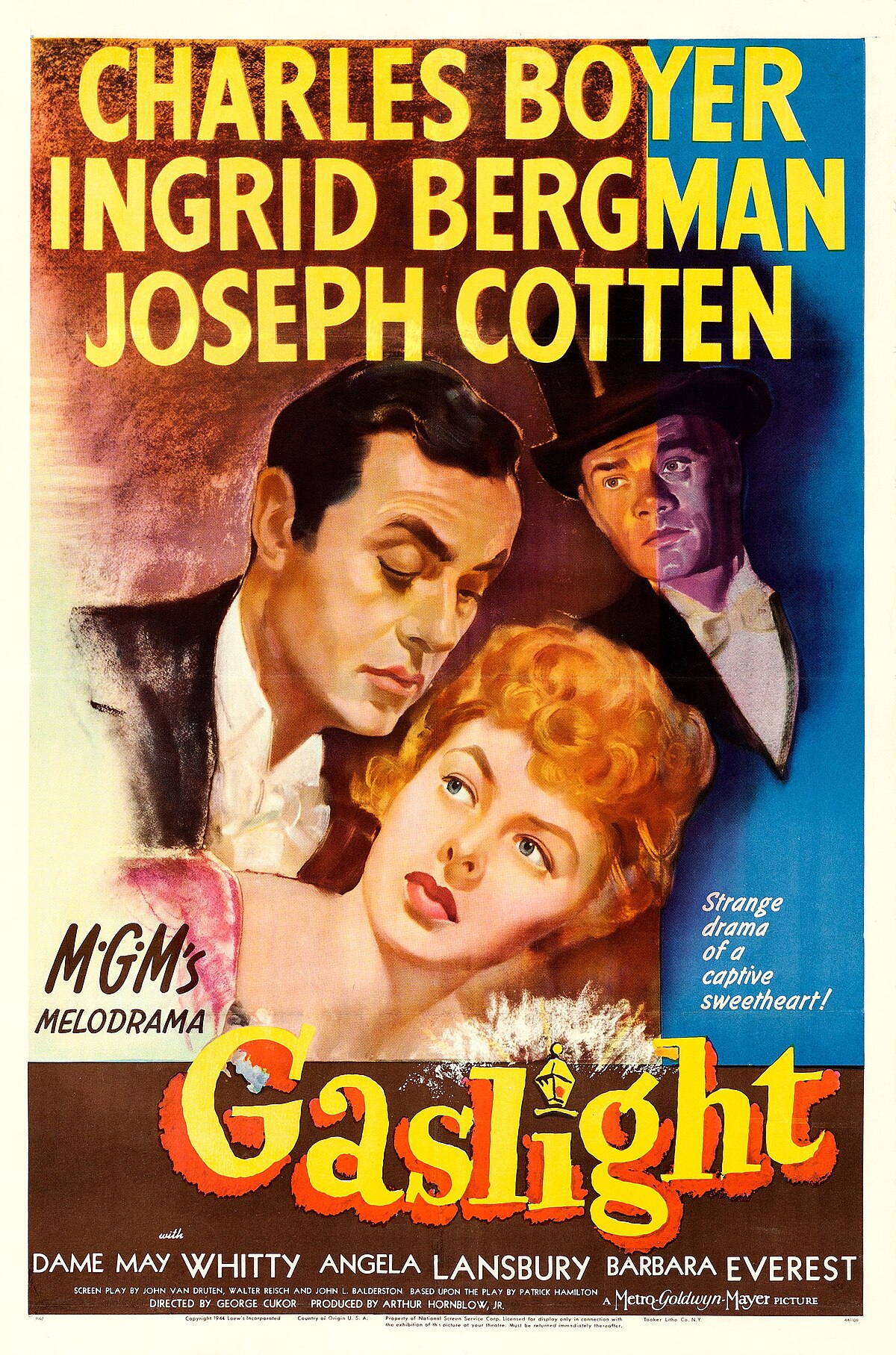
The word comes from a 1944 film called Gaslight. A woman watches the gas lamps in her house go dim every evening, and hears footsteps in the attic above her. She is right about all of it. Her husband is up there hunting for hidden jewels, and lighting the attic lamps drops the pressure to every other lamp in the house.
"Copyright 1944 Loew's Incorporated"., Public domain, via Wikimedia Commons
When she says so, he tells her kindly that she is imagining it, and that she has been imagining a lot lately. He is not arguing about the lights. He is building a case that she cannot be trusted to report a room, and he means to have her committed on it.
The instrument, not the fact
An ordinary lie disputes one thing and leaves you intact. You check, you find out, and you are fine. Gaslighting goes after the equipment you would check with. It is a long run of small corrections to your memory, your perception and your judgment, until the readings stop counting.
That is why it is slow and why it is boring. A brooch you must have mislaid, a letter that never came, an argument that went differently. No single item is worth a fight. When the instrument is gone you have to borrow one, and there is exactly one available. The person doing the correcting becomes your source for what happened yesterday.
The tell is not the disagreement. It is the subject changing from what happened to what is wrong with you. And it works far better when other people will nod along. "You are hysterical", "you are paranoid", "you have been drinking": the accusation is picked for who will believe it.
It has put people in hospitals. Doctors in the Lancet described three cases of relatives trying to have someone committed on exactly those grounds, and named the pattern after the film. That is the difference between an argument and this. An argument can end, because somebody can be shown to be right. This one has no end, because it was never about the lights.
How gaslighting works
Gaslighting relies on an unequal power dynamic or a relationship where one person trusts the other. The manipulator steadily puts forth a false narrative, insisting that the other person is mistaken, misremembering events, or reacting irrationally. While one party listens and tries to understand the other person's perspective, the manipulator consistently negates that perspective.
This dynamic typically occurs over a long duration rather than in a single argument. Over time, the person being manipulated can struggle to maintain their individual autonomy and may develop low self-esteem, depression, or anxiety. The outcome is that the victim ceases to trust their own senses and depends on the manipulator to tell them what actually occurred.
The origin of the term
The term comes from Patrick Hamilton's 1938 British play Gas Light, which was adapted into a 1940 British film and a 1944 American film starring Charles Boyer and Ingrid Bergman. The story depicts a husband attempting to isolate his heiress wife and persuade her that she is mentally ill so he can steal from her. He secretly searches the attic for hidden jewels, which lowers the house's gas pressure and dims the gaslights, but he repeatedly tells his wife she is imagining the dimming lamps and the attic noises.
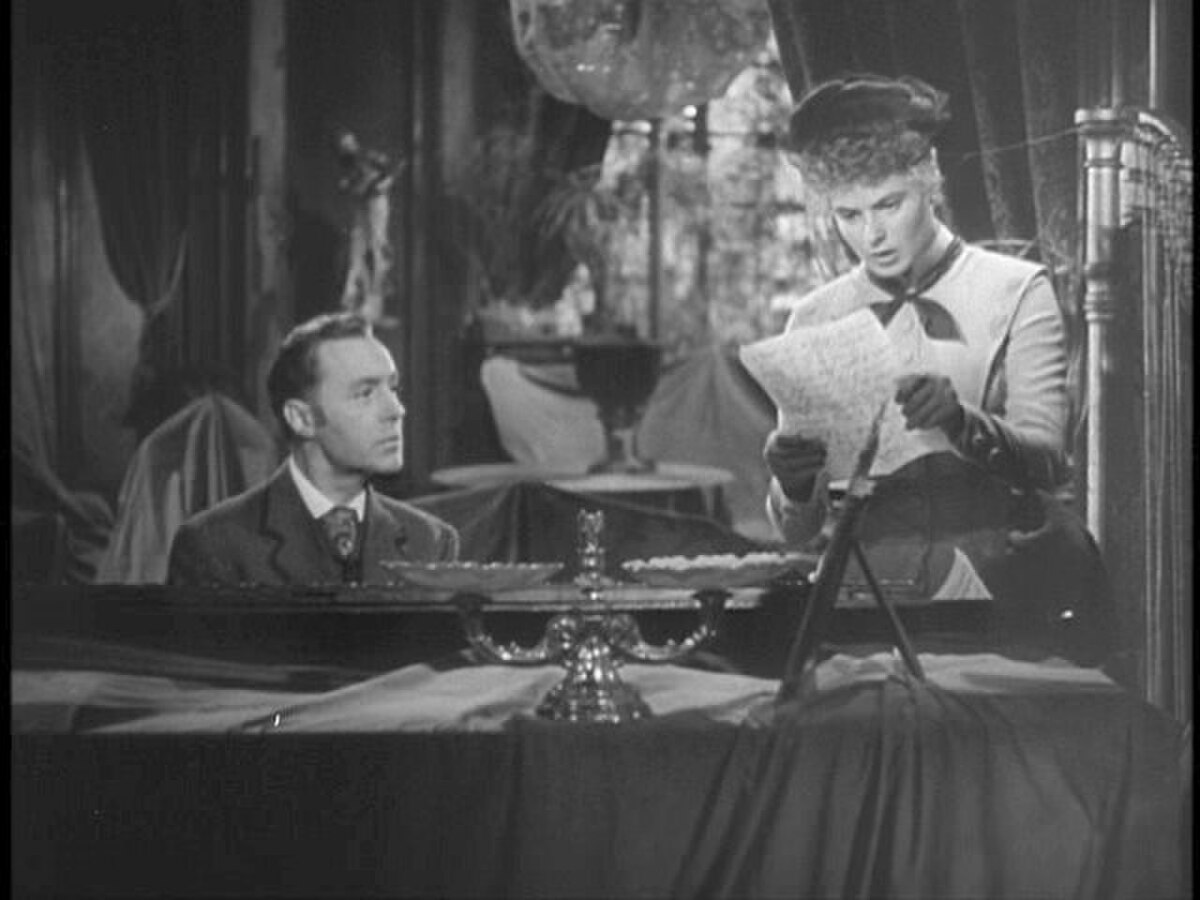
Charles Boyer and Ingrid Bergman in the 1944 film Gaslight, which established the plot that gave the manipulation tactic its name. Unknown authorUnknown author, Public domain, via Wikimedia Commons
The gerund form gaslighting was first recorded in print in 1961. According to the American Psychological Association, the term originally referred to extreme manipulation intended to induce mental illness or justify committing someone to a psychiatric institution. In clinical case reports, psychiatrists documented instances where relatives or retirement home staff fabricated symptoms, such as staging incontinence or alleging alcoholism, to force people into psychiatric hospitals for financial gain or personal convenience.
How the word became a buzzword
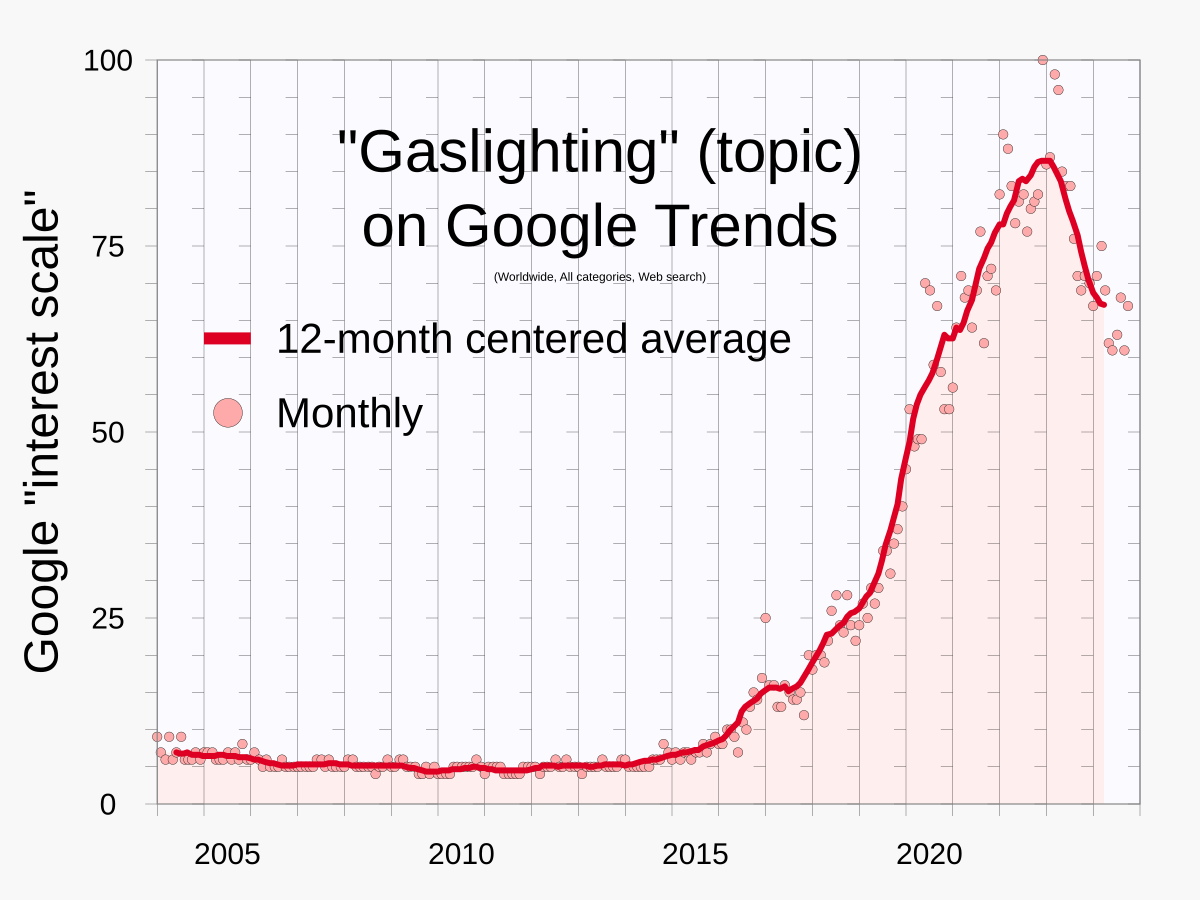
Gaslighting remained an obscure term for decades; The New York Times used it only nine times between its first appearance in 1995 and 2015. It entered everyday speech in the mid-2010s. The American Dialect Society named gaslight the most useful new word of 2016, and Merriam-Webster named it Word of the Year in 2022.
Google Trends shows search interest in the topic began a steep rise in 2016 as the term spread into popular usage. RCraig09, CC BY-SA 4.0, via Wikimedia Commons
Mental health experts have raised concerns that the word is now used too broadly. In 2022, The Washington Post reported that it had become a trendy piece of therapy speak used to describe ordinary relationship disagreements. Robin Stern, co-founder of the Yale Center for Emotional Intelligence, notes that someone simply being insistent or trying to influence another person is not gaslighting.
Test yourself
Why insist on tiny, trivial disagreements rather than big ones?
Each is too small to be worth checking. Nobody pulls out a receipt over a mislaid brooch, so nothing gets settled and the corrections accumulate. The size is what makes them add up.
You prove one of their lies outright. Does that break the spell?
No, the doubt was never about that fact. Winning one item leaves the doubt in place, because the doubt was built out of dozens of small items and aimed at your judgment rather than at any one of them.
Play the lesson in edgi and the card is yours. It lands on your Map next to the ideas it connects to, and turns from matte to foil to gold as you learn more around it.
How is gaslighting different from a normal disagreement?
A normal disagreement involves two people discussing conflicting views about a specific situation. Gaslighting is a sustained pattern where one party manipulates and denies the other person's perceptions to undermine their confidence in their own mind.
Is gaslighting an official clinical diagnosis?
The American Psychological Association considers gaslighting a colloquialism rather than a formal medical term. While it appears in psychiatric case studies and research papers, it describes a pattern of manipulative behavior rather than a diagnosable psychiatric illness.