Hedonic treadmillWhy big life changes stop making us happier
The hedonic treadmill is the psychological tendency for humans to quickly return to a stable baseline level of happiness after major positive or negative life events. When good or bad things happen, our expectations and perceptions shift to normalize the new situation. As a result, working harder for external gains rarely produces permanent increases in well-being.
By the edgi team We find the most surprising true thing about an idea and build a 60-second lesson around it.
In 1971, psychologists Philip Brickman and Donald Campbell studied two groups: recent lottery winners and people who had become paraplegic. They expected the winners to be ecstatic and the victims to be devastated.
The Publishers Clearing House Prize Patrol delivering an oversized check to a sweepstakes winner in 2011. Publishers Clearing House, CC BY-SA 3.0, via Wikimedia Commons
A year later, both groups had largely returned to their original, baseline levels of happiness.
The adaptation trap
This is the hedonic treadmill. We don't just experience events; we adapt to them. When you get a raise, your expectations rise to match it. When you face hardship, you eventually normalize the new reality.
You are running on a treadmill: you keep working for more happiness, but your psychological set point stays exactly where it started.
The exit ramp
Because we adjust so quickly, we fall victim to the Diderot effect, the belief that one more purchase will finally satisfy us. To break the cycle, psychologists suggest savoring: the deliberate, active practice of appreciating a positive experience to slow down your brain's adaptation.
Portrait of Denis Diderot, painted by Dmitry Levitzky in 1773, showing him in a red gown with a white ruffled shirt. Dmitry Levitzky, Public domain, via Wikimedia Commons
How hedonic adaptation works
In 1971, psychologists Philip Brickman and Donald Campbell coined the term hedonic treadmill after observing that people maintain a fairly stable baseline level of happiness despite shifts in wealth or circumstances. In 1978, Brickman and colleagues linked this to adaptation level theory, which states that our perception of any stimulus depends on how it compares to our previous experiences.
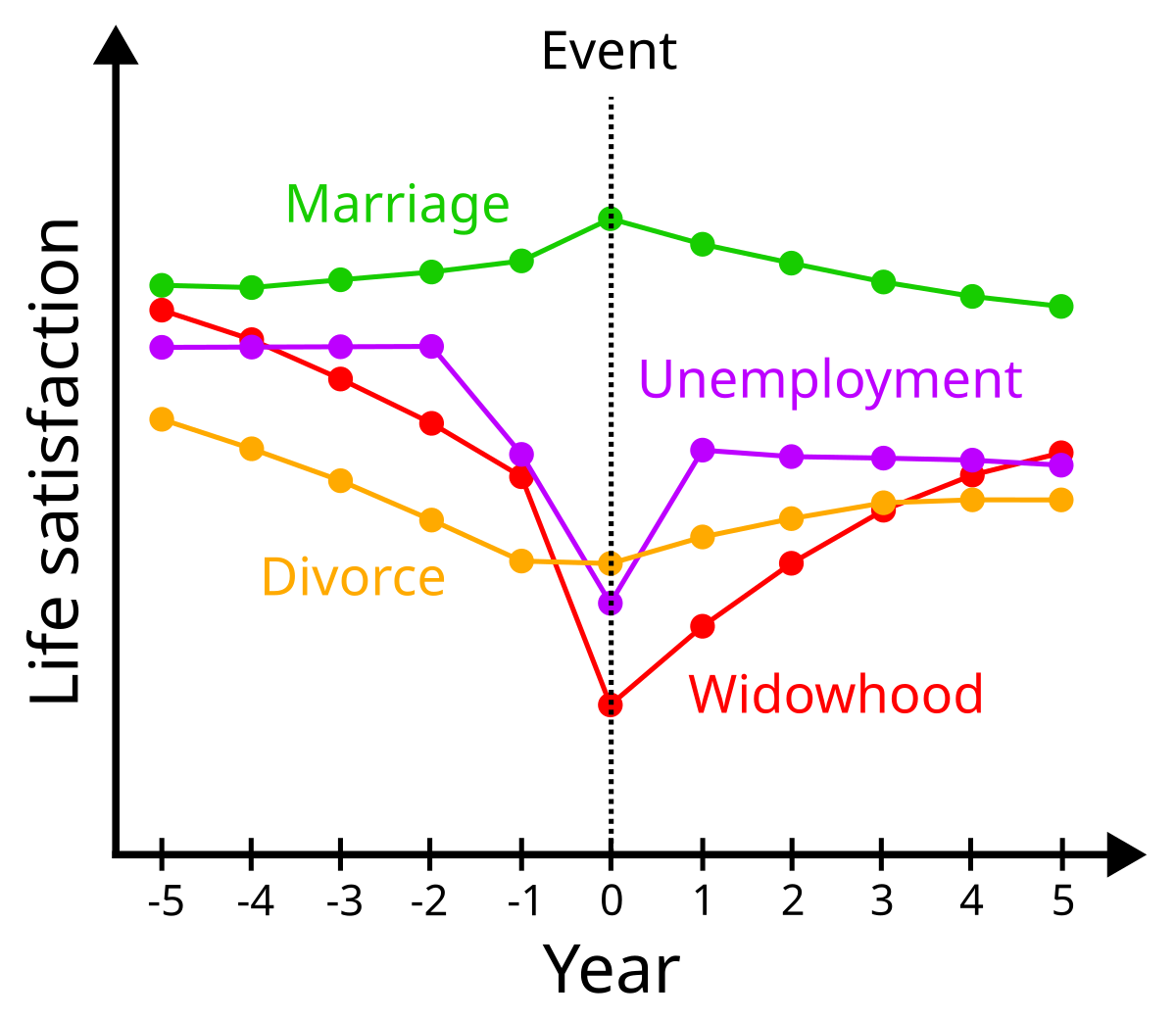
Life satisfaction spikes or drops following major emotional events before steadily drifting back toward a baseline set point. Phlsph7, CC0, via Wikimedia Commons
Researchers Shane Frederick and George Loewenstein classified adaptation into three main processes: shifting adaptation levels, desensitization, and sensitization. Shifting adaptation levels occurs when a person resets their idea of a neutral baseline. For instance, an employee who receives a raise initially feels happier, gets used to the larger salary, and returns to their baseline, though they remain capable of enjoying a holiday bonus. Desensitization decreases emotional sensitivity over time, such as people living in war zones who become less shocked by daily destruction. Sensitization, by contrast, is an enhanced response from repeated exposure, such as a connoisseur developing deeper pleasure and selectivity for fine wine or food.
Why our happiness set point resists change
Adaptation relies on several cognitive and biological mechanisms. On a psychological level, people shift their goals, attention, and interpretations of situations. Social theorist Gregg Easterbrook identified a habit called abundance denial, where individuals create rationales to feel deprived even when their material conditions improve. Biologically, neurochemical processes may desensitize overstimulated pathways in the brain, preventing permanent states of intense positive or negative feelings.
Later research updated the original idea that everyone returns to the same neutral baseline. A 2006 review by Ed Diener, Richard Lucas, and Christie Scollon established that individuals have distinct set points that are partly heritable. A 10-year study of over a thousand twin pairs by David Lykken and Auke Tellegen found that genetics account for roughly 50 percent of happiness levels.
Set points are also not completely rigid. Longitudinal research by Frank Fujita and Diener found that while life satisfaction remains stable for most people, about a quarter of the population experiences significant, lasting baseline shifts following major life events like long-term disability, divorce, or widowhood.
Test yourself
According to the hedonic treadmill, what happens when someone receives a significant salary increase?
Expectations rise to match the income. As new circumstances become normal, expectations scale upward, keeping overall happiness stable despite external improvements.
When people experience major life changes, does the hedonic treadmill cause their baseline happiness to permanently shift or eventually return?
Eventually return. The hedonic treadmill describes how human emotional baselines adjust back to their set points following both positive and negative life events.
Does the hedonic treadmill imply that major life events permanently alter baseline happiness?
No, happiness resets. The hedonic treadmill describes how human happiness constantly returns to a stable baseline despite major life changes.
Play the lesson in edgi and the card is yours. It lands on your Map next to the ideas it connects to, and turns from matte to foil to gold as you learn more around it.
Can a person have more than one happiness set point?
Yes. Researchers have found that individuals can possess multiple baselines, such as separate set points for life satisfaction and subjective well-being. These baselines can move within a personal range rather than remaining fixed at a single number.
What is the biological purpose of the hedonic treadmill?
Hedonic adaptation functions like other sensory adaptations that protect and sharpen perception. Adjusting emotional sensitivity to new circumstances helps redirect motivation, protecting people from complacency while helping them accept unchangeable realities.