Ikigai is a Japanese concept that refers to a person's reason for living or what makes life feel worth it. It is not a blueprint for career ambition, but rather a personal source of motivation, joy, and daily fulfillment. The feeling arises naturally from actions undertaken willingly, ranging from simple morning routines to community service.
By the edgi team We find the most surprising true thing about an idea and build a 60-second lesson around it.
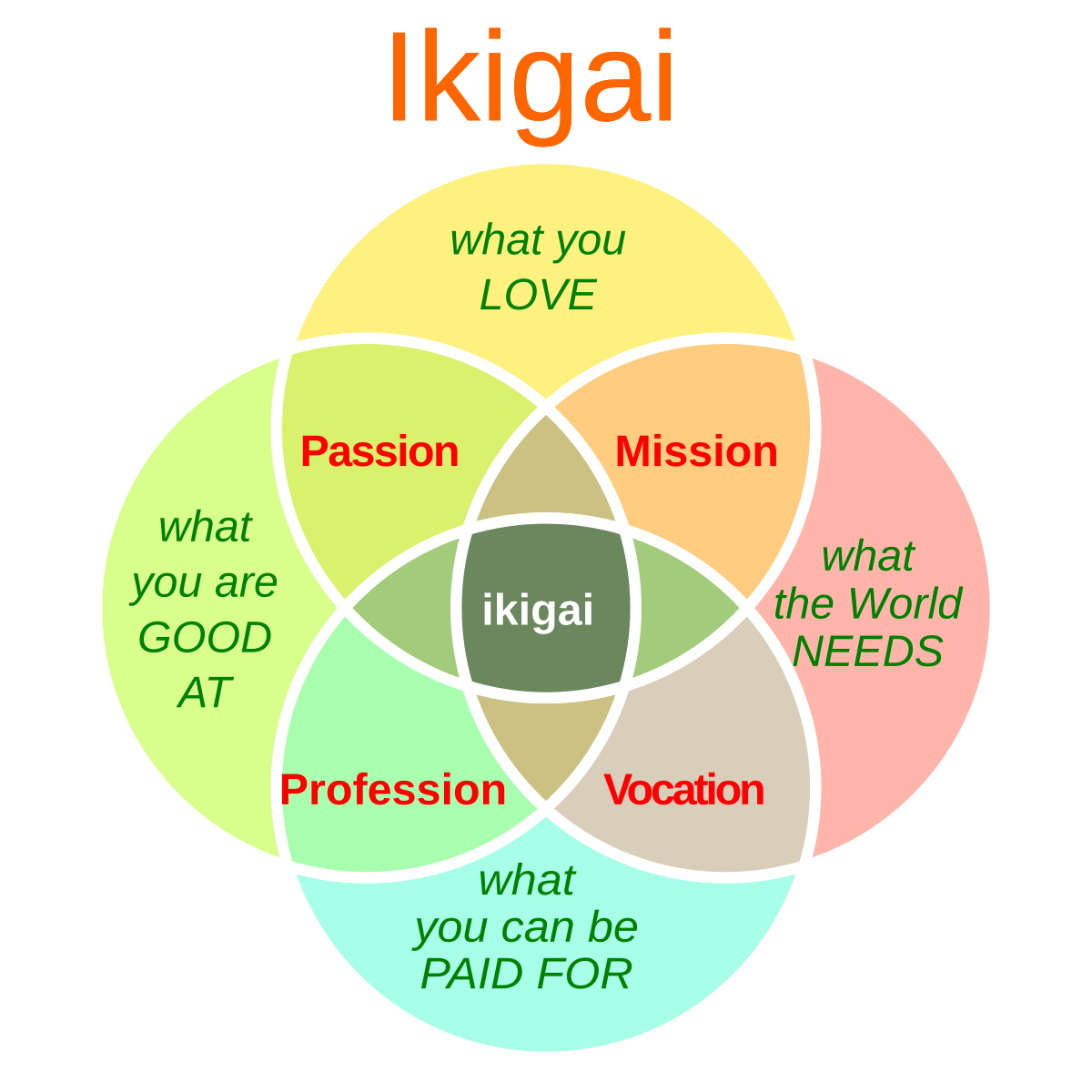
You have likely seen a Venn diagram online claiming to show the path to Ikigai. It promises the intersection of passion, mission, vocation, and profession.
Diagram illustrating the concept of Ikigai as an intersection of four overlapping circles: "what you LOVE", "what you are GOOD AT", "what the World NEEDS", and "what you can be PAID FOR". Eugenio Hansen, OFS, CC BY-SA 4.0, via Wikimedia Commons
That diagram is a Western invention from 2011. It has nothing to do with the actual Japanese concept.
The humble reality
In Japan, Ikigai is not about your career or a grand, singular life purpose. It is a small, daily reason to get out of bed. It is the morning cup of tea, a walk in the park, or the sunrise.
It is the reason you keep moving, even when the world feels chaotic.
The karate master
Researchers studying Okinawa, a region with some of the world's longest-living people, found the locals had no word for retirement. One 102-year-old karate master explained his Ikigai was simply the feeling of his feet hitting the mat each morning.
It wasn't a career goal. It was the physical joy of continuing his craft.
What the word actually means
The term combines iki, meaning life or alive, and kai, meaning effect or result. Put together, it translates to a reason for being alive or what makes life worth living. Psychiatrist Mieko Kamiya first popularized the concept in her 1966 book, On the Meaning of Life, after working with leprosy patients.
In 2022, the Japanese government defined ikigai as anything that brings value and joy to life. It encompasses relationships like children and friends, as well as personal hobbies and work. Japanese psychologist Katsuya Inoue broke the concept down into two parts: the specific objects or sources that give life value, and the internal feeling that life has meaning because of those sources.
The three types of ikigai
Inoue categorized ikigai into three distinct forms based on how a person relates to society. Social ikigai involves activities accepted and valued by others, such as volunteering or local community projects. Non-social ikigai focuses inward without direct ties to society, including personal faith or strict self-discipline.
The third category is anti-social ikigai. This refers to motivation driven by dark emotions, such as a desire for revenge or sustaining hatred toward someone. While not positive, it still functions psychologically as an active reason to keep living.
Where the Venn diagram comes from
The popular four-circle Venn diagram combining passion, mission, vocation, and profession is not an authentic Japanese tradition. It originated in 2011 when Andrés Zuzunaga created a purpose diagram, which blogger Marc Winn later relabeled with the word ikigai.
Héctor García and Francesc Miralles featured the graphic in their book on longevity, spreading the idea worldwide. Critics point out that treating ikigai as a perfect match between market value and personal talent creates an unrealistic ideal that ignores how ordinary people experience daily purpose.
Test yourself
Which lifestyle routine best reflects the principle of ikigai?
Volunteering weekly at a town garden. Ikigai relies on having an active, meaningful role that connects daily effort to the surrounding community.
What does the Japanese concept of ikigai refer to?
A daily reason for being. Ikigai refers to a personal reason for being or life's meaning, which provides daily direction and lowers chronic stress.
What does a person need to find deep, lasting motivation in daily life?
Small, routine daily pleasures. Lasting drive often comes from simple daily anchors rather than monumental achievements or career milestones.
Play the lesson in edgi and the card is yours. It lands on your Map next to the ideas it connects to, and turns from matte to foil to gold as you learn more around it.
Studies show that people who lack ikigai are more likely to suffer from cardiovascular disease, though research found no link to the development of malignant tumors. In Okinawa, maintaining daily purpose alongside close social groups called moai is linked to lower interest in retirement and longer lives.
Has the meaning of ikigai changed over time in Japan?
Yes. Anthropologist Chikako Ozawa-de Silva found that older generations viewed ikigai as fitting into standard company and family roles, whereas younger generations connect it more to individual future dreams.