Subjective well-beingWhy your brain sets your happiness baseline
Subjective well-being is a person's own evaluation of their life, based on their personal perspective rather than objective standards like income or health. It splits happiness into everyday moods, overall life satisfaction, and a sense of purpose. While external events cause short-term emotional shifts, long-term well-being remains remarkably stable over time.
By the edgi team We find the most surprising true thing about an idea and build a 60-second lesson around it.
We tend to think happiness is a destination, a better job, a bigger house, or a lottery win. But psychology shows we have an internal "happiness thermostat" that resists permanent change.
An 1814 English State Lottery Ticket is shown, with the number "5753" handwritten across it. I took a photograph of this lottery document I own, CC BY-SA 3.0, via Wikimedia Commons
This internal measure of your life is called Subjective well-being, and it cares less about your bank account than your brain's own set point.
The lottery lesson
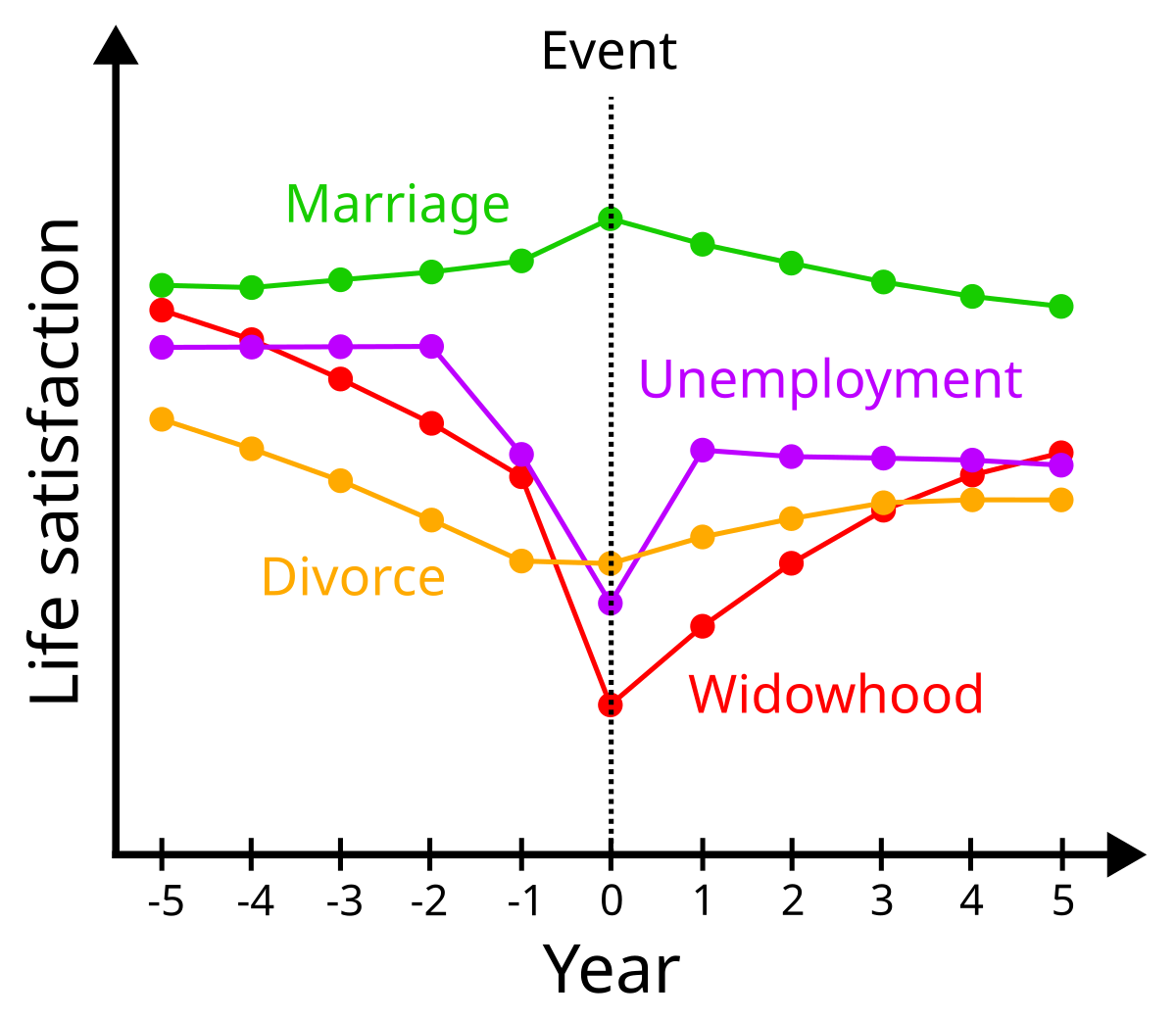
In 1971, researchers Philip Brickman and Donald Campbell studied two extreme groups: lottery winners and people who had suffered life-altering accidents. After eighteen months, both groups reported nearly identical levels of daily happiness.
The winners had adjusted to their wealth, and the victims had adapted to their new physical reality. Both returned to their baseline.
Graph illustrating the hedonic treadmill concept, plotting life satisfaction (Y-axis) against Year (X-axis) relative to an event at year 0. Phlsph7, CC0, via Wikimedia Commons
The treadmill effect
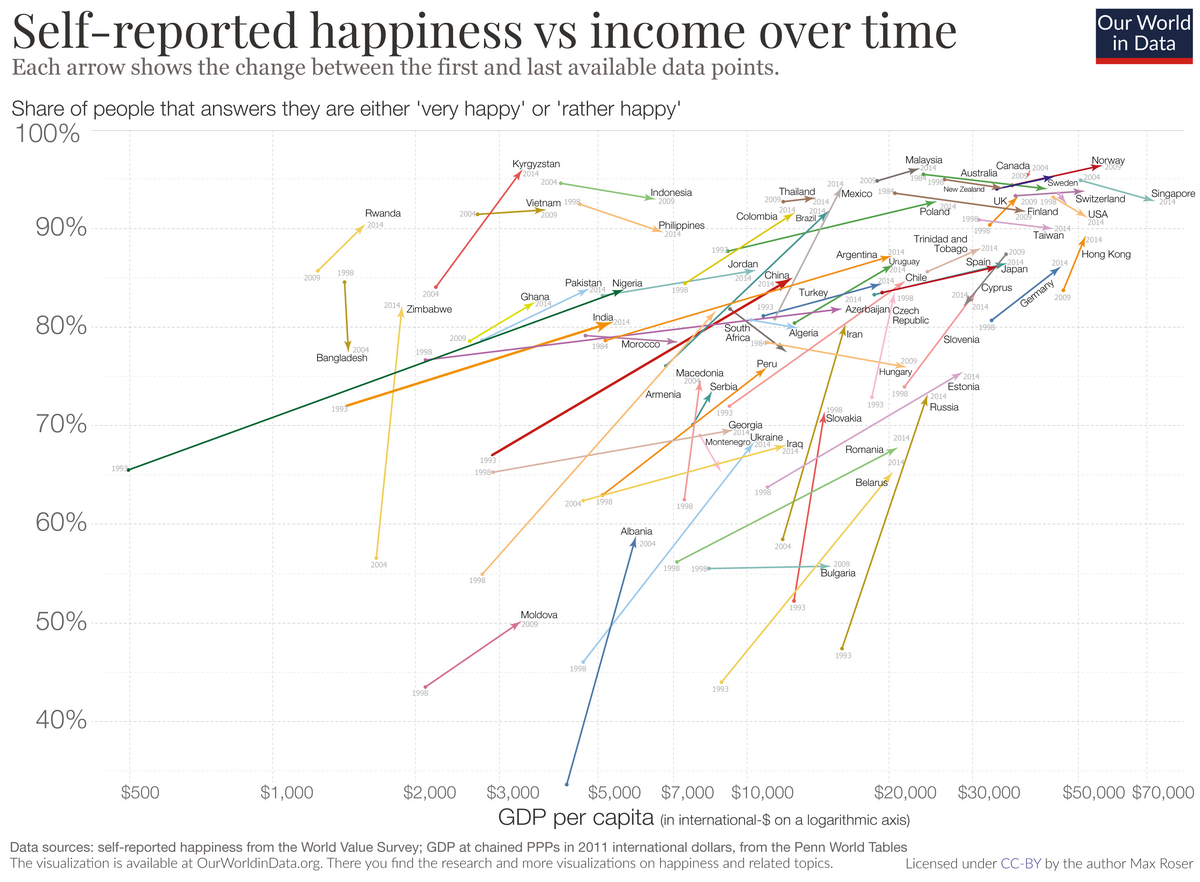
This cycle is called the Hedonic treadmill. Like a treadmill, you keep running to chase a new normal, but you stay in the same place. This explains the Easterlin paradox: as countries get richer and GDP climbs, their citizens' reported life satisfaction rarely budges.
Scatter plot with arrows showing the relationship between self-reported happiness and GDP per capita across various countries over time. Esteban Ortiz-Ospina and Max Roser, CC BY 4.0, via Wikimedia Commons
We don't experience life through objective facts, but through a mental system designed to keep us running in place.
The three components of subjective well-being
Psychologist Ed Diener established that subjective well-being is an umbrella term made of distinct parts rather than a single trait. The first part is affect, which tracks emotional experiences: frequent positive moods and infrequent negative ones. Hedonic balance calculates the difference between these pleasant and unpleasant feelings over time.
The second part is life satisfaction, which is a cognitive judgment of how well life matches personal standards. Unlike momentary moods, life satisfaction is a stable, long-term evaluation that can cover specific domains such as work or an entire lifetime.
The third component is eudaimonia, which focuses on meaning, purpose, and personal flourishing. While researchers study eudaimonic factors in people from elementary school age onward, collecting reliable data on meaning remains an ongoing challenge in positive psychology.
How life circumstances interact with subjective well-being
Major life events can sharply alter emotional well-being in the short term. The onset of the COVID-19 pandemic, for instance, lowered emotional well-being by 74%.
Physical health and subjective well-being also share a reciprocal relationship. Good health correlates with higher happiness, while positive emotions and optimism have beneficial effects on physical health.
Even so, subjective well-being maintains a strong link to stable personality traits. External conditions like income or physical assets influence how people rate their lives, but subjective well-being focuses strictly on how individuals evaluate those conditions themselves.
Test yourself
Why does the Easterlin paradox show that rising national GDP fails to permanently raise subjective well-being?
Citizens adapt to new wealth and reset expectations. As living standards rise, people quickly adapt to the new normal and their internal happiness thermostat resets, leaving reported life satisfaction unchanged.
How does subjective well-being typically respond to a major life windfall like winning the lottery?
It eventually returns to a baseline set point. Subjective well-being is governed by an internal baseline that resists permanent shifts, causing people to adapt to new wealth over time.
What happens to long-term happiness after a major life windfall?
It returns to a baseline set point. We think a huge win changes our baseline forever, but our brain has an internal thermostat that quickly adapts to new wealth and returns us to our default mood.
Play the lesson in edgi and the card is yours. It lands on your Map next to the ideas it connects to, and turns from matte to foil to gold as you learn more around it.
Researchers evaluate life satisfaction and affect balance separately. They commonly rely on self-reports, but they can also use informant ratings from people who know the subject.
Is subjective well-being the same thing as happiness?
Subjective well-being is an umbrella term rather than a single definition of happiness. It combines a hedonistic definition based on momentary emotions with a cognitive definition based on personal life evaluation.