Positive psychologyStudying flourishing, not disease
Positive psychology is the scientific study of the conditions and processes that lead to human flourishing, positive relationships, and well-being. Instead of only diagnosing mental disorders, it investigates what makes life fulfilling and meaningful. It treats traits like optimism, resilience, and gratitude as measurable skills that people can actively develop.
By the edgi team We find the most surprising true thing about an idea and build a 60-second lesson around it.
For decades, psychology treated the human mind like a car engine: you only looked under the hood when it was broken. In 1998, Martin Seligman, one of the field's leading researchers, was gardening with his five-year-old daughter.
She scolded him for being a grump. It was a wake-up call. He realized he knew everything about learned helplessness but nothing about building actual happiness.
The science of thriving
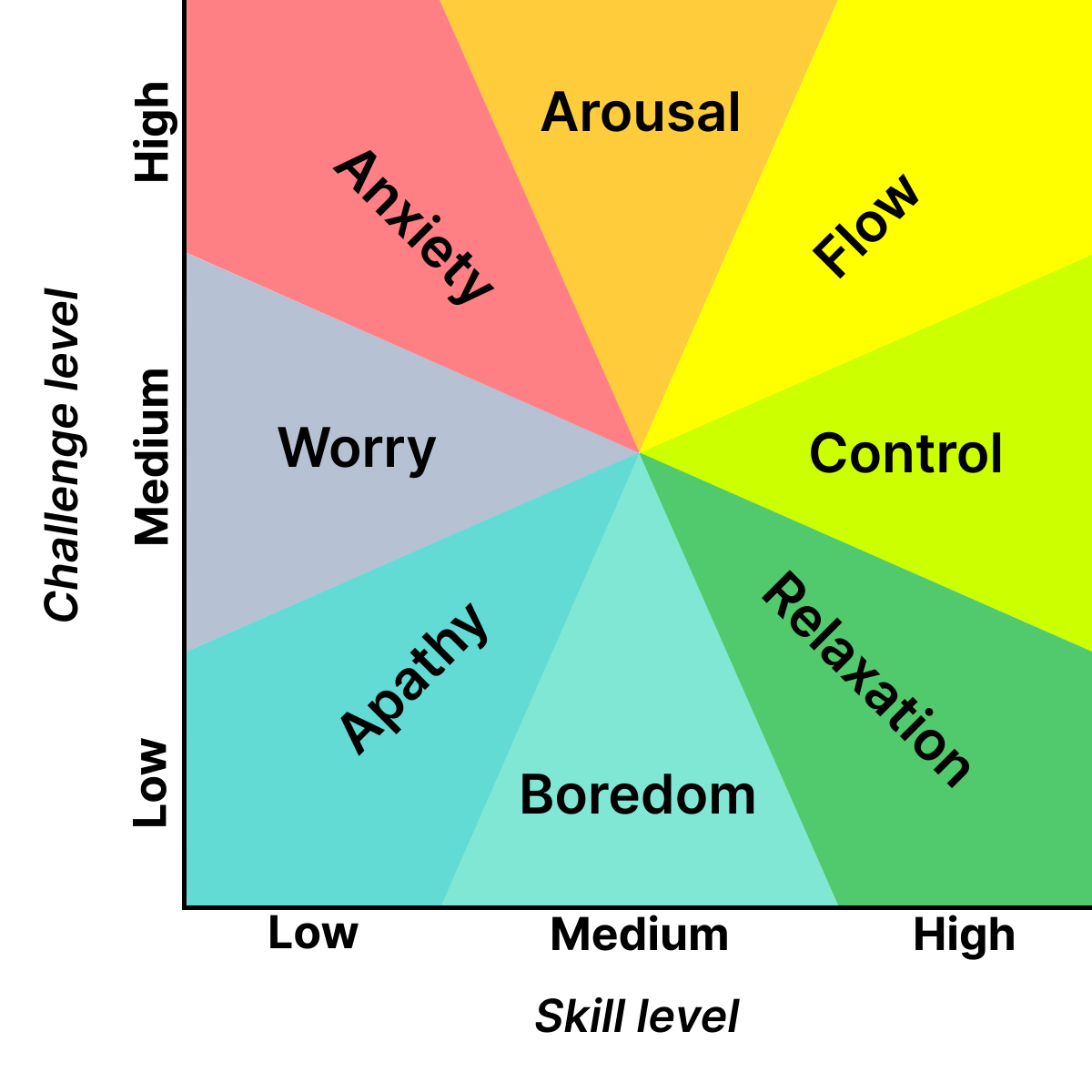
Positive psychology didn't just rebrand being happy. It treats flourishing as a skill set, like building a muscle. Researchers began studying specific, measurable traits like resilience, gratitude, and flow, that state of total absorption in a task.
Graph illustrating Csikszentmihalyi's flow model, plotting "Challenge level" (Low, Medium, High) on the Y-axis against "Skill level" (Low, Medium, High) on the X-axis. Oliverbeatson, Public domain, via Wikimedia Commons
It suggests that happiness isn't just the absence of suffering; it's the presence of specific, teachable strengths.
Beyond the clinic
This shift moved mental health beyond the therapy office. Today, it informs social–emotional learning in schools, helping kids build psychological capital before they ever face a crisis.
We now know that optimism isn't just a mood. It is a practice you can train.
How positive psychology shifted the field
From its early days, mainstream psychology relied heavily on a disease model, focusing almost exclusively on mental illness, maladaptive behavior, and psychological disorders. The term itself appeared as early as 1954 in Abraham Maslow's book Motivation and Personality, but clinical practice continued to focus on dysfunction.
Martin Seligman promoted positive psychology to investigate practical ways of building well-being in individuals and communities. U.S. Department of Defense photo by D. Myles Cullen, U.S. Army/Released., Public domain, via Wikimedia Commons
That focus changed in 1998 when Martin Seligman launched positive psychology as the central theme for his term as president of the American Psychological Association. Seligman argued that psychology needed to use rigorous scientific methods to nurture talent, build resilience, and improve everyday life rather than solely repairing damage.
The components of human flourishing
Positive psychology draws on ancient philosophical roots, including Aristotle's idea of eudaimonia, a Greek concept often translated as flourishing or living a good life through virtue. Modern researchers split happiness into two types: hedonic happiness, which involves seeking pleasure and positive emotions, and eudaimonic happiness, which focuses on meaning, purpose, and optimal functioning.
Aristotle explored the cultivation of virtues and eudaimonia, forming the philosophical basis for modern flourishing theories. After Lysippos, Public domain, via Wikimedia Commons
Psychologists study several core factors that drive subjective well-being. Strong social connections with family, friends, and colleagues play a central role, alongside physical exercise, meditation, and involvement in community groups. Models by researchers such as Ed Diener and Carol Ryff show that long-term well-being depends on self-acceptance, personal growth, autonomy, and how people evaluate their life satisfaction.
Test yourself
An athlete recovers from injury entirely. Why might they still struggle to perform?
Absence of injury does not equal thriving. Mental health is not merely the absence of suffering; flourishing requires building active strengths, just as physical fitness requires more than just healing.
Which is the better definition of mental health?
Building personal strengths. Many equate health with simply not being sick. However, research shows that happiness requires proactive development of skills like resilience, not just waiting for problems to go away.
___ is a cognitive bias that leads people to expect favorable outcomes, even when the odds are unfavorable.
Optimism. Positive psychology studies optimism not just as a feeling, but as an explanatory style for why things happen.
Play the lesson in edgi and the card is yours. It lands on your Map next to the ideas it connects to, and turns from matte to foil to gold as you learn more around it.
What is the difference between hedonic and eudaimonic happiness?
Hedonic happiness focuses on emotional pleasure, positive mood, and the avoidance of pain. Eudaimonic happiness focuses on purpose, personal growth, and fulfilling one's potential.
Where is positive psychology applied today?
It is applied in education to teach social and emotional skills, in workplaces to build engagement, and in community development and healthcare programs to build psychological resilience.