Investigative genetic genealogyTracking crime through cousins
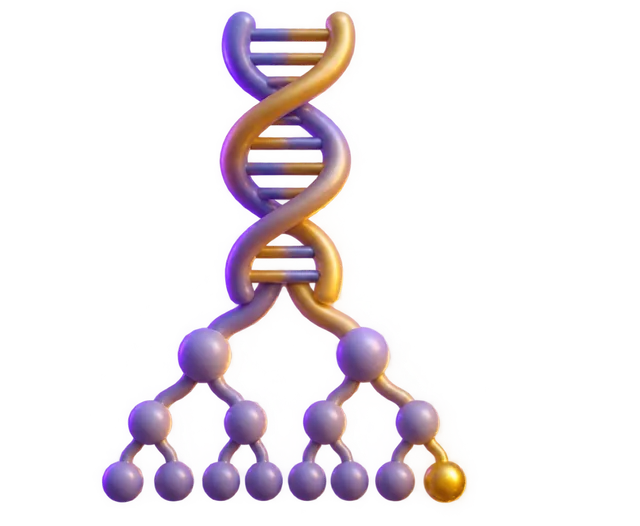
Investigative genetic genealogy is a forensic method that identifies unknown suspects or human remains by comparing crime-scene DNA to public genealogy databases created by consumer testing services. Instead of requiring a direct hit in a police database, it finds distant relatives through shared blocks of DNA and traces family trees down to a single person. This technique can pinpoint an individual even if only a third or fourth cousin has ever submitted a sample.
By the edgi team We find the most surprising true thing about an idea and build a 60-second lesson around it.
In 2018, investigators used investigative genetic genealogy to finally identify Joseph DeAngelo as the Golden State Killer after decades of evasion. They had no match in standard criminal DNA databases.
Logo for the Combined DNA Index System (CODIS), featuring a stylized double helix DNA strand within a blue sphere, encircled by a black ring with the words "COMBINED DNA INDEX SYSTEM" and "CODIS" in… FBI, Public domain, via Wikimedia Commons
Instead, they uploaded a profile generated from crime-scene evidence to a public genealogy platform, searching for distant family connections.
How it works
Genetic genealogy compares crime-scene DNA with profiles voluntarily uploaded by everyday people tracing their family trees. Even a third or fourth cousin shares enough genetic material to point investigators toward a common ancestor.
Detectives then build family trees downward, factoring in ages, locations, and timelines to zero in on a suspect.
The privacy dilemma
This technique has helped solve hundreds of cold cases and identify unidentified victims in tragedies like the Bear Brook murders. However, it means genetic privacy is no longer an individual choice.
Forensic facial reconstructions by Carl Koppelman of the four victims of the Bear Brook murders, known as the Allenstown Four. CarlK90245, CC BY-SA 4.0, via Wikimedia Commons
When one person submits a saliva sample to a direct-to-consumer ancestry site, they inadvertently expose their entire extended family to police searches.
How distant relatives solve cold cases
A database of roughly 1.2 million genetic profiles can identify a third cousin or closer for more than 90 percent of the population. Investigators upload crime-scene genetic data to public platforms such as GEDMatch or Family TreeDNA, which allow files from various testing companies to be cross-searched. The software looks for identity-by-descent segments, which are shared stretches of DNA that reveal a common ancestor.
Genealogy specialists at companies like Parabon Nanolabs and Othram, or non-profits like the DNA Doe Project, then build family trees downward from those shared ancestors. They combine the genetic connections with census data, ages, gender, and places of residence. An investigator only needs a fifth cousin or closer in a database to systematically trace their way to an unknown suspect.
Applications beyond serial offenders
The method is used for far more than high-profile murder cases. It has identified over 460 deceased individuals, solved cases of living unidentified persons, and helped locate victims of human trafficking. Search teams also use it to identify victims of natural disasters such as floods, wildfires, and earthquakes when dental records or facial recognition fail.
Police have also used the technique to identify nearly 40 mothers in decades-old Baby Doe cases where deceased newborns were discovered. In many instances, the identified women faced murder charges, though outcomes varied from decades in prison to lighter manslaughter pleas or no prison time. The rapid expansion of these investigations has raised complex legal questions that standard courts are still attempting to address.
Privacy debates and false leads
Because consumers upload sensitive genetic data to research their heritage, scholars debate whether police searches violate Fourth Amendment protections against unreasonable searches. Most courts handling challenges from criminal defendants have ruled that the Fourth Amendment does not protect the genetic information of consumers or their relatives in public databases.
The method can also generate false leads. Before investigators solved the 1996 murder of Angie Dodge, police obtained a court order for Ancestry.com records and interrogated filmmaker Michael Usry based on a partial familial match. A subsequent direct DNA test was required to prove Usry was not the perpetrator.
Play the lesson in edgi and the card is yours. It lands on your Map next to the ideas it connects to, and turns from matte to foil to gold as you learn more around it.
What rules govern how federal agencies use this technique?
The US Department of Justice issued an interim policy in 2019 to set parameters for forensic genetic genealogy searches. However, this policy serves as internal guidance and does not restrict otherwise lawful investigative actions if agents choose to skirt its rules.
How many cases have been resolved using this method?
By December 2023, the technique had solved 651 criminal cases and exposed 318 individual perpetrators. It had also successfully identified 464 deceased individuals and four living unidentified people.