Levels-of-processing effectWhy meaning beats repetition
The levels-of-processing effect is the finding that how well you remember something depends on how deeply you analyze it during encoding. Shallow handling based on appearance or sound creates fragile traces that quickly fade. Connecting an item to its meaning produces a durable memory trace, even if you never intentionally tried to memorize it.
By the edgi team We find the most surprising true thing about an idea and build a 60-second lesson around it.
In 1975 Fergus Craik and Endel Tulving showed people words one at a time, and put a question in front of each word. Sometimes the question was about the shape: is this in capital letters? Sometimes about the sound: does it rhyme with train? Sometimes about the meaning: does it fit in this sentence?
Nobody had been told a memory test was coming. They thought the study was about the questions, and they answered yes or no as quickly as they could. Then came the test nobody had been warned about. Which of these words did you see?
A light blue "Blue Book Examination Book" is shown next to an open, lined examination booklet. Mikus, CC BY-SA 4.0, via Wikimedia Commons
The answer followed the question
Words that had carried a meaning question came back far more often than words that had only been checked for capital letters. The rhyme question landed between the two. This is the levels-of-processing effect. What you retain tracks how deeply you handled the thing, and the moment of handling is the encoding.
Nobody in that room was trying to memorise, so effort is not what separated the three groups. The difference is what each question forced a person to do with a word in the second they had it.
The honest limit and the use
Depth is easier to see than to define. Critics have said for fifty years that deep is only a label for whichever questions turn out to work, which would make the theory circular. The ordering holds anyway, and it holds in advance. Ask what something means, what it resembles, where it would break, and it comes back better than if you asked what it looked like.
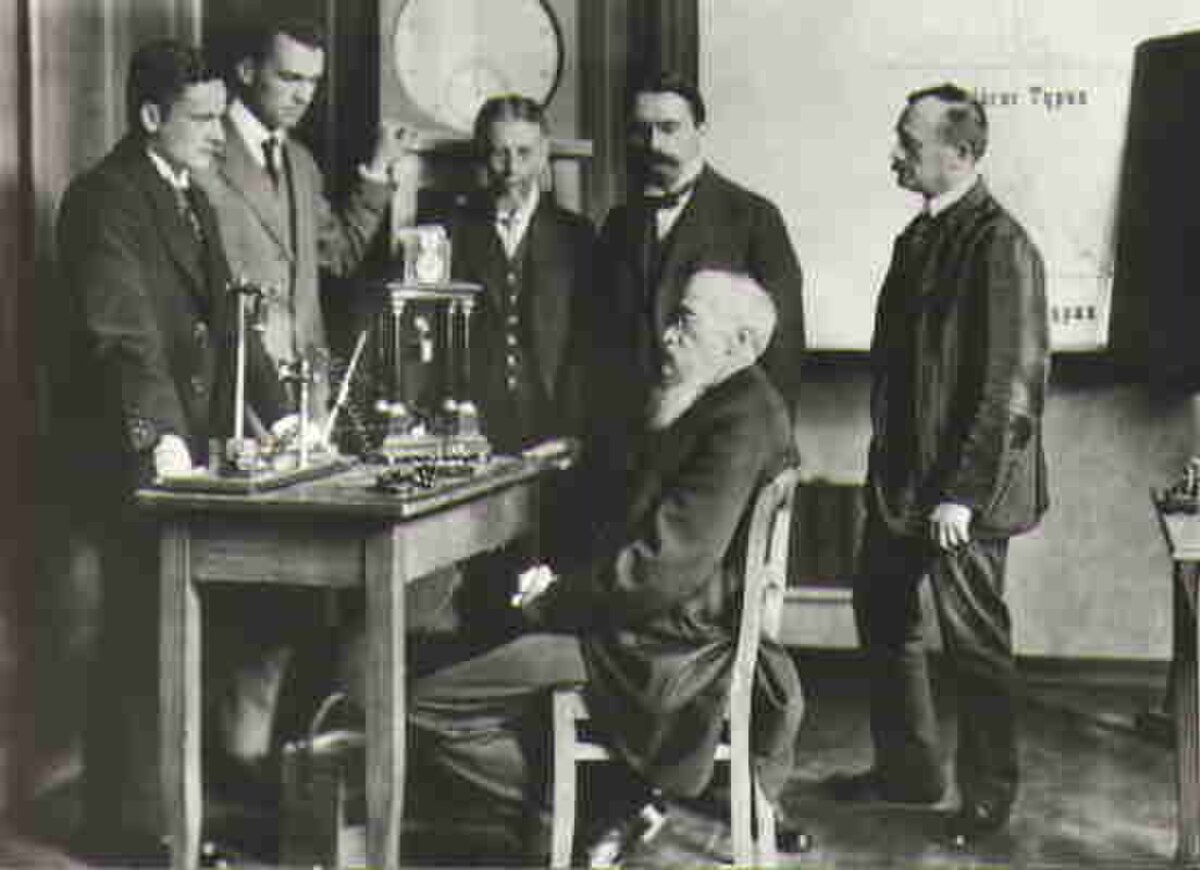
Wilhelm Wundt (seated) with five colleagues in his psychological laboratory, often considered the first of its kind. Unknown authorUnknown author, Public domain, via Wikimedia Commons
Which is a habit rather than a technique. Before you move on from a page, put it a question only its meaning can answer: what is this an example of, and where would it stop working?
How the three levels of processing work
In 1972, Fergus Craik and Robert Lockhart proposed that memory recall is a direct function of depth of mental processing. Shallow processing analyzes only physical or sensory traits. Visual or structural processing looks strictly at surface features, such as letter casing, fonts, or spelling patterns. Phonemic processing handles how words sound, like checking if a term rhymes with another.
Semantic processing sits at the deepest level. Here, a person analyzes what a stimulus actually means and links it to existing concepts. Craik and Lockhart argued that simple maintenance rehearsal, repeating an item without analyzing its meaning, does not improve long-term retention. Deep semantic analysis creates elaborate representations that resist rapid decay.
In a 1975 study, Craik and Endel Tulving tested this by asking participants questions about 60 words. Some questions targeted visual details, such as italics. Others checked phonemic qualities, like beginning sounds. The rest forced semantic processing in context. Words processed semantically were remembered far better than those processed shallowly.
What modifies processing depth?
Preexisting knowledge directly changes how deeply an item is processed. When a stimulus fits neatly into familiar semantic structures, it activates related memories across a semantic network. This expanded activation strengthens the final memory trace.
The self-reference effect amplifies this benefit even further. People recall words, such as personality trait adjectives, far better when asked if the word describes themselves rather than if it shares a meaning with another word. Personal life events possess wide networks of connected memories, providing an unusually deep anchor for new information.
Recall also depends on whether tests are explicit or implicit. The levels-of-processing effect appears consistently on explicit memory tests that ask people to recall stimuli directly. Implicit tests, such as word-completion puzzles, do not follow this pattern and can even reverse standard processing benefits.
Test yourself
When reading complex material, how does the levels-of-processing effect suggest you should engage with it?
Ask questions that require meaning. Processing material for meaning produces stronger retention than surface-level checks or mere repetition.
In the levels-of-processing effect, does recall improve primarily because of intentional study effort or semantic engagement?
Semantic engagement. Recall tracks how deeply information is processed, not whether a person consciously tried to memorize it during encoding.
You have one minute with a new term you have to know. What should you do with it?
Think of a case it would not cover. A question that needs the meaning does more than one that needs the surface. Copying works on the shape of the words and saying it works on the sound.
Play the lesson in edgi and the card is yours. It lands on your Map next to the ideas it connects to, and turns from matte to foil to gold as you learn more around it.
How does levels of processing differ from the Atkinson-Shiffrin model?
The multi-store Atkinson-Shiffrin model assumed that any rehearsal improves long-term memory strength. The levels-of-processing model argues that mere repetition fails to build durable memories without deep semantic processing.
What is specificity of processing?
Specificity of processing means a stimulus is recalled best when retrieved through the same format used to input it. For instance, spoken words are recalled best with auditory cues, while written images respond best to visual presentations.
What happens to memory when the hippocampus is damaged?
Damage to the hippocampus prevents the formation and retrieval of new long-term memories. Despite this damage, the ability to temporarily hold and reproduce a small amount of information over the short term usually remains intact.