Working memory is the cognitive system that holds and manipulates information temporarily so you can reason and make decisions. Unlike passive short-term storage, it lets you actively process what you keep in mind. Decades of research show its raw capacity is remarkably small: only about four items at a time without grouping.
By the edgi team We find the most surprising true thing about an idea and build a 60-second lesson around it.
Working memory is what you are holding in mind right now: the front half of this sentence, a number somebody just read out, the step you were about to take. It is small. Nelson Cowan went back through decades of experiments in 2001 and put the limit at about four items once people are prevented from rehearsing or grouping them.
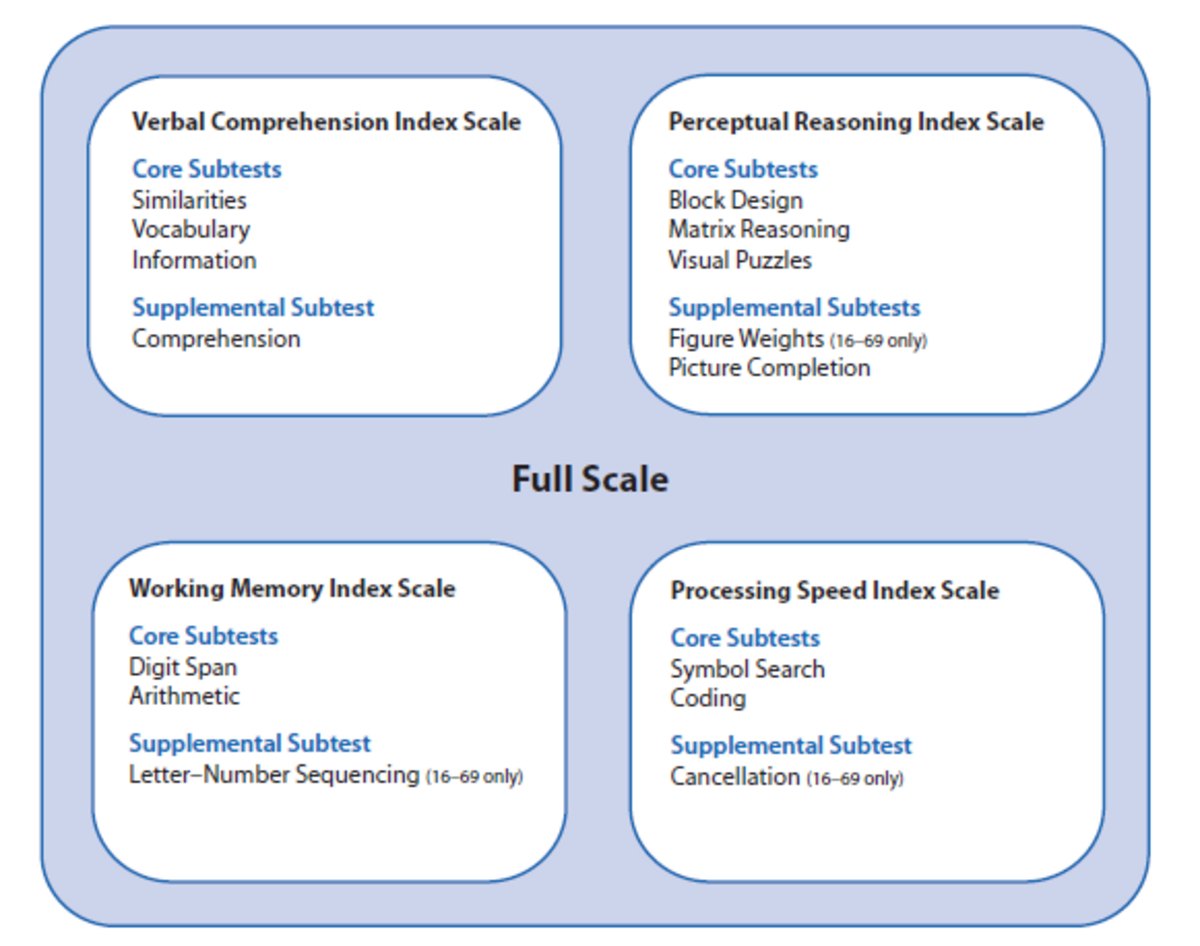
A diagram illustrating the structure of the WAIS-IV test, divided into four main index scales: Verbal Comprehension Index Scale, Perceptual Reasoning Index Scale, Working Memory Index Scale, and… Susieraiford, CC BY-SA 4.0, via Wikimedia Commons
You have probably heard seven. That came from a 1956 paper by George Miller which reported different spans for different material and treated the rough agreement as a curiosity, not a law.
The man with the 79-digit span
In the late 1970s an undergraduate known as SF began coming into a lab to have digits read aloud to him. At the start he could hold about seven of them. He was a competitive distance runner. Partway in he started hearing groups of digits as running times, so 3492 arrived as three minutes forty-nine point two, a near record for the mile.
An animated GIF of an analog stopwatch, showing the main hand moving from 0 to 5 seconds, with a smaller inner dial for minutes. Lookang, CC BY-SA 3.0, via Wikimedia Commons
Over more than 230 hours he worked up to about 79 digits. Then the researchers read him letters instead, and his span dropped straight back to roughly where it had begun. His capacity had not grown at all. What had grown was the size of the thing he could count as one.
Chunks, not slots
A chunk is whatever your existing knowledge lets you treat as a single unit. To someone who cannot read music, five notes on a stave are five things; to a pianist they are one chord. That is why the same limit feels generous in a field you know well. The number of units is fixed, and what fits inside a unit is drawn from long-term memory.
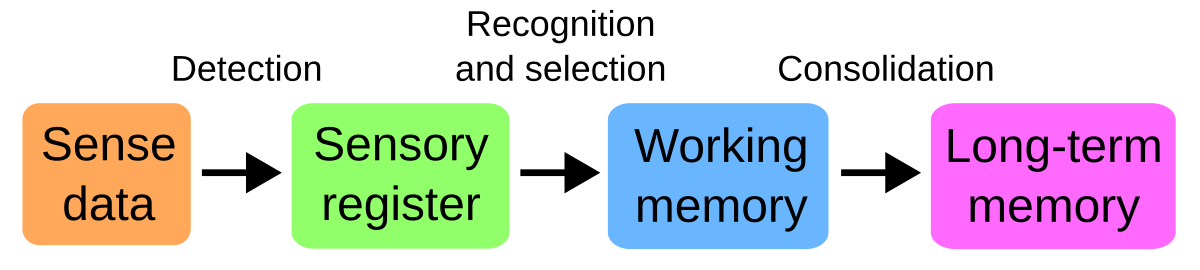
Simplified model of cognitive processes associated with perception and memory, depicted as a linear flow from "Sense data" to "Long-term memory". Phlsph7, CC0, via Wikimedia Commons
Which is the usable part. You cannot train the number up, so the move is to make the units bigger: learn the pattern first, and the details stop arriving as separate things.
How does the multicomponent model work?
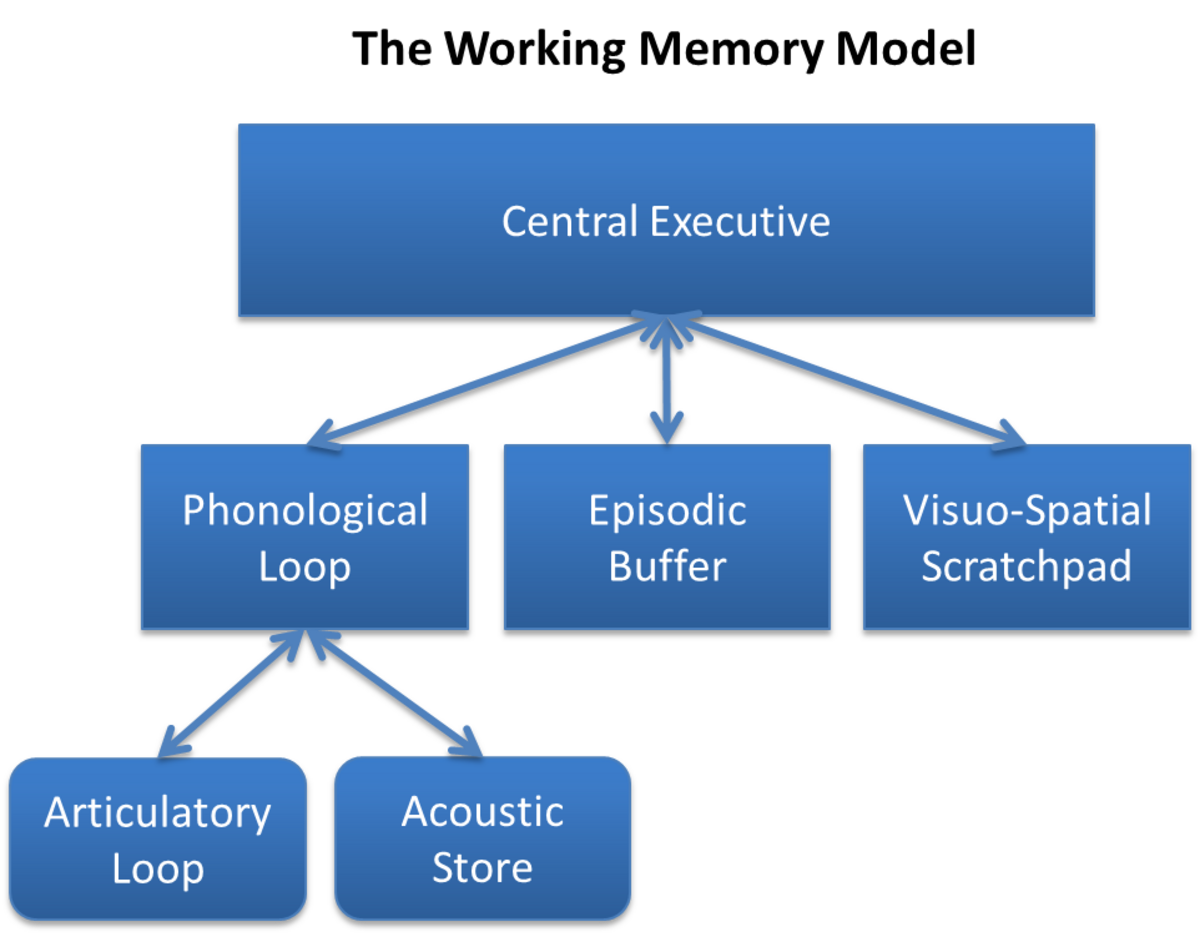
In 1974, Alan Baddeley and Graham Hitch showed that a single store could not account for all temporary memory. They proposed a model guided by a central executive. This control center coordinates mental tasks, directs attention to relevant inputs, and suppresses distractions.
Baddeley and Hitch's model showing the central executive managing the phonological loop, episodic buffer, and visuospatial sketchpad. Cheese360, CC BY-SA 3.0, via Wikimedia Commons
The central executive oversees separate subordinate systems for different data types. The phonological loop stores speech sounds and keeps them fresh through rehearsal, such as repeating a phone number silently. The visuospatial sketchpad stores visual details, shapes, colors, and mental maps.
In 2000, Baddeley added the episodic buffer to connect these parts. This component temporarily binds verbal, visual, and spatial details into integrated representations and acts as a bridge to long-term memory.
How is working memory linked to long-term memory?
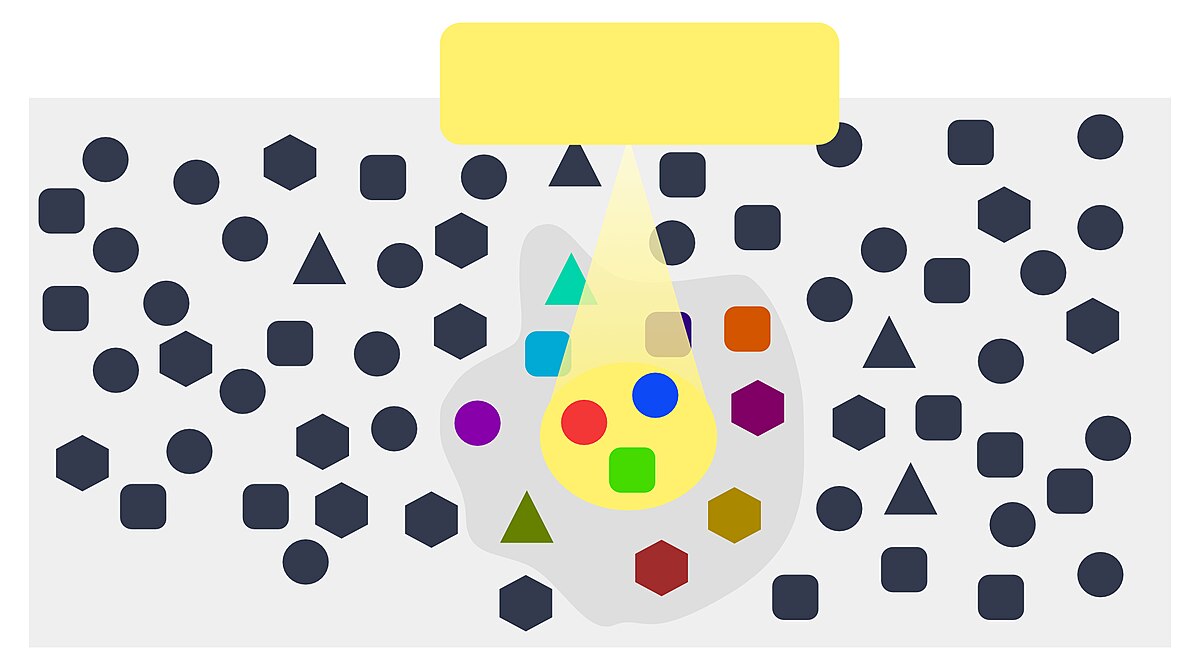
Some cognitive scientists do not view working memory as a separate box in the brain. Nelson Cowan proposed that working memory consists of long-term memory representations that have been activated, with a narrower focus of attention limited to about four items.
A diagram illustrating how a narrow spotlight of attention selects a small subset of items from a wider field of activated memories. Blacktc, CC BY-SA 4.0, via Wikimedia Commons
K. Anders Ericsson and Walter Kintsch introduced long-term working memory, which relies on retrieval structures to access stored knowledge instantly. Klaus Oberauer later refined this model by describing a single-element focus nested inside the broader focus of attention to process one chunk at a time.
Test yourself
When working memory is overloaded with too many individual items, what is the best strategy?
Find patterns to group items into chunks. Because slot capacity is fixed, trying to hold more separate pieces fails. Grouping items into larger meaningful units using prior knowledge lets you hold more information at once.
Does working memory capacity increase through intensive practice?
No, it stays roughly the same. Working memory capacity remains fixed at roughly four items. Intensive practice changes the size of the units you can group together, not the number of slots available.
A chess player glances at a board for five seconds and rebuilds it. How?
Each group of pieces is one known unit. Capacity runs at about four units for everyone. A player who knows the positions counts a whole cluster as one unit, so four units carry far more board.
Play the lesson in edgi and the card is yours. It lands on your Map next to the ideas it connects to, and turns from matte to foil to gold as you learn more around it.
What is the difference between short-term memory and working memory?
Short-term memory refers strictly to holding information for a few seconds. Working memory includes the active manipulation and coordination of that information during complex cognitive tasks.
Which part of the brain supports working memory?
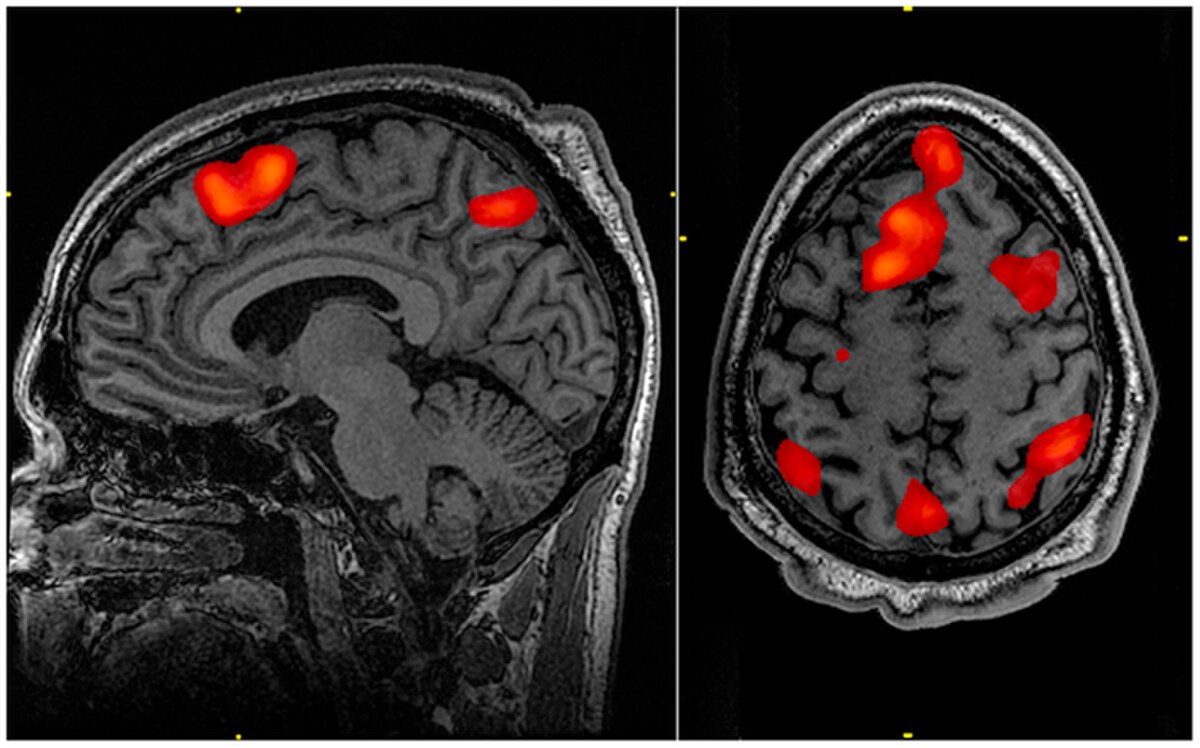
Experiments going back over a century, including ablation studies by Hitzig, Ferrier, and Carlyle Jacobsen, identified the prefrontal cortex as a primary structure for temporary information maintenance and delayed responses.
Who first coined the term working memory?
The term was coined by George Miller, Eugene Galanter, and Karl Pribram in the 1960s, a period when cognitive theories frequently compared human mental functions to computers.