Spaced repetitionWhy timing matters more than effort
Spaced repetition is a learning method where you review information at increasing intervals of time instead of all at once. Spreading reviews apart exploits how memory naturally fades, fixing facts into long-term memory far more effectively than equal time spent cramming. The ideal review schedule depends on when you need to remember the material, not on how difficult it feels right now.
By the edgi team We find the most surprising true thing about an idea and build a 60-second lesson around it.
In 2008 Nicholas Cepeda and four colleagues taught more than 1,350 people the same set of obscure facts, then brought every one of them back for a single review of those same facts. The gap was the only thing that varied. Some reviewed the next day, some after a week, some three months later. Everyone then sat a final test, some of them a week on and some a year on.
University of Pennsylvania students taking a United States Navy examination for commission in McKean Hall at Penn Law in June 1918. Unknown authorUnknown author or not provided, Public domain, via Wikimedia Commons
One review, same facts, same effort. Where the gap fell decided how much survived. Spaced repetition is nothing more elaborate than that: the same passes, moved apart.
Why cramming loses
Cramming puts both passes in one sitting. The second runs minutes after the first, while nothing has been lost yet, so it costs a full pass and buys very little. The people who reviewed with no gap did worst at every long delay in the study. Repetition still helps. Repetition with nothing in between helps least.
A student is shown with their head buried in their arms on a desk, covered by a red and black plaid blanket, indicating stress or exhaustion from homework. jessica mullen from austin, tx, CC BY 2.0, via Wikimedia Commons
It does get you through tomorrow's exam, which is why it survives. The difference turns up the week after, when the material was supposed to still be there.
The gap scales with the deadline
The best gap in Cepeda's data was not a fixed number of days. It moved with how far away the final test was. For a test a week out, the gap that worked best was about a day. For a test a year out, about three weeks.
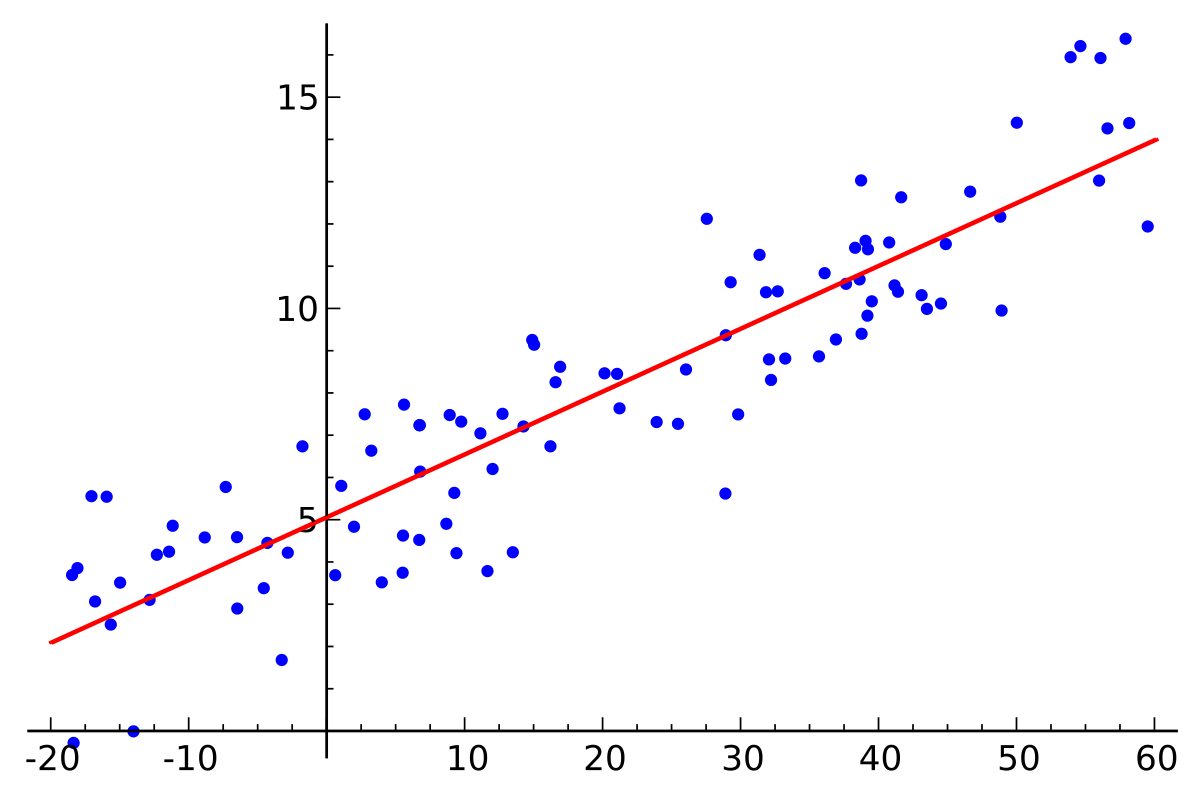
A scatter plot showing an example of simple linear regression, with numerous blue data points and a single red line representing the regression line. Sewaqu, Public domain, via Wikimedia Commons
So the rule is a ratio, not an interval. Roughly a fifth of the wait for something you need soon, and a smaller share as the deadline moves further out. And none of it says to review the moment you feel it slipping. The schedule is set by when you need the material, not by how shaky it feels today.
How the spacing effect works
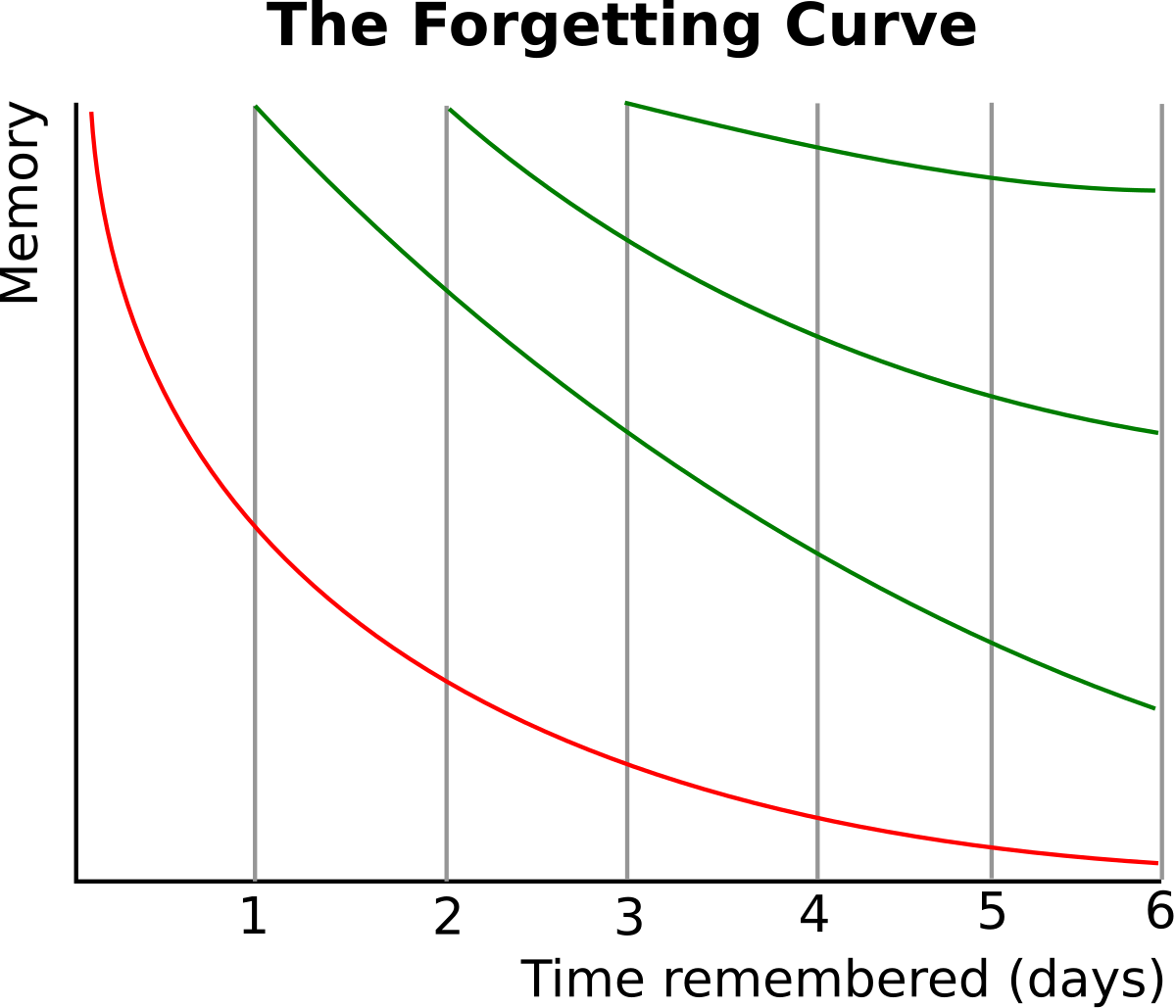
In the 1880s, German scientist Hermann Ebbinghaus mapped the forgetting curve, a graph showing how rapidly learned information drops out of memory over time. He observed that reviewing material at specific intervals curbs this loss.
The forgetting curve shows how memory decays over time and how spaced reviews flatten the curve to retain information longer. The original uploader was Icez at English Wikipedia., Public domain, via Wikimedia Commons
Instead of keeping review intervals identical, the technique expands them. If a fact is recalled correctly, the time before the next review doubles or grows longer. If recall fails, the item drops back to an earlier interval for more frequent repetition.
This expanding schedule ensures a high rate of successful recall while pushing facts deeper into long-term memory. It is commonly used for vocabulary acquisition in second-language learning, where thousands of individual items must be retained indefinitely.
From paper flashcards to software
In 1932, C. A. Mace proposed scheduling study sessions at intervals of one day, two days, four days, and eight days. In 1973, Sebastian Leitner turned this principle into a physical tool called the Leitner system.
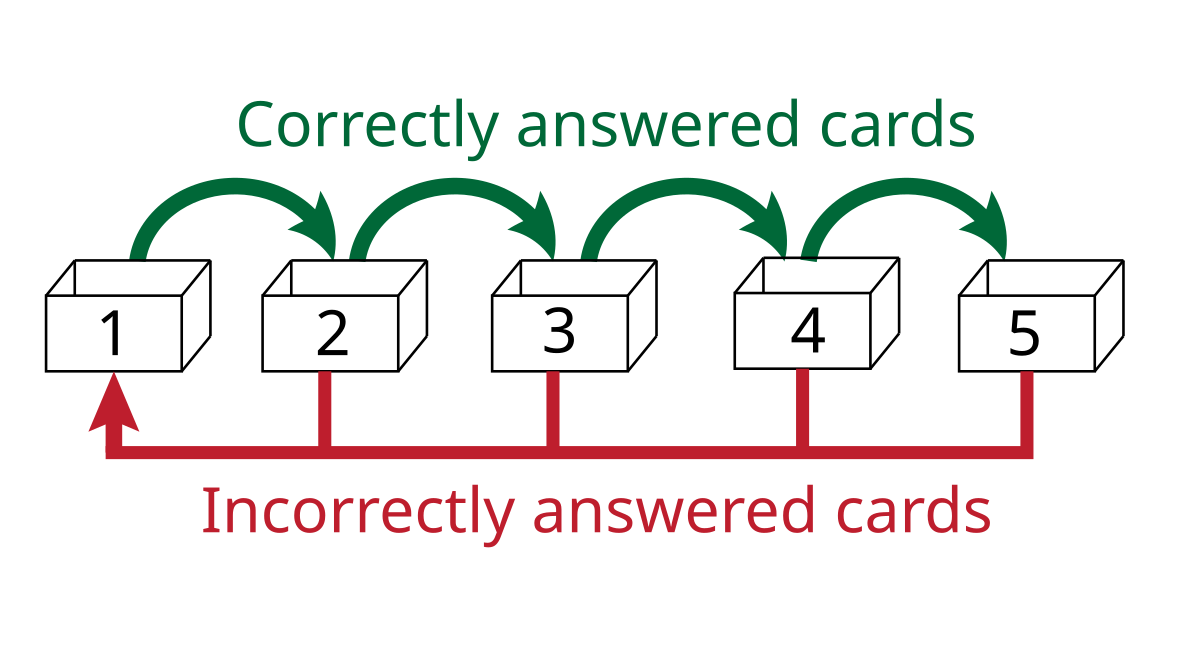
In the Leitner system, correctly answered cards advance to less frequent review boxes while failed cards reset to the first box. Zirguezi, CC0, via Wikimedia Commons
The Leitner system sorts physical flashcards into boxes based on mastery. Correctly answered cards move forward into boxes that are reviewed less often, while forgotten cards return to the first box for frequent review.
Personal computers in the 1980s automated this sorting. Modern software tracks individual difficulty for thousands of cards, automatically adjusting spacing intervals so learners can maintain target recall rates of 90 percent or higher.
Applications in medicine and clinical memory
Spaced repetition is not limited to classroom study. In 1985, researchers Schacter, Rich, and Stampp demonstrated that the method helps patients suffering from amnesia and memory impairments.
Clinical trials show that expanding review intervals helps individuals with Alzheimer's disease and dementia remember object names, daily tasks, personal details, and family relations weeks or months later. In one 2003 study, a woman with Alzheimer's was trained to pair her grandchild's name with a photograph and successfully retained the name five days later.
Test yourself
When should you schedule a spaced repetition review session according to optimal retention data?
Based on when you need the knowledge. The optimal schedule is set by your target deadline rather than subjective feelings of memory decay.
In spaced repetition, how should review intervals scale relative to the target deadline?
They scale proportionally. Spaced repetition uses intervals that scale proportionally with the deadline, requiring wider gaps for more distant tests.
Your exam is six days away and you have two study sessions. When should the second go?
About a day after the first session. The best gap runs at roughly a fifth of the wait for a target this close, which puts it a bit over a day out. A second pass in the same sitting adds the least.
Play the lesson in edgi and the card is yours. It lands on your Map next to the ideas it connects to, and turns from matte to foil to gold as you learn more around it.
It is a physical flashcard method created in 1973 by Sebastian Leitner. Cards sit in different compartments and advance to less frequent review sessions as you answer them correctly, returning to the start whenever you fail.
Can spaced repetition help with memory disorders?
Yes. Studies since the 1980s show that expanding retrieval intervals helps patients with amnesia, dementia, and Alzheimer's retain daily tasks, object names, and face-name associations over long periods.