Reminiscence bumpWhy older adults remember youth best
The reminiscence bump is the tendency for adults over forty to remember more personal events from their adolescence and early adulthood than from other life stages. When researchers plot memory recall across an entire life, personal recollections peak sharply between the ages of ten and thirty. Later routines often fade into a blur, but memories from these formative years remain easily accessible decades later.
By the edgi team We find the most surprising true thing about an idea and build a 60-second lesson around it.
If you are over forty, your brain is biased toward the music, movies, and events of your late teens. Researchers plotting autobiographical memory across a lifespan discovered a massive, unexpected spike in memories between the ages of ten and thirty.
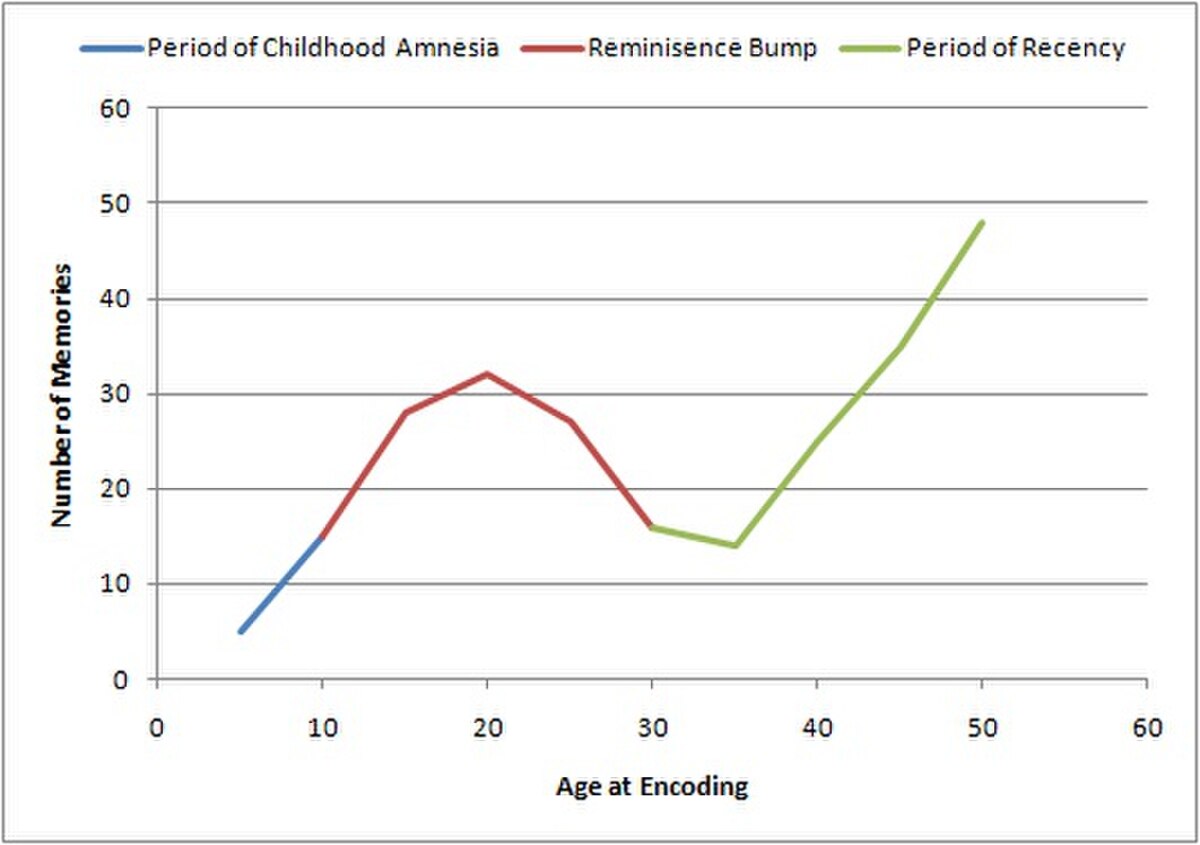
A line graph titled "Lifespan Retrieval Curve" plots the "Number of Memories" (Y-axis) against "Age at Encoding" (X-axis) from 0 to 60 years. Psyc3330 w11, Public domain, via Wikimedia Commons
The season of firsts
This period is packed with novel experiences: first loves, first cars, and first taste of independence. Your brain encodes these intense, identity-shaping moments more deeply than the routine years that follow.
The permanent anchor
Episodic memory from your twenties often feels like high-definition video while middle age feels like a blur. This lasting mental footprint is known as the reminiscence bump.
The lifespan retrieval curve
When researchers plot autobiographical memory over a lifetime, the resulting graph falls into three distinct zones. The first section spans birth to age five and represents childhood amnesia, a time from which people recall almost nothing. The second section is the reminiscence bump, typically appearing between the ages of 10 and 30, where the volume of recalled memories spikes. The final section is a standard forgetting curve running from the end of the bump to the present day.
The exact boundaries of the bump shift slightly depending on how researchers trigger the memories. Tests using word cues, such as the Crovitz-Schiffman cue-word technique where participants date memories prompted by specific words, reveal a bump between the ages of 8 and 22. When researchers ask people to identify their most important life events, the bump shifts to ages 15 through 27.
Why youth memories stick
Several theories explain why the brain favors this specific window of life. The cognitive account points out that adolescence and young adulthood combine rapid, novel change with a following period of stability. Novel events receive deeper mental processing, and the stability that follows helps keep memory cues intact over time. At the same time, the biological account notes that encoding efficiency and cognitive capacity peak between the ages of 10 and 30, meaning the brain stores information more effectively during these years.
Identity and cultural expectations also drive recall. The narrative account argues that memories defining personal goals, beliefs, and self-identity are rehearsed far more often as people build their life stories. The life script account adds that cultures expect major positive transitions, such as marriage or having a child, to occur during early adulthood. These expected milestones provide a structured schema for memory, whereas sad or traumatic events show no bump and remain flat across the lifespan.
Test yourself
What causes the reminiscence bump in adults over forty?
A concentration of novel life experiences. The reminiscence bump happens because adolescence and early adulthood are packed with identity-shaping firsts that anchor memories deeply, not because aging somehow improves overall recall.
When examining autobiographical memory in older adults, where does the reminiscence bump typically appear?
Between ages ten and thirty. The reminiscence bump is a massive spike in vivid memories specifically occurring between ages ten and thirty due to the high density of novel, foundational life events during that window.
When examining autobiographical memory in older adults, where does the reminiscence bump typically appear?
Between ages ten and thirty. The reminiscence bump is a massive spike in vivid memories specifically occurring between ages ten and thirty due to the high density of novel, foundational life events during that window.
Play the lesson in edgi and the card is yours. It lands on your Map next to the ideas it connects to, and turns from matte to foil to gold as you learn more around it.
No, sad and traumatic events do not produce a bump. Research shows that recall for negative events remains stable across the entire lifespan, whereas culturally expected positive milestones peak sharply.
How do researchers test the reminiscence bump in labs?
Researchers often use the Crovitz-Schiffman cue-word technique, presenting participants with specific words to trigger memories. Participants recall the first event that comes to mind and date when it happened, consistently creating a peak of memories from early adulthood.