Allostatic loadHow chronic stress reshapes the body
Allostatic load is the cumulative physical wear and tear on your body caused by chronic or repeated stress. Instead of returning to a stable baseline after a threat, your body recalibrates its internal systems to cope with ongoing pressure. Over time, keeping these stress responses permanently turned on damages organs, alters brain structures, and accelerates disease progression.
By the edgi team We find the most surprising true thing about an idea and build a 60-second lesson around it.
Your body is designed to handle stress, but not indefinitely. In short bursts, hormones like cortisol sharpen your focus and boost your energy to survive immediate threats.
But when that threat never goes away, like a never-ending deadline, those same hormones begin to erode your own tissues.
The debt
Scientists used to think the body always returned to a fixed baseline, a concept called homeostasis. In 1993, researchers Bruce McEwen and Eliot Stellar proposed allostasis instead: the body recalibrates to a new, more taxed state to survive constant pressure.
Animated diagram illustrating negative feedback in the regulation of blood sugar, showing a fluctuating sine wave representing glucose levels returning to a stable set-point. Helloportobello, CC BY-SA 4.0, via Wikimedia Commons
This "new normal" isn't healthy. It is a biological debt that accumulates wear and tear on your heart, brain, and immune system.
The cost
This is called allostatic load. It is the literal physical price you pay for prolonged stress. It explains how our social environment gets under our skin to alter cellular health.
This research birthed a field called psychoneuroimmunology, proving that stress is a physical erosion that can age your organs by decades.
How predictive stress turns into physical damage
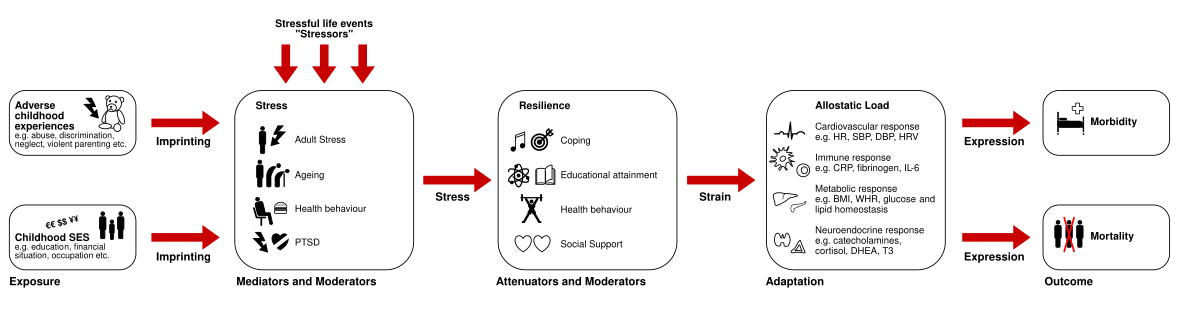
The brain regulates the body through allostasis by predicting needs and preparing to meet them before they happen. A major goal of this predictive regulation is reducing uncertainty about future outcomes. Anticipating needs requires significant brain energy. When the brain cannot resolve that uncertainty, the stress response stays activated, and allostatic load begins to accumulate.
This diagram illustrates how exposure to adverse experiences leads through stress mediators to allostatic load and severe health outcomes. Jwdietrich2, CC BY 4.0, via Wikimedia Commons
Constant activation damages multiple body systems simultaneously. It produces blood flow turbulence in coronary and cerebral arteries, increases blood pressure, accelerates atherogenesis, and causes cognitive dysfunction and depressed mood. Over extended periods, high allostatic load can permanently alter brain architecture and weaken an organism's ability to cope with future uncertainty.
The two distinct types of allostatic load
Researchers Bruce McEwen and John Wingfield identified two distinct categories of allostatic load based on energy balance. Type 1 allostatic load happens when energy demand exceeds energy supply, pushing the body into an emergency survival state. This occurs during starvation, hibernation, and critical illness. Once the external challenge passes, the animal can regain positive energy balance and return to its normal life cycle.
Type 2 allostatic load occurs when an organism consumes sufficient or excess energy but experiences social conflict or dysfunction. This pattern is common in human societies and captive animals. Unlike Type 1, Type 2 does not trigger an escape response and requires learning or changes in social structure to resolve. It also shifts thyroid function differently: while Type 1 reduces triiodothyronine concentrations, Type 2 increases them.
How scientists measure cumulative strain
Scientists measure allostatic load using a composite index of biomarkers across the neuroendocrine, cardiovascular, immune, and metabolic systems. In the endocrine system, chronic stress elevates corticotropin-releasing factor and disrupts the hypothalamic pituitary adrenal axis, causing lower cortisol in the morning, higher cortisol in the afternoon, and elevated blood sugar.
In the nervous system, prolonged stress causes neurons to shorten their dendrites, which reduces attention spans and increases fear responses. Meanwhile, ongoing activation of the sympathetic nervous system elevates inflammatory cytokines and impairs cell-mediated acquired immunity. Researchers also measure these effects in animals using tools such as the rat cumulative allostatic load measure.
Test yourself
In psychoneuroimmunology, how does social stress physically impact a person?
It alters cellular health like a toxin. Social and psychological stress gets under the skin to cause physical erosion and alter cellular health across bodily systems.
Does allostatic load mean the body always returns to a fixed baseline?
No, it recalibrates to a taxed state. Homeostasis assumes the body returns to a fixed baseline, but allostasis means the body recalibrates to a new, more taxed normal that accumulates physical wear.
How does allostatic load differ from acute stress responses?
It represents cumulative biological debt. While short bursts of stress hormones save you from immediate threats, chronic exposure builds up a biological debt that erodes health.
Play the lesson in edgi and the card is yours. It lands on your Map next to the ideas it connects to, and turns from matte to foil to gold as you learn more around it.
What is the difference between homeostasis and allostasis?
Homeostasis is the regulation of physiological processes to maintain a stable state in response to the environment. Allostasis is the broader predictive system that achieves stability through physiological change and anticipation.
Can physical exercise cause allostatic load?
Yes. Certain demanding situations, including exhausting physical exercise and adapting to antarctic conditions, create a blend of both Type 1 and Type 2 allostatic load.
How does chronic stress affect brain cells directly?
Prolonged stress causes structural abnormalities in the nervous system, specifically shortening the dendrites of neurons. This physical shortening leads to decreased attention and heightened fear conditioning.