A habit is a routine behavior that is repeated regularly and occurs with little to no conscious thought. It develops as repeated actions become imprinted in neural pathways, linking specific contexts directly to behaviors. Roughly 43 percent of daily human actions are performed out of habit rather than active decision making.
By the edgi team We find the most surprising true thing about an idea and build a 60-second lesson around it.
You have probably been told it takes 21 days to build a habit. The number comes from a 1960 book by a plastic surgeon called Maxwell Maltz. Maltz was not studying habits. He had noticed that his patients took about three weeks to stop being startled by a new face in the mirror, and he wrote that down as an observation.
A hamadryas baboon is shown interacting with its reflection in a mirror, with a person visible behind the mirror. Moshe Blank, CC BY-SA 3.0, via Wikimedia Commons
The observation got repeated as a rule. It has been quoted that way for sixty years, mostly by people who have no idea where it came from.
What 96 people actually did
Phillippa Lally's team at University College London measured how long it actually takes. Ninety-six volunteers each picked one small daily action and did it in the same setting for twelve weeks. The actions were ordinary: a glass of water with lunch, a fifteen minute walk before dinner. Every day people rated how automatic it felt, and those ratings traced a curve for each person.
The Wilkins Building at University College London (UCL), featuring its iconic neoclassical portico and dome, with numerous students and visitors gathered on the steps and surrounding plaza on a sunny… Diliff, CC BY-SA 3.0, via Wikimedia Commons
The curve climbs fast and then flattens. Among the people whose ratings settled into a clean curve, the median time to reach the flat part was 66 days, three times the number in the book. The spread matters more than the median. The quickest person got there in 18 days, the slowest took 254, and plenty of people were still climbing when the twelve weeks ran out.
What the curve looks like
Missing a day is the part people are frightened of, and Lally's data has an answer. One missed opportunity did not measurably change anybody's curve. The rating dipped by less than half a point and the climb carried on the next day. The rule people repeat to each other, that one slip puts you back at the start, is not in the numbers.
The early days do carry more weight, because the curve is steepest at the beginning. Week one moves the score more than week eight does, which is the opposite of how it feels. The useful version of the advice has no fixed number in it. The curve has the same shape for everyone, steep at the start and flat somewhere between three weeks and eight months.
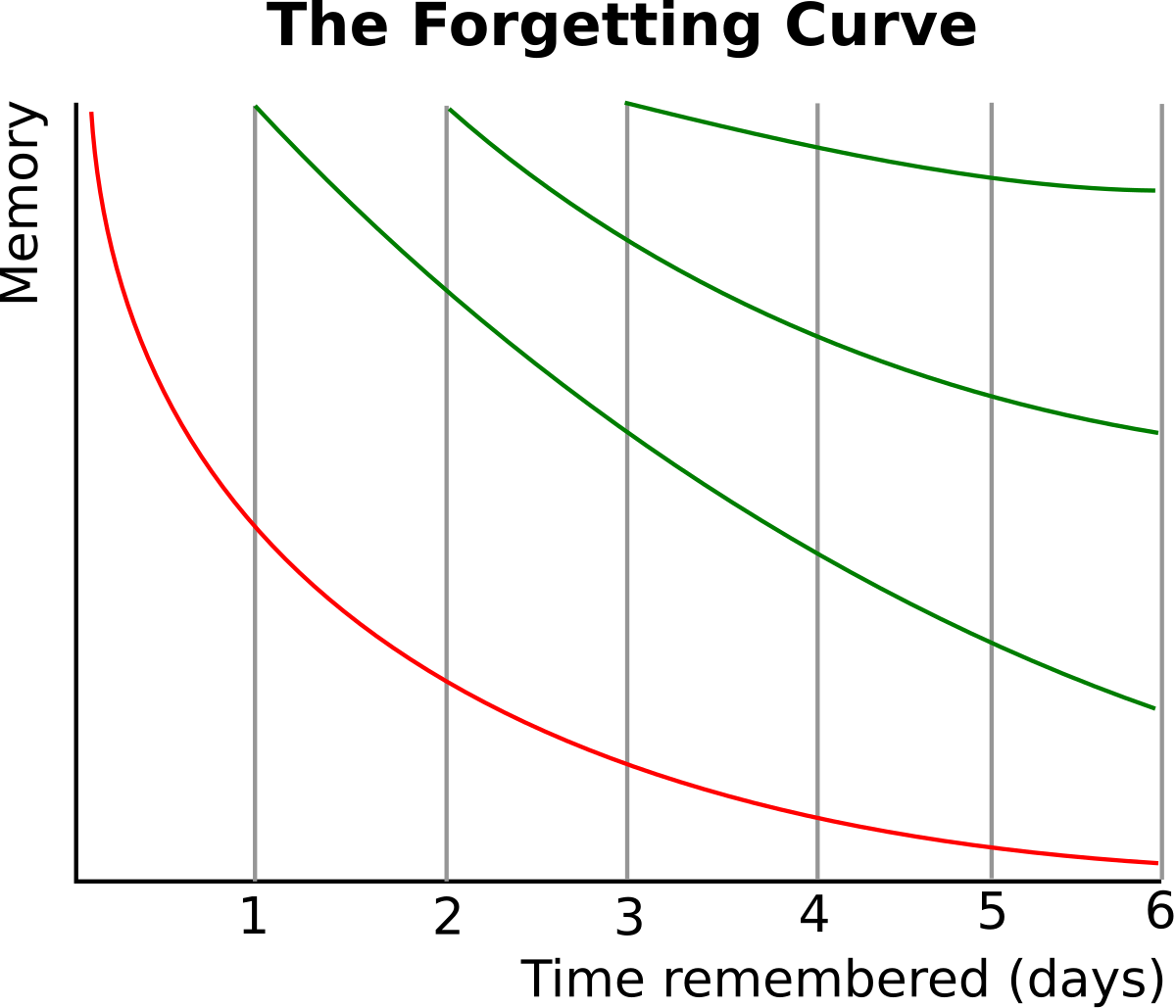
Graph illustrating the forgetting curve and the effect of spaced repetition on memory retention. The original uploader was Icez at English Wikipedia., Public domain, via Wikimedia Commons
How does habit formation work?
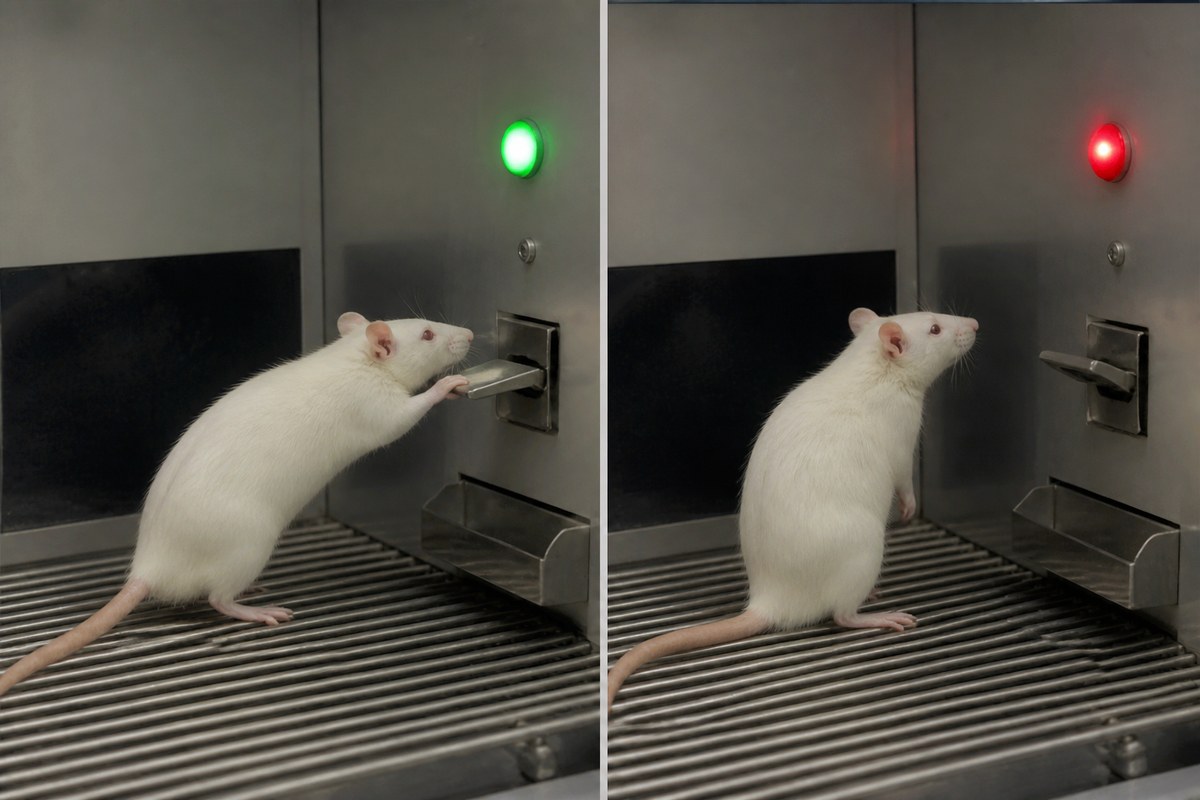
Habit formation relies on a four-part mechanism: a context cue, a craving, behavioral repetition, and a reward. The context cue is an environmental trigger, such as a physical location, a time of day, or a preceding action. This cue sparks a craving for a specific outcome, which motivates the person to repeat the behavior.
When the behavior yields a reward, such as a positive feeling, it strengthens the connection between the context and the action. Over time, the conscious goal that originally prompted the action fades, and the behavior becomes automatic. Features of automatic behavior include efficiency, lack of awareness, unintentionality, and uncontrollability. Studies show that intermittent or uncertain rewards are especially effective at driving this learning process.
How long does automaticity take to build?
Automaticity increases with repetition along a curve that rises quickly and eventually levels off at an asymptote. While popular lore suggests habits form in 21 days, experimental work by Phillippa Lally and colleagues showed that reaching automaticity takes an average of 66 days, with a real range between 18 and 254 days.
The early repetitions carry the greatest weight because the automaticity curve is steepest at the start. Missing a single repetition does not derail the process; research shows that one missed opportunity produces an automaticity dip of less than half a point and does not change the overall trajectory.
What are keystone habits and life disruptions?
Some routines act as keystone habits, meaning they trigger the formation of other related habits. For instance, establishing a regular exercise routine can prompt people to eat better and reduce credit card spending. In workplace settings, focusing on safety can serve as a keystone habit that improves overall productivity.
Habits are deeply tied to stable environments, which makes them vulnerable to disruption during major life events. Transitions such as graduating, getting married, having a first child, divorcing, or moving to a new home weaken old cues and allow routines to shift rapidly.
Test yourself
Which approach gives a new routine the best chance of surviving past two weeks?
Tying the behavior to a fixed daily anchor. Anchoring an action to an established daily event provides a reliable cue, removing the need to deliberate each time.
Why does a new routine feel much harder after two weeks?
Early motivation fades before automation forms. Initial novelty and conscious drive fade within weeks, long before the brain builds an automatic habit loop.
You have done a new morning stretch for four weeks and it still takes effort. What does Lally's data say?
Four weeks of effort is the middle of the normal range. The median time to the flat part of the curve was 66 days and the slowest volunteer took 254. At four weeks most people were still climbing.
Play the lesson in edgi and the card is yours. It lands on your Map next to the ideas it connects to, and turns from matte to foil to gold as you learn more around it.
The word habit comes from the Latin words habere, meaning to have or consist of, and habitus, meaning a state of being. In thirteenth-century French, it referred specifically to clothing before evolving to mean an acquired mode of behavior.
What happens when a habit conflicts with a conscious goal?
An oppositional context occurs when an automatic habit pushes for one action while a conscious goal demands another. Because habits are stored in procedural memory from past repetition, they often override current intentions unless conscious control intervenes.
Who first studied habit levels scientifically?
Nikolai Bernstein studied habit formation in the 1920s and 1930s by tracking the physical motions of learners and experts. He proposed that behavior is governed by five levels of control, ranging from fully automatic procedural movement to higher reasoning.