ReinforcementWhy habits survive after the reward fades
Reinforcement is a process in behavioral psychology where a consequence increases the likelihood that an action happens again in the future. It works by linking an antecedent cue, an action, and an outcome. Even if a reward loses its value later on, heavily reinforced behaviors can continue running automatically.
By the edgi team We find the most surprising true thing about an idea and build a 60-second lesson around it.
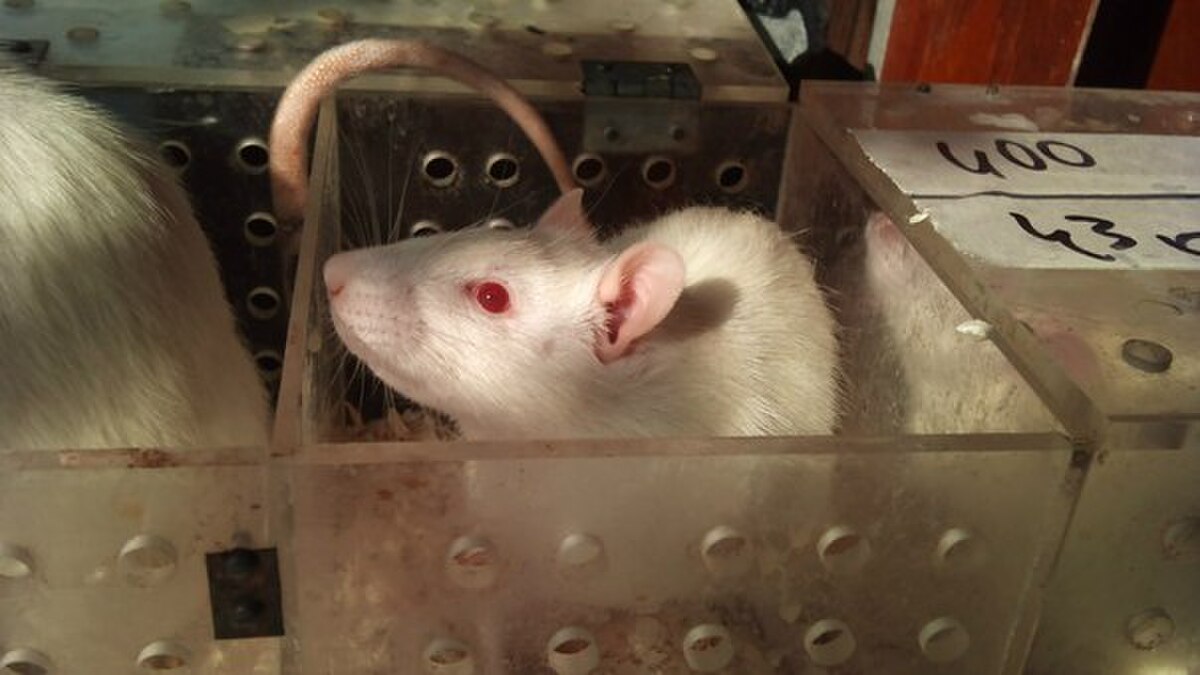
Reinforcement is the plainest idea in psychology. A behaviour that is followed by something good happens more often afterwards, and B. F. Skinner built a box in the 1930s to watch it happen. A rat in the box presses a lever and food arrives. Nobody trains it. The consequence does the work, and the pressing climbs within a session. That is operant conditioning.
A white laboratory rat with red eyes is shown in a clear plastic Skinner box, part of an experimental setup. Levorian, CC BY-SA 4.0, via Wikimedia Commons
Every habit you have was assembled this way at some point. Something you did was followed by something worth having, often enough that you stopped choosing it each time.
When the reward goes bad
In 1982 Christopher Adams ran the obvious test. Two groups of rats learned to press a lever for sugar water. One group got a moderate amount of practice, the other went on much longer. Then he ruined the sugar. The rats drank it and were made ill afterwards, which is enough to produce a conditioned taste aversion, a lasting refusal to go near the stuff.
Back at the lever, the moderately trained rats cut their pressing right down. They knew what the lever was for, and what it was for was no longer worth having. The heavily trained rats kept pressing. Same aversion, same lever, same sugar they would not drink. The amount of previous practice was the only difference between the two groups.
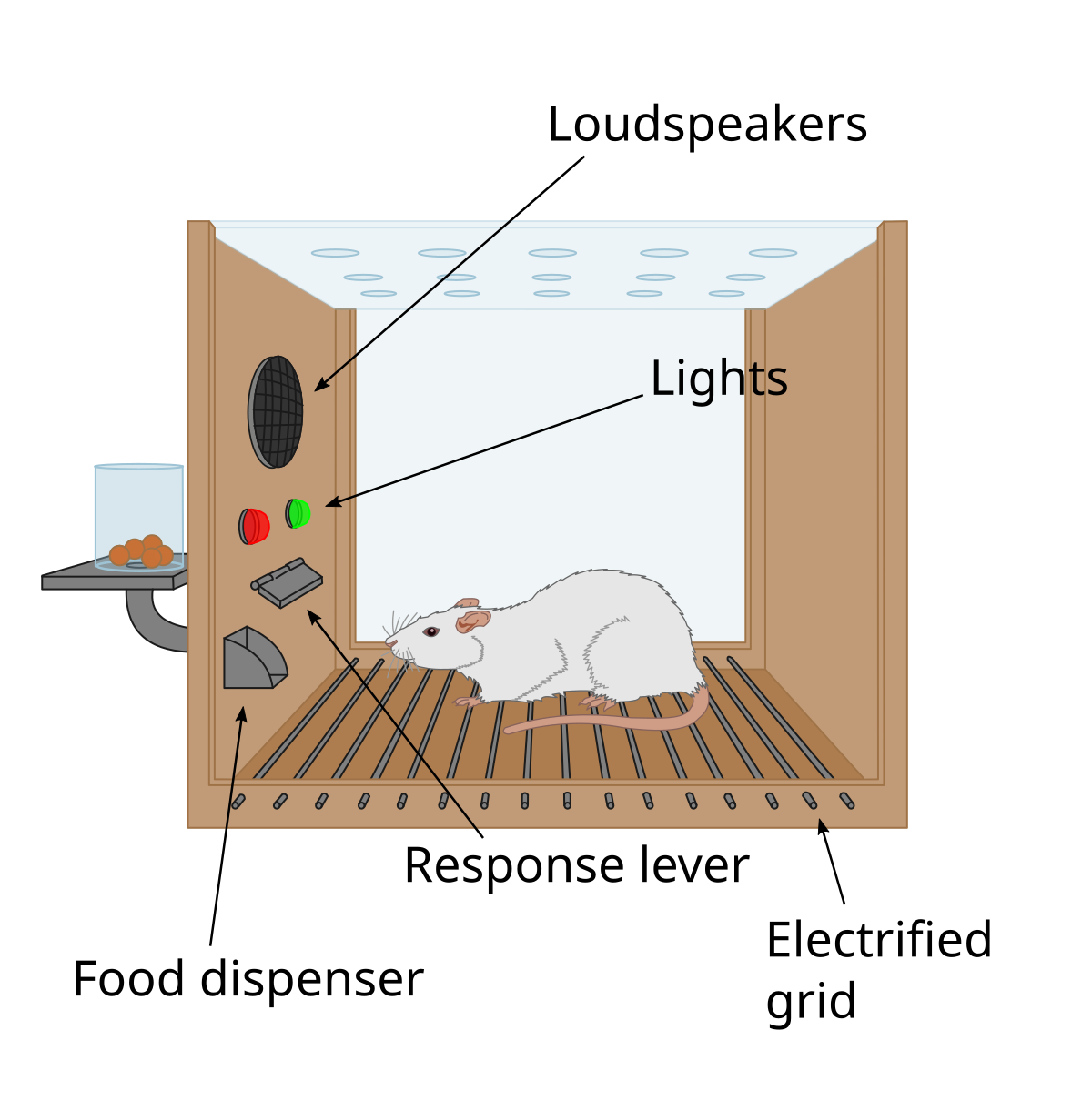
Diagram of a Skinner box, an operant conditioning chamber, showing its internal components. Original: AndreasJS Vector: Pixelsquid, CC BY-SA 3.0, via Wikimedia Commons
The reward drops out
Practice changes what a behaviour answers to. Early on it answers to the outcome: you do it for what it gets you, and if that sours you stop. After enough repetitions the outcome stops being consulted. The behaviour still runs, but the situation is triggering it rather than the payoff pulling it.
Which is why asking yourself whether you still enjoy something is such a weak move against an old habit. Liking built the thing. Liking has not been running it for years.
How reinforcement changes behavior
A stimulus counts as a reinforcer only if it measurably increases the frequency of the behavior that preceded it. Subjective enjoyment does not define it: a cookie given to a child who asks for one is only reinforcing if the child asks for cookies more frequently in future identical settings.
This operant conditioning chamber demonstrates how an animal learns to press a lever in response to an antecedent cue to receive a reinforcer. Original: AndreasJS Vector: Pixelsquid, CC BY-SA 3.0, via Wikimedia Commons
In operant conditioning, reinforcement operates in a three-part sequence: an antecedent stimulus, an operant behavior, and a reinforcing consequence. When a rat pushes a lever in the presence of a light to receive food, the light is the antecedent, the press is the behavior, and the food is the reinforcer.
B. F. Skinner established this framework in his 1938 book The Behavior of Organisms following early puzzle-box work by Edward Thorndike. Skinner argued that positive reinforcement creates lasting behavior change, whereas punishment produces temporary suppression alongside detrimental side effects.
The difference between positive and negative reinforcement
In behavioral science, positive and negative describe the arithmetic of the environment rather than good or bad feelings. Positive reinforcement introduces a stimulus to increase a behavior, such as a teacher praising a student for answering a question in class.
Negative reinforcement increases a behavior by removing or withholding an unpleasant stimulus. Taking an aspirin is a classic case: the action is reinforced because it removes the headache, making you more likely to take aspirin the next time pain appears.
Negative reinforcement is frequently confused with punishment, but they produce opposite results. Reinforcement always increases the probability of a response, whereas punishment always reduces it by adding an unpleasant factor or taking away a pleasant one.
Test yourself
You no longer enjoy a TV series and keep watching it anyway. What does that suggest?
Liking built it and stopped running it. Once a behaviour has been repeated enough, it stops being checked against the payoff. Rats with extra practice kept pressing for sugar they had been made to hate.
What did the extra practice change in Adams's rats?
Whether the sugar still mattered. Moderately trained rats stopped pressing once the sugar had been made repellent. The heavily trained rats carried on, so the outcome had stopped governing the behaviour.
Play the lesson in edgi and the card is yours. It lands on your Map next to the ideas it connects to, and turns from matte to foil to gold as you learn more around it.
What is the difference between reinforcement and punishment?
Reinforcement increases the future probability of a behavior, while punishment decreases it. Punishment can take the form of adding an unpleasant factor or taking away a pleasant factor, and it does not require physical pain to work.
Where is reinforcement applied in practice?
Reinforcement is widely used in applied behavior analysis, special education, coaching, parenting, therapy, management, and self-help. It is also a core concept in medical models that analyze addiction and compulsions.