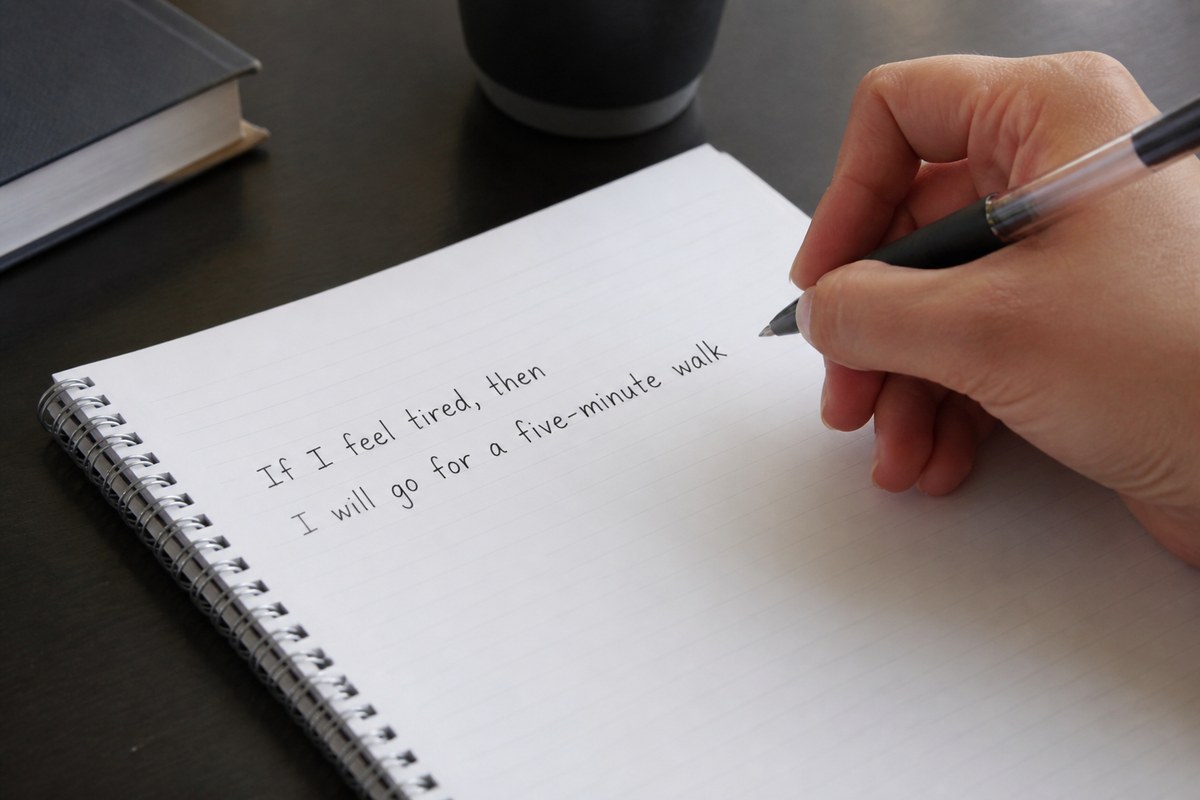
An implementation intention is a self-regulation strategy that uses an if-then sentence to link a specific future cue to an exact behavior. While standard goals state what you want to achieve, an implementation intention decides the when, where, and how in advance. This shifts action from deliberate willpower to an automatic response triggered by your environment.
By the edgi team We find the most surprising true thing about an idea and build a 60-second lesson around it.
In 2002 Sarah Milne, Sheina Orbell and Paschal Sheeran gave 248 students material designed to make them want to exercise: the health risks, the benefits, the usual persuasion. One group got that alone. A second group got the same material, then wrote one sentence naming the day, time and place they would do twenty minutes of vigorous exercise that week.
A lecture is taking place at the Faculty of Biomedical Engineering, CTU in Prague, with a male instructor in a white lab coat addressing a classroom of students. VIC CVUT, CC BY 3.0, via Wikimedia Commons
A week later, 35 percent of the persuaded group had exercised. Of the group who had written the sentence, 91 percent had. Both groups had been handed the same reasons, so motivation was not what separated them. One group had settled when and where before the week started.
Why the sentence works
Peter Gollwitzer named the technique. An implementation intention is a sentence with a fixed shape: if this situation comes up, then I will do this specific thing. A goal says what you want and leaves the moment of doing it open. An if-then sentence closes the moment, so the day itself does the remembering.
The named moment turns up whether or not you thought about it that morning. You do not have to spot the opportunity, and nothing is asked of your self-control at the point of acting. Gollwitzer and Sheeran later pooled 94 tests of this, covering more than eight thousand people. The average effect was medium to large, which is a great deal for one sentence.
A white Westclox digital alarm clock with a red LED display shows the time "4:00" with a "PM" indicator in the top left corner. Tysto, Public domain, via Wikimedia Commons
What makes a good one
A weak if-then plan is vague about the first half. "When I get a chance to go to the gym" names nothing that will actually occur at a particular hour on a particular day. A strong one names a moment you cannot miss. After I put the kettle on. When the meeting ends. As soon as I sit down at my desk. The trigger has to be something the day already contains.
A step aerobics instructor leads a class of people performing exercises on step platforms in a gym. Spc. Crystal Abbott /10th PCH, Public domain, via Wikimedia Commons
The second half has to be small enough to either do or not do. "Read more" is a wish. "When I get into bed I read one page before I pick up my phone" is a thing that either happened or did not. Write one now for whatever you keep meaning to start, naming a real moment and a real place. That is the whole intervention.
Why standard goal setting fails
Research shows that goal intentions account for only 20% to 30% of the variance in human behavior. People rarely struggle with deciding what they want, but past behavior remains a far better predictor of future actions than good intentions alone. Abstract wishes leave the exact moment of execution undecided.
Psychologist Peter Gollwitzer introduced implementation intentions in 1999 to resolve this gap between intention and action. Unlike general goal intentions, which state an outcome like wanting to exercise or study, implementation intentions belong to the post-decisional phase of action. Once a person commits to a goal, framing actions around specific situations produces far higher rates of goal attainment.
How strategic automaticity works
Writing an if-then plan creates a mental representation of a future cue, sharpening your attention, perception, and memory toward that exact moment. When the named situation occurs, the planned response triggers automatically and efficiently without conscious deliberation. Psychologists call this process strategic automaticity.
By removing the need to weigh options in the moment, the technique preserves cognitive resources for other tasks and guards against competing distractions. The planned behavior executes without hesitation, turning conscious decisions into automatic habits.
Constructing an effective if-then plan
A practical plan identifies a recurring cue and attaches an immediate, non-negotiable response. For example, a person postponing chores might plan: "If I get home before 19:00, then I will immediately clean my room for 15 minutes." Another addressing low afternoon activity might use: "If it is 12:30, then I will walk to the nearest shop to buy a snack."
The then-clause must be carried out without exceptions. Pausing to deliberate on whether an exception is justified introduces cognitive burden, weakening the automatic link between the cue and the action.
Test yourself
In a study on exercise habits, what did students who ended up exercising far more do differently beforehand?
They wrote down when and where. Both groups received the same motivating material. The group that also named a day, a time and a place reached 91 percent, against 35 percent.
Which of these is a usable if-then plan for flossing?
After I brush my teeth, I floss. An if-then plan names a moment the day already contains and an action you either do or do not. "Whenever I get the chance" names no moment at all.
Play the lesson in edgi and the card is yours. It lands on your Map next to the ideas it connects to, and turns from matte to foil to gold as you learn more around it.
What role does commitment play in implementation intentions?
An implementation intention requires strong commitment to both the overarching goal and the specific plan. Without genuine commitment, the if-then statement will have almost no effect on your actions.
Can implementation intentions be modified over time?
Yes. A person can revise their if-then plans after some time, particularly when routines or environmental situations change.