Habit reversal trainingReplacing tics with competing actions
Habit reversal training is a behavioral therapy that teaches people to replace unwanted repetitive actions with a physical movement that makes the habit impossible to perform. Instead of relying on willpower to stop an action, a person learns to catch the physical urge right before it happens and hold an opposing posture until the feeling fades. It provides a structured alternative to medication for tic disorders and body-focused repetitive behaviors.
By the edgi team We find the most surprising true thing about an idea and build a 60-second lesson around it.
A tic does not arrive from nowhere. Most people with Tourette syndrome describe a premonitory urge first, a building sensation in the shoulder or the throat that the tic relieves. Ordinary habits have the same shape. Before the nail reaches the mouth or the hand goes to the hair there is a moment, usually unnoticed, when the thing is about to happen.
Habit reversal training starts by making that moment visible. The early sessions are spent on noticing alone: when it happens, what it feels like beforehand, what your hands were doing.
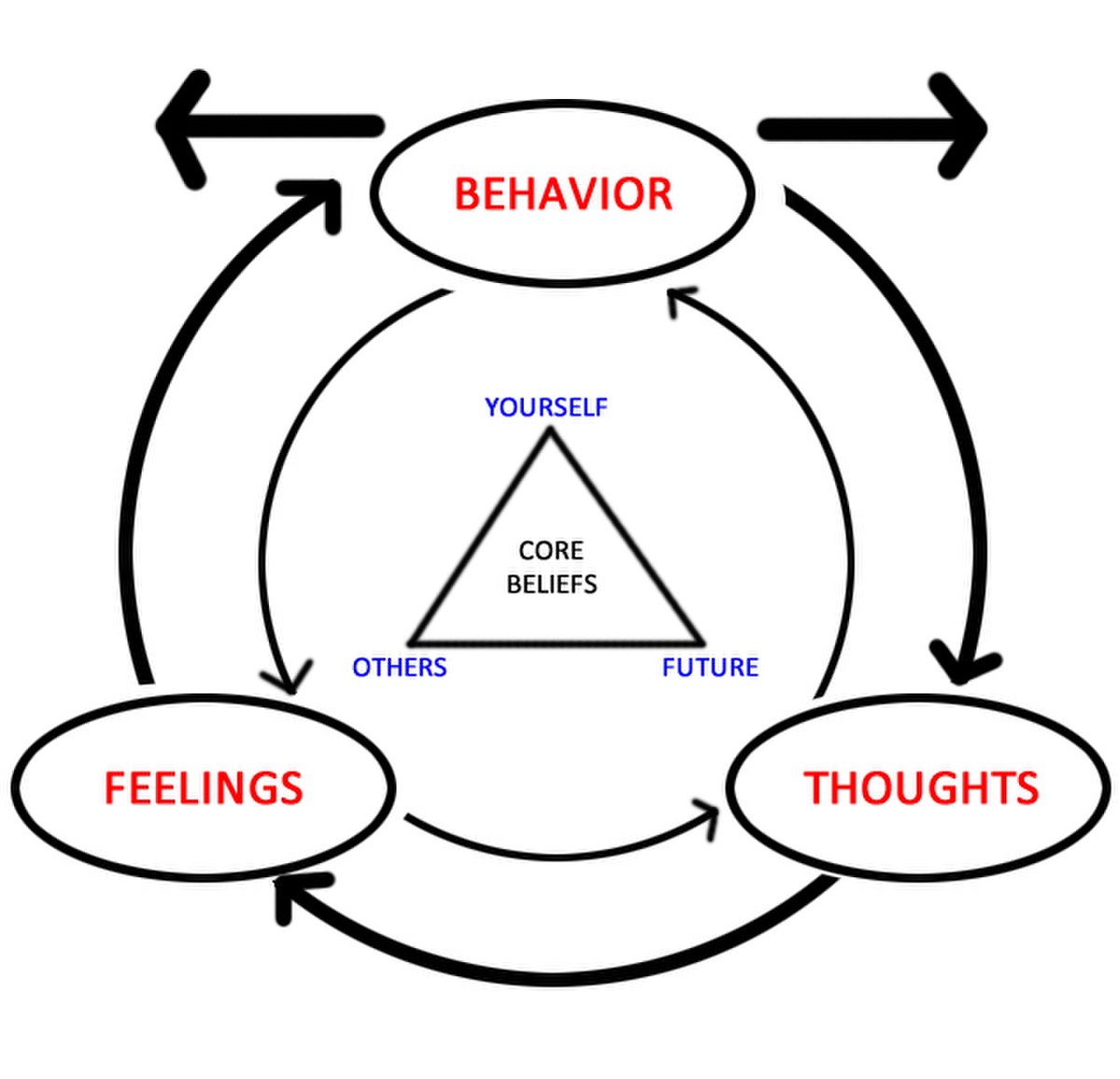
Diagram depicting the basic tenets of Cognitive Behavioral Therapy (CBT), illustrating how "BEHAVIOR," "FEELINGS," and "THOUGHTS" mutually influence each other in a cyclical manner. Urstadt, CC BY-SA 3.0, via Wikimedia Commons
The competing response
A competing response is the part that does the work. You choose a movement you can hold that the behaviour physically cannot happen through. For hair pulling it might be closing both hands into fists and resting them on your thighs. For a shoulder tic, tensing the shoulder downwards. The requirement is that the two cannot run at once.
Logo depicting a stylized fist clenching a red rose with green leaves. RootOfAllLight, CC0, via Wikimedia Commons
You use it at the urge rather than after the event, and you hold it until the urge passes, which is usually inside a minute. The situation that sets the behaviour off is left exactly as it was. Only the response changes.
Does it work
John Piacentini's team tested habit reversal properly. 126 children with a tic disorder were randomly assigned to eight sessions of behaviour therapy, or of supportive therapy, over ten weeks. The people rating the children did not know who had had which. 52.5 percent of the behaviour therapy group were rated much or very much improved, against 18.5 percent of the comparison group.
Histogram displaying the frequency of 'Tips' values, with 'count' on the Y-axis and 'Tips' on the X-axis. Visnut, CC BY-SA 3.0, via Wikimedia Commons
The same method is used on nail biting, skin picking and trichotillomania, the compulsion to pull out your own hair, and it is now a standard first treatment for tics. The transferable part is small enough to use today. Pick the behaviour, work out what the moment before feels like, and choose a movement that would make it impossible.
The five parts of habit reversal
Psychologists Nathan H. Azrin and Ronald G. Nunn published the original habit reversal method in 1973. The complete treatment package consists of five distinct components: awareness training, competing response training, contingency management, relaxation training, and generalization training.
Awareness training teaches a person to detect the subtle warning signs of an action, such as the premonitory urge that builds before a tic or the hand positions that precede nail biting. Once that urge is detected, competing response training introduces an incompatible movement, such as clenching fists or tensing shoulders downward, to physically prevent the target behavior until the urge passes.
Conditions treated by habit reversal
Habit reversal training has shown large effect sizes across a broad variety of repetitive behavioral disorders. It is an established treatment for thumb sucking, nail biting, skin picking, lip-cheek biting, stuttering, and temporomandibular disorder (TMJ).
It also serves as the core of Comprehensive Behavioral Intervention for Tics (CBIT), a first-line therapy for Tourette syndrome. In controlled clinical trials, the therapy reduced the severity of vocal and motor tics, producing more durable improvements than general supportive therapy.
Limitations and treatment barriers
Habit reversal requires sustained concentration and self-monitoring. Children younger than ten may struggle to understand the process, while individuals with severe tics or co-occurring ADHD often find it difficult to maintain the necessary focus to suppress movements.
Practical access remains a common hurdle. There is a shortage of therapists trained in behavioral interventions outside of specialty clinics, and treatment costs can restrict access for many patients.
Test yourself
You pick at the skin around your fingernails without noticing. Where does habit reversal start?
Learning to feel it coming. The first phase is awareness training: catching each occurrence and the sensation just before it. You cannot hold a competing response at an urge you never notice.
What does a competing response have to be?
Impossible to do at the same time. The movement is chosen because the target behaviour physically cannot run through it, and it is held at the urge until the urge passes. Distraction is a different thing.
Play the lesson in edgi and the card is yours. It lands on your Map next to the ideas it connects to, and turns from matte to foil to gold as you learn more around it.
Decoupling is a self-help variant of habit reversal training. A 2012 meta-analysis confirmed that it shows efficacy for treating repetitive behavioral disorders.
How effective is habit reversal across different disorders?
Research shows consistent effect sizes of approximately 0.80 across repetitive disorders. It has met formal standards as a well-established treatment for stuttering, nail biting, thumb sucking, and TMJ disorders.
Can habit reversal training be combined with medication?
Yes. Clinical guidance considers habit reversal a viable treatment either on its own or in combination with medication for managing tic disorders.