AutomaticityWhy practice makes actions hard to stop
Automaticity is the ability to carry out actions and mental tasks without thinking about the low-level steps. It develops through repetition and practice, turning complex routines like reading, walking, or driving into fast, unconscious habits. While this frees your mind to focus on other things, it also means these automatic responses can trigger on their own and prove difficult to stop.
By the edgi team We find the most surprising true thing about an idea and build a 60-second lesson around it.
In 1935 John Ridley Stroop printed colour words in the wrong colours. The word red in blue ink, the word green in yellow ink, a hundred of them on a page. The instruction was simple. Say the colour of the ink and ignore the word. The same people had already done the job with plain coloured squares, so the words were the only thing that had changed.
The squares took about 63 seconds. The mismatched words took 47 seconds longer, an increase of 74 percent, and people stumbled far more often on the way.
An animated GIF of an analog stopwatch, showing the main hand moving from 0 to 5 seconds, with a smaller inner dial for minutes. Lookang, CC BY-SA 3.0, via Wikimedia Commons
You cannot decide not to read
Reading is the culprit. By the time you have looked at the word red you have read it, and no decision you made beforehand stops that from happening. Psychologists call this automaticity. A process is automatic when it starts on its own, runs fast, and is hard to stop once it has gone.
Black and white close-up photograph of a human eye, focusing on the iris and pupil. Boodlemason, CC BY-SA 3.0, via Wikimedia Commons
The word does not make the ink harder to see. It arrives with an answer already attached, and you have to hold that answer back while you work out the one you actually want. Holding it back is what costs the 47 seconds. The Stroop effect has been reproduced thousands of times, and knowing exactly what is coming does not spare you.
What automatic costs you
Automatic is what you want most of the time. You do not want to spend attention on the clutch or sound out every word on a page, and handing the job over is most of what practice is for. The bill arrives when the automatic answer is the wrong one. Drive a route you have driven a thousand times, meaning to stop at the shop, and you can be home with nothing bought.
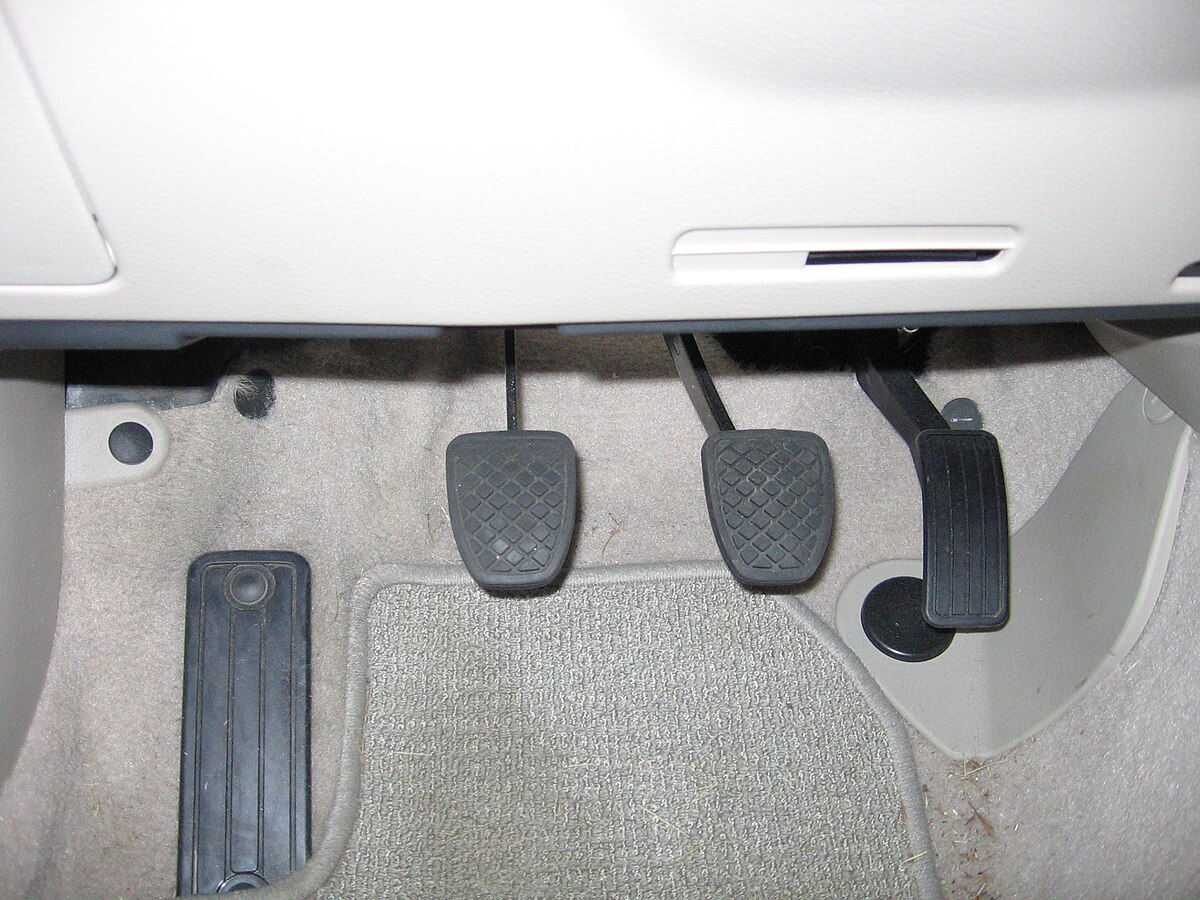
The footwell of a 2007 Subaru Legacy shows the automobile pedals from left to right: a foot rest, clutch, brake, and accelerator. Tckma at English Wikipedia, Public domain, via Wikimedia Commons
It arrives again when you try to take the job back. Skilled golfers putt worse under pressure once they start attending to the steps of their own stroke, which was going better unsupervised. From the inside none of this feels like anything, which is why people learn their own habits backwards. The empty shopping bag, the missed junction, the hour that went somewhere.
The four marks of an automatic habit
A routine does not need to be completely unconscious to count as automatic. In 1994, researcher John Bargh identified four common features of automatic behavior: low awareness, lack of intention, high efficiency, and poor controllability.
An automatic process requires minimal mental resources, meaning cognitive load stays low. It often starts without a deliberate choice and resists outside intervention once initiated. Not all four features must be present at once. For example, stereotype activation is unintentional and efficient, yet people can still maintain some conscious awareness of it.
Why thinking about routine actions breaks them
Conscious attention can actively degrade an automatic skill. Under pressure, focusing deliberately on the mechanics of an established habit alters the timing and execution of the pattern, leading to performance collapse.
Driving long distances can induce highway hypnosis, an automatic state where a driver handles complex road events without conscious attention. Zakmkldz, CC BY-SA 4.0, via Wikimedia Commons
Psychologists call this disruption the centipede effect, based on the fable where a toad paralyzes a centipede by asking it which leg moves first. George Humphrey noted in 1923 that a tradesperson who directs constant attention to routine work spoils the job. When a practiced routine is forced back under conscious supervision, execution frequently deteriorates.
How automatic patterns respond to empty cues
Automatic habits can be triggered by superficial cues rather than genuine reasons. In a study cited by Robert Cialdini, researchers Langer, Chanowitz, and Blank tested how people waiting in line for a photocopier responded to small requests.
When a researcher asked to skip the line by saying, 'because I have to make some copies', compliance reached 93 percent. That was nearly identical to the 94 percent rate for a real excuse ('because I'm in a rush') and far higher than the 60 percent rate when no reason was given. The word 'because' acted as an automatic trigger for compliance, though people only accepted the empty cue when the requested favor remained small.
Test yourself
Why is it slow to name the ink of the word red printed in blue?
You have already read the word. Reading runs by itself, so the word arrives with an answer attached and you have to hold it back. Across 100 items that cost people 47 extra seconds.
Your hand reaches for your phone in a quiet moment before you decide to. Why?
The reach starts on its own. An automatic process starts without a decision and finishes before you notice it running. That is how the phone gets into your hand ahead of the choosing.
Play the lesson in edgi and the card is yours. It lands on your Map next to the ideas it connects to, and turns from matte to foil to gold as you learn more around it.
As explained by LaBerge and Samuels, developing automatic decoding skills frees mental capacity. A reader who decodes words automatically can simultaneously comprehend text, draw inferences, and connect ideas to prior knowledge.
What is highway hypnosis?
Highway hypnosis is an automatic driving state that occurs on long trips. A practiced driver navigates the car and responds to road events properly while their conscious mind focuses elsewhere.