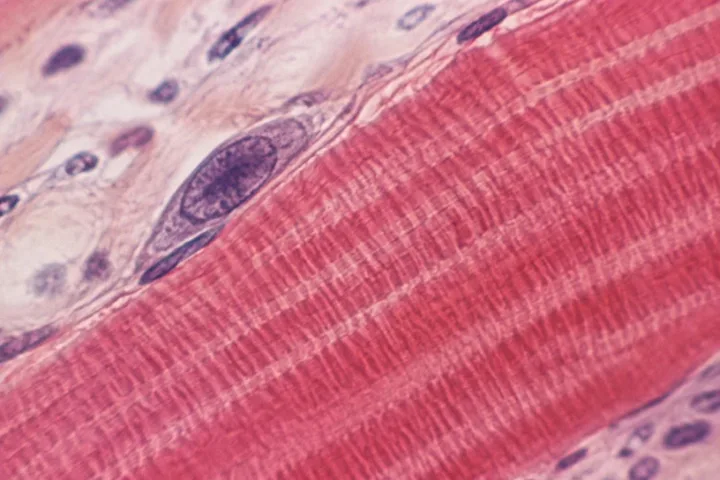
A myosatellite cell is a dormant stem cell nestled against the outer edge of a skeletal muscle fiber. Because mature muscle cells cannot divide, these reserve cells wake up during injury or exercise to multiply and repair the tissue. They fuse directly into damaged muscle fibers, donating their own nuclei so the fiber can rebuild.
By the edgi team We find the most surprising true thing about an idea and build a 60-second lesson around it.
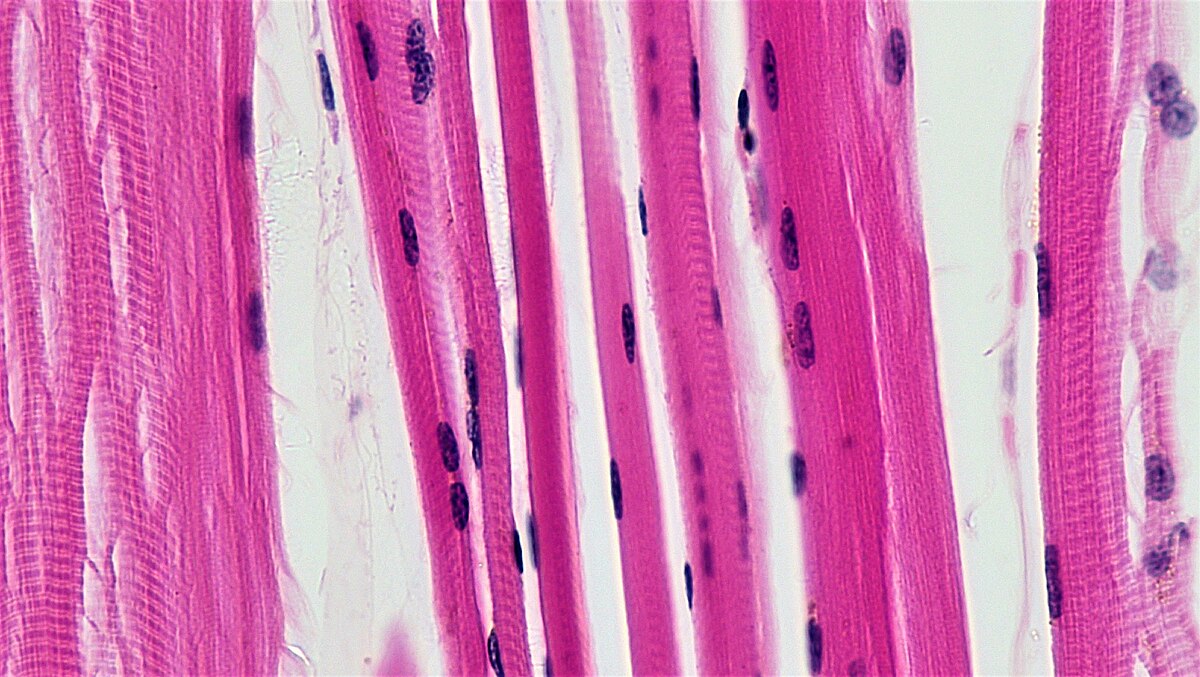
A muscle cell is enormous, holds hundreds of nuclei, and cannot divide. Tear one and the fiber has no way to replace itself. So muscle keeps spares. Pressed against the outside of every fiber, tucked under its outer wrapping, sit small stem cells doing nothing at all.
Alexander Mauro found them in 1961 with an electron microscope, and named them for where they sit: satellite cells, parked on the surface of something much larger. They can sit there for decades. Damage the fiber and they wake up, divide, and move to the tear.
What they do when they arrive
A satellite cell does not become a new fiber. It fuses into the damaged one, merges its contents in, and hands over its nucleus. The fiber ends up with more nuclei than it had. A nucleus holds the plans, so more of them lets the same cell run more protein production at once.
Take satellite cells away in a mouse and muscle repair stops dead. Nothing else in the body can do this job. Growth is a different story. Mice stripped of their satellite cells still put on muscle under load; the fibers just got bigger with the nuclei they already had.
What the muscle keeps
Nuclei added during growth stay put, in rodents at least. Fibers that grew and then wasted right back down held on to the extra nuclei for most of the animal's life. The effect it would explain is real. People who built muscle, lost it, and came back reach their old level faster than they reached it the first time.
Whether human fibers keep them is disputed. The studies came out mixed, and the rival explanation is chemical marks on the muscle's DNA that make a gene easier to switch on next time.
Where satellite cells live and how to identify them
A resting satellite cell contains very little cytoplasm and a small nucleus packed with dense heterochromatin. It sits wedged in the narrow space between the fiber's cell membrane, known as the sarcolemma, and the basement membrane surrounding it. In this resting state, it has few organelles such as mitochondria, ribosomes, or endoplasmic reticulum, and it neither divides nor produces proteins.
Scientists distinguish quiescent satellite cells from the surrounding muscle using specific genetic markers, including Pax7, CD34, and Myf5. In human tissue, researchers identify both dormant and active satellite cells through a surface glycoprotein called neural cell adhesion molecule, or NCAM.
How satellite cells activate and rebuild muscle
Mechanical strain or trauma releases signaling molecules that awaken the satellite cell from its resting state. The cytokine hepatocyte growth factor, or HGF, moves into the muscle tissue to trigger activation, while insulin-like growth factor 1 (IGF-1) encourages the cells to multiply.
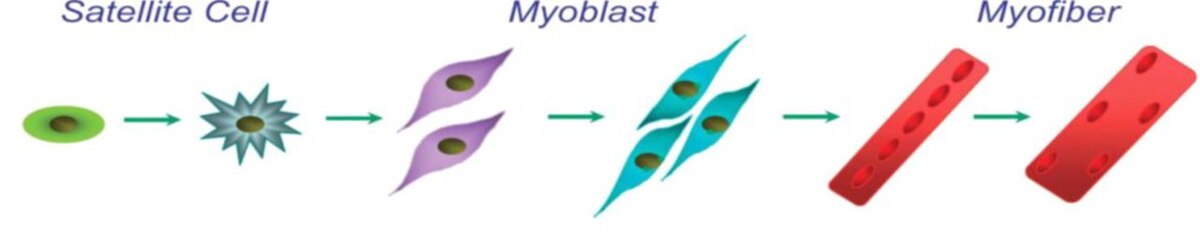
Once active, satellite cells gain new organelles, re-enter the cell cycle, and proliferate as skeletal myoblasts. These dividing cells then begin producing muscle filament proteins like desmin and transcription factors such as MyoD and myogenin. They either fuse into damaged fibers to donate new nuclei or merge together to form entirely new muscle fibers, following a path similar to fetal development.
If a muscle injury is too severe, regeneration remains incomplete. In those cases, fibroblasts deposit scar tissue in the extracellular matrix, which permanently impairs normal muscle function.
Test yourself
How do myosatellite cells contribute to muscle growth versus muscle repair?
Repair needs them, but growth can happen without them.. Muscle fibers can increase in size using their existing nuclei when loaded, but they rely entirely on satellite cell fusion to repair structural damage.
When a myosatellite cell repairs a torn muscle fiber, how does it accomplish the fix?
It fuses into the fiber and hands over its nucleus.. Mature muscle fibers are giant cells that cannot divide on their own. Satellite cells fix them by fusing directly into the damaged fiber and donating their nuclei to boost protein production.
Muscle fibers gain nuclei while they grow. Which part of that is still in dispute?
Whether they keep them after shrinking. The donation is settled: reserve cells on the outside fuse in and hand over nuclei. What nobody has pinned down in people is whether the fiber holds on to them once the muscle is lost again, which is what would make a second build cheaper than the first.
Play the lesson in edgi and the card is yours. It lands on your Map next to the ideas it connects to, and turns from matte to foil to gold as you learn more around it.
What happens if a body runs out of satellite cells?
Without satellite cells, skeletal muscle loses its ability to repair tears or heal from trauma. In laboratory experiments, removing these cells in mice caused muscle regeneration to stop completely.
Do all satellite cells in the body share the same genes?
Most satellite cells express the paired box proteins Pax7 and Pax3. However, satellite cells located in the head musculature follow a distinct developmental program and lack Pax3.