Progressive overloadWhy repeating a workout stops working
Progressive overload is the training principle of gradually increasing the stress placed on your muscles and nervous system. Because the body only maintains the strength needed for recent demands, workouts must become progressively harder to trigger ongoing muscle growth and power. Without continually increasing the load, physical adaptation stops.
By the edgi team We find the most surprising true thing about an idea and build a 60-second lesson around it.
Your body treats muscle as expensive, and keeps what the last few weeks demanded of it. The first time you lift something genuinely heavy, that is a demand. Do the same lift every week for two months and your body has already built for it. Nothing further is being asked.
Progressive overload is the rule that follows: the load has to keep moving past what you have already adapted to. It is why a routine that worked in January does nothing by April. It was first put to the test in an army hospital in 1945, when Thomas DeLorme prescribed resistance training to injured soldiers, the weights going up as they got stronger.
They recovered far faster than on the light exercise that was standard, and the method entered medicine as progressive resistance exercise: the same rule, clinical name.
The levers
There are only a few ways to ask for more. Add weight, add reps at the same weight, add sets, or take less rest between them. The steps are small: one more rep, or the smallest plate on the rack. Progression has a ceiling. Over the same number of weeks, untrained beginners add strength roughly five times faster than trained lifters do, and then the curve flattens hard.
That flattening is the same rule running out of easy room, which is why beginners measure progress by the week and experienced lifters measure it by the season.
How you know it is working
None of that tells you whether it is working. How hard a session felt is not a measurement, and neither is what the plan said you would be lifting by now. So take one session you can reproduce exactly, run it, and run it again a few weeks later in the same conditions.
Easier at the same weight and the same effort means the demand got collected. Harder means it did not. Harder is not a reason to add more. The building happens in the days after a session, so weeks of going backwards usually mean you are training again before the last session has been paid for.
How the body adapts to increasing stress
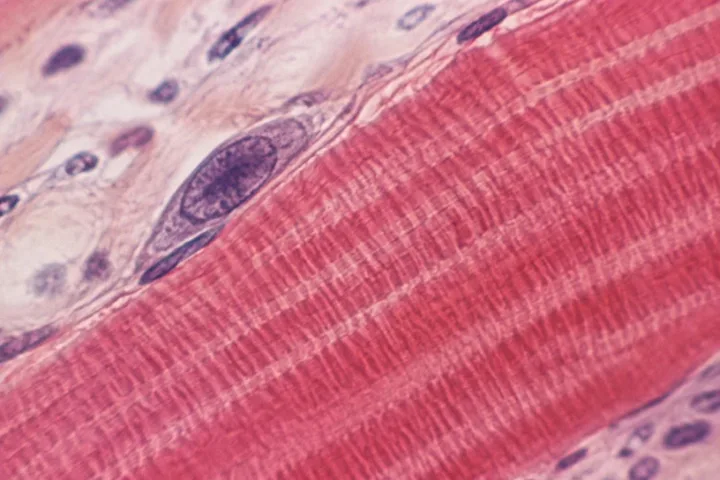
Placing muscles under greater demand than usual triggers a biological adaptation process. Neuromuscular adaptations occur first, allowing the nervous system to recruit muscle fibers more effectively and increase lifting strength before any visible size appears. Continued training then causes muscle hypertrophy, which increases the physical cross-section of the muscle and strengthens connective tissues.
These structural improvements allow the body to handle higher amounts of physical stress. However, the adaptation process slows down or halts entirely unless the body faces a greater magnitude of stress than before.
The variables used to increase load
Lifters apply progressive overload by adjusting specific training variables: volume, intensity, frequency, and interval duration. Volume represents the total repetitions multiplied by the resistance used, while intensity measures the effort relative to a person's maximal capacity. Frequency tracks how often training occurs, and interval duration measures the rest time taken between sets.
A lifter who establishes a baseline, such as eight repetitions of a bench press at 50 kilograms, progresses by altering one of these levers. They might increase the weight to 52 kilograms for the same eight repetitions, add extra sets, or shorten the rest intervals between sets.
From ancient legend to modern medicine
The earliest legendary example comes from Milo of Croton in ancient Greece, who reportedly carried a growing calf on his shoulders every day until it became a full-grown bull. The clinical method developed in 1944 when Dr. Thomas DeLorme treated injured soldiers at Gardiner General Hospital in Chicago.
Most doctors at the time believed heavy lifting harmed the heart and prescribed light exercise instead. DeLorme used progressive resistance training to rehabilitate an injured veteran named Thaddeus Kawalek, who recovered full use of his knee far faster than standard patients. That success established progressive resistance as a core method in modern physical therapy and athletic training.
Test yourself
How should an experienced lifter identify true fitness progress using progressive overload?
Compare a replicated session over time. Subjective fatigue and static plans can be misleading; the only honest check is running an identical session under the same conditions to see if it feels easier.
Does progressive overload require adding total weight every single workout?
No, other variables can increase demand. Progressive overload can be achieved by adding reps, adding sets, or shortening rest times, not just by adding more weight.
You go all out on the same weight every session for three months. Then what?
Growth stops once your body has built for it. Effort is not what is measured. Your body built what that weight needed in the first few weeks, and has had no reason to build anything further since.
Play the lesson in edgi and the card is yours. It lands on your Map next to the ideas it connects to, and turns from matte to foil to gold as you learn more around it.
What happens if training stress increases too quickly?
Excessive training stimuli without adequate recovery lead to overtraining. This causes performance to decline across a training program and raises the risk of illness, injury, or loss of motivation.
What is periodization?
Periodization is the practice of scheduling varied training loads and adequate recovery across a long-term program. It prevents overtraining, sustains physical adaptations, and breaks the monotony of repeating identical routines.