An open market operation is when a central bank buys or sells securities in the open market to manage the supply of money and adjust interest rates. The central bank pays for these purchases by simply adding electronic money to commercial banks' reserve accounts out of thin air. When it sells securities, it removes those reserves, shrinking the total money supply.
By the edgi team We find the most surprising true thing about an idea and build a 60-second lesson around it.
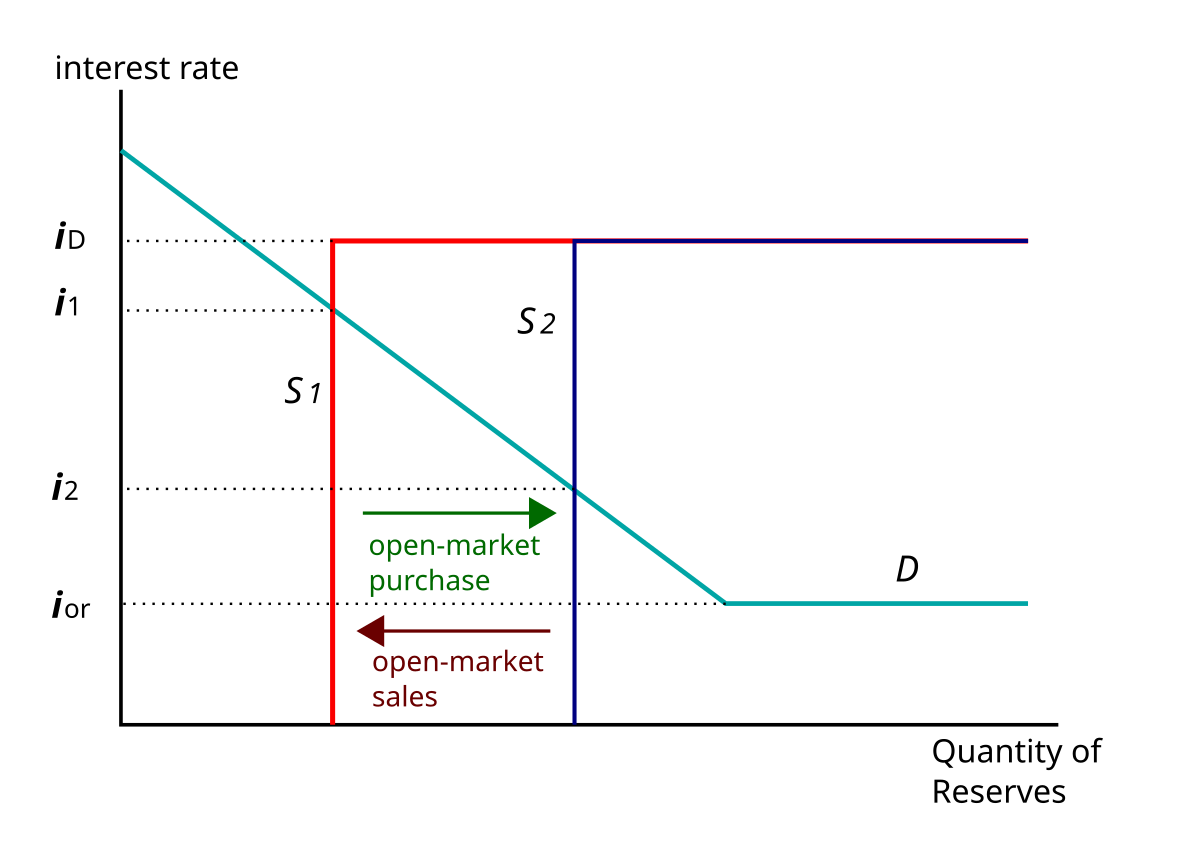
An open market operation is a Federal Reserve purchase or sale of securities to carry out monetary policy. The Fed's policy committee decides what the operation should accomplish. The New York Fed trading desk carries it out. When the Fed buys, it pays by adding money to banks' reserve accounts at the Fed; a sale removes reserve balances.
Graph illustrating the mechanism of open market operations in the market for reserves, plotting interest rate (Y-axis) against Quantity of Reserves (X-axis). Kwj2772, CC BY-SA 4.0, via Wikimedia Commons
The Fed buys and sells existing securities in the secondary market. It does not buy a newly issued Treasury security directly from Treasury.
Treasury borrows and manages debt
Treasury issues new Treasury securities at auction to finance the government. That is borrowing by the government. Treasury can also buy back an older security as part of debt management. The security is retired, but Treasury still raises the cash for the purchase by issuing debt elsewhere.
Seal of the United States Department of the Treasury, featuring a blue circular border with the text "THE DEPARTMENT OF THE TREASURY" at the top and "1789" at the bottom. U.S. Government. The original 1780s seal is believed to have been designed by Francis Hopkinson., Public domain, via Wikimedia Commons
A Fed purchase can involve the same kind of Treasury bond, but the Fed is carrying out monetary policy rather than borrowing or managing government debt.
Who made the decision?
The New York Fed also runs government debt auctions and buybacks as a fiscal agent. Treasury decides what to issue or repurchase. For an open market operation, Fed policymakers make the decision and the trading desk executes it for the Fed.
If Treasury ordered the transaction to finance or manage debt, it is a Treasury operation. If Fed policymakers ordered it to carry out monetary policy, it is an open market operation.
How open market operations work
A central bank does not need to print paper currency to conduct an open market operation. It maintains electronic reserve accounts for major commercial banks. When the central bank buys existing government bonds or other eligible assets, it credits the seller bank's account with newly created electronic money.
To shrink the money supply, the central bank reverses the process by selling securities back into the market. Payment for those bonds is debited from commercial bank reserve accounts, pulling that money completely out of circulation.
Central banks can also conduct these transactions through secured loans known as repurchase agreements. In those deals, the central bank provides fixed-period liquidity while holding eligible assets as collateral.
Why central banks trade securities
Selling securities shrinks the money supply and decreases total demand for products, services, and workers. Because money becomes scarcer, interest rates rise while inflation drops. Central banks like the US Federal Reserve, the Bank of England, and the European Central Bank use these operations to hit target interest rates.
In the late 1970s and early 1980s, Federal Reserve Chairman Paul Volcker used open market operations to contract the money supply directly. Countries with an exchange rate anchor also use open market foreign exchange interventions to keep their currencies at a fixed rate.
Since the 2008 financial crisis, many central banks have shifted to an ample reserves floor system, reducing the need for daily fine-tuning operations. Major central banks also introduced quantitative easing, committing to pre-set, large-scale purchases of longer-term bonds and corporate debt.
Test yourself
Fed policymakers direct the New York Fed to buy an old Treasury bond. What is it?
A Federal Reserve open market operation. The Fed's direction and monetary-policy purpose make it an open market operation. Treasury directs buybacks for debt management.
Is a Treasury auction an open market operation?
No, Treasury issuance is government borrowing. Treasury auctions sell new debt to finance the government. Open market operations are Fed trades in existing securities to carry out monetary policy.
Play the lesson in edgi and the card is yours. It lands on your Map next to the ideas it connects to, and turns from matte to foil to gold as you learn more around it.
What makes an open market operation different from government debt auctions?
A government Treasury issues new debt at auction to borrow cash and fund public spending. An open market operation is ordered solely by central bank policymakers to execute monetary policy by trading existing securities on the secondary market.
How does quantitative easing differ from conventional open market operations?
Quantitative easing uses the same core mechanics but commits to purchasing predefined, large volumes of securities over a fixed timeframe. It also focuses on longer-term and riskier debt, such as long-maturity government bonds and corporate bonds.