United States Treasury securityHow debt became cash
A United States Treasury security is a debt instrument issued by the federal government, representing a formal promise to repay borrowed money with interest. Because the government backs them with its full faith and credit and holds a strong record of repayment, investors treat them as one of the lowest-risk investments in the world. Large institutions and corporations routinely use them as equivalents to holding cash.
By the edgi team We find the most surprising true thing about an idea and build a 60-second lesson around it.
A United States Treasury security is an IOU issued by the federal government. It states when Treasury will repay the borrowed money and how any interest will work. The repayment date is called maturity. A security that matures in four weeks serves a different need from one that matures in 30 years.
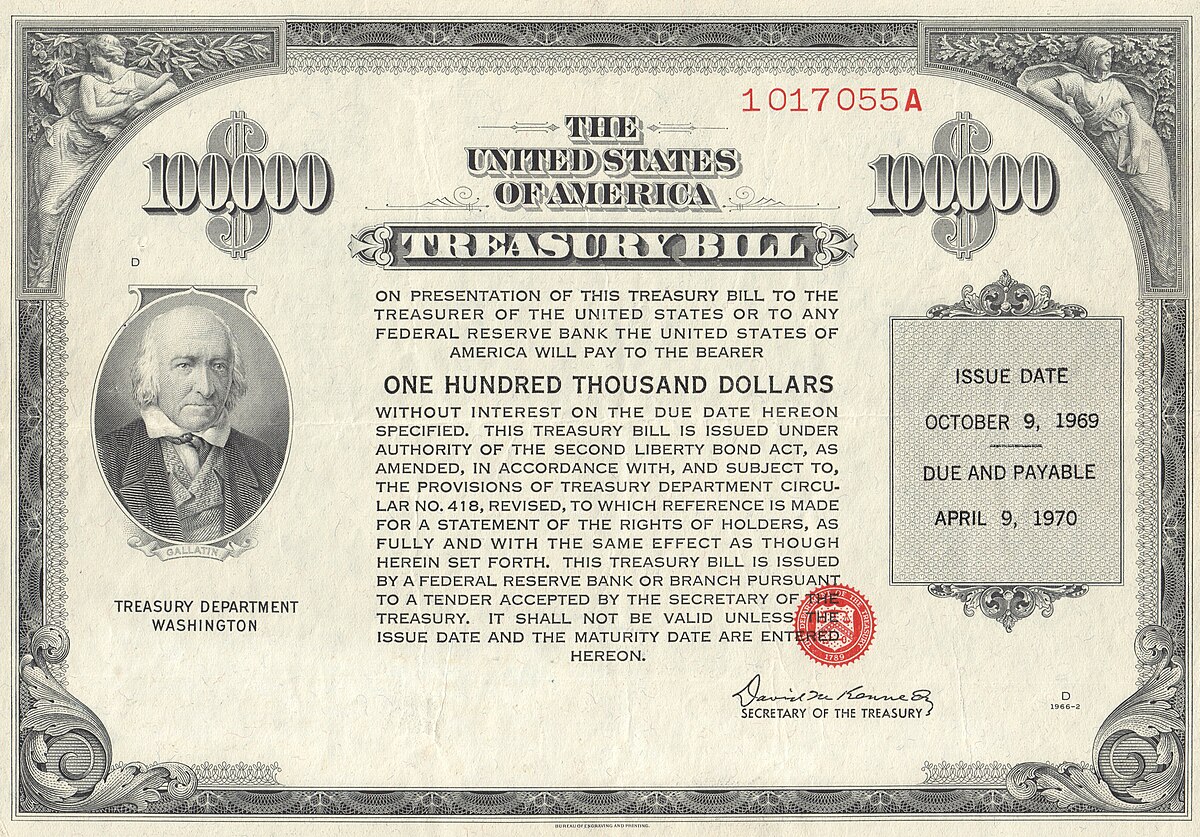
Front of a 1969 $100,000 United States Treasury Bill, featuring a portrait of Salmon P. JHerbstman, Public domain, via Wikimedia Commons
Treasury calls these securities marketable because an owner can usually sell them to someone else before maturity.
The name tells you the clock
Treasury bills run from 4 to 52 weeks. If you buy a $100 bill for $98, Treasury pays you $100 at maturity. The $2 difference is your interest. Treasury notes have terms from 2 to 10 years, while Treasury bonds currently have 20- or 30-year terms. Notes and bonds pay interest every six months.
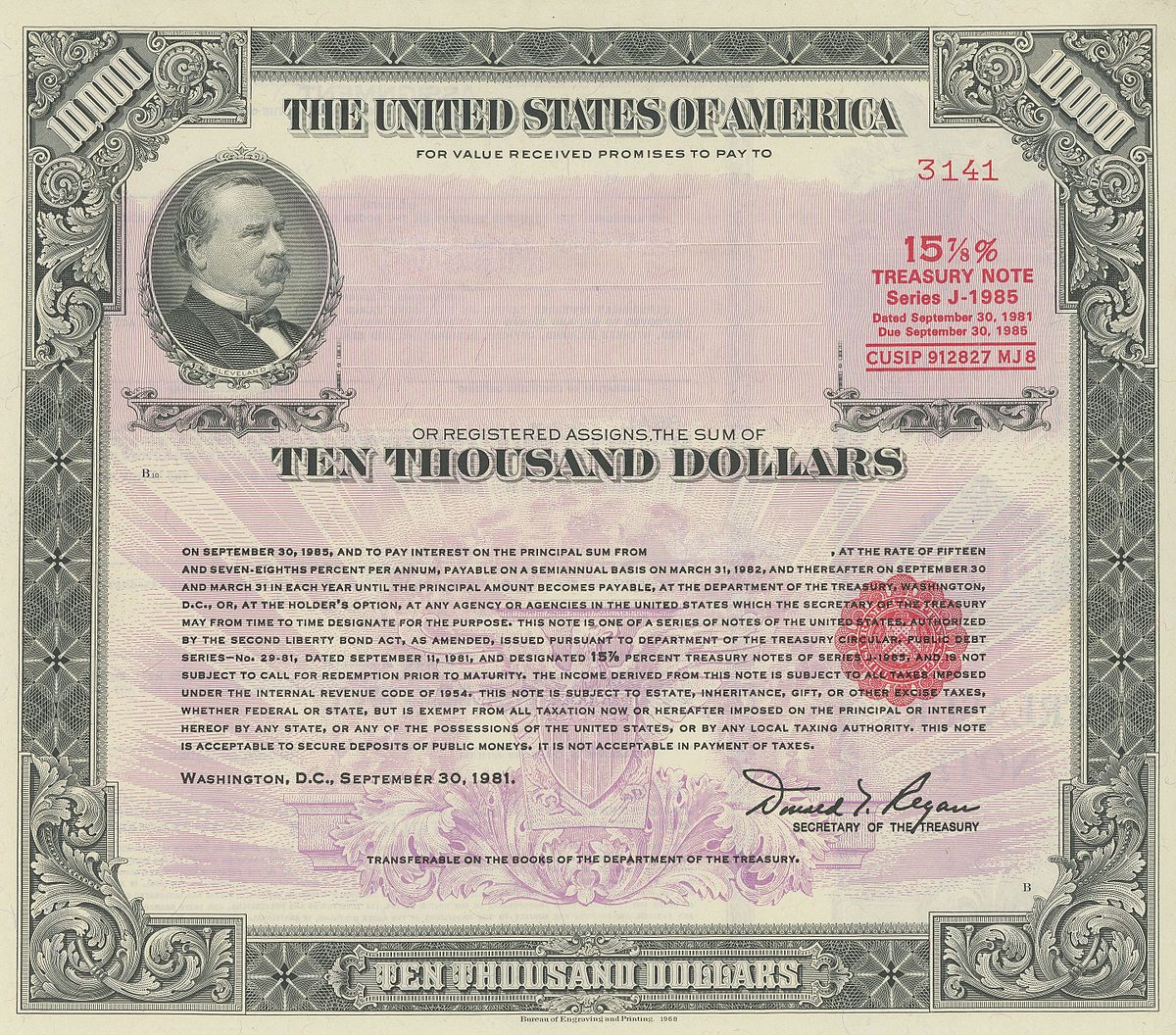
Front of a 1981 $10,000 United States Treasury Note with a 15.875% interest rate, featuring a portrait of Grover Cleveland on the left. JHerbstman, Public domain, via Wikimedia Commons
TIPS raise or lower their principal as consumer prices change. A floating-rate note resets its interest rate using recent 13-week Treasury bill rates.
A new sale is not every trade
Treasury issues new securities through an auction. Money paid for the new issue reaches Treasury, whether the buyer bids directly or uses a bank or broker. After issuance, an owner can resell the security in the secondary market. A pension fund might sell a note to a bank, with no new money going to Treasury.
An auction in progress, with an auctioneer and several assistants scanning the crowd for bidders. No machine-readable author provided. Che assumed (based on copyright claims)., CC BY-SA 3.0, via Wikimedia Commons
The same security can change hands many times before maturity. Treasury's payment terms stay the same; only the owner changes.
Types of marketable Treasuries
The federal government categorizes its marketable debt by maturity length and payment structure. Treasury bills, or T-bills, mature in one year or less and pay no regular interest. Instead, they sell at a discount to their face value, meaning a buyer pays less upfront and collects the full amount upon maturity. Regular T-bills are issued in terms of 4, 6, 8, 13, 17, 26, and 52 weeks with a minimum purchase amount of $100.
Longer-term debt pays fixed interest every six months. Treasury notes have maturities from 2 to 10 years, while Treasury bonds span 20 or 30 years. Treasury Inflation-Protected Securities (TIPS) adjust their principal value alongside changes in consumer prices, and floating-rate notes reset their interest rates based on recent 13-week bill rates.
How Treasury auctions work
Before 1929, the government set fixed prices for its debt, leading to problems in the late 1920s when attractive interest rates caused chronic over-subscription. Buyers purchased undervalued debt directly from the Treasury and immediately flipped it for higher prices in the open market.
To let market demand set the price, the Treasury shifted to an auction system on December 13, 1929, starting with $100 million in three-month bills. The Federal Reserve Bank of New York conducts these auctions, selling securities to the highest bidders. After the initial auction sale, these securities trade freely on secondary markets between banks, pension funds, and other investors without sending any new funds to the government.
Test yourself
Which Treasury security changes its principal with inflation?
Treasury Inflation-Protected Securities. TIPS adjust principal using changes in the Consumer Price Index. Bills are short-term securities, while floating-rate notes adjust their interest payments instead.
Does Treasury receive new cash whenever an old note is resold?
No, a resale just changes its owner. Money from a newly issued security goes to Treasury. A secondary-market sale transfers an existing security between investors.
Play the lesson in edgi and the card is yours. It lands on your Map next to the ideas it connects to, and turns from matte to foil to gold as you learn more around it.
What happens when different bills mature on the same day?
When a newly issued shorter bill shares a maturity date with an older, longer-running bill, the Treasury treats it as a reopening. The new issue receives the same unique identification code, known as a CUSIP number, as the existing debt.
What are Cash Management Bills?
Cash Management Bills are irregular, short-term debt instruments sold through discount auctions. The Treasury issues them during periods of extraordinary cash needs when its balances run low.
What are non-marketable Treasury securities?
Non-marketable securities cannot be resold on secondary markets after purchase. Examples include savings bonds sold to individuals, the State and Local Government Series, and the Government Account Series held by federal units.